
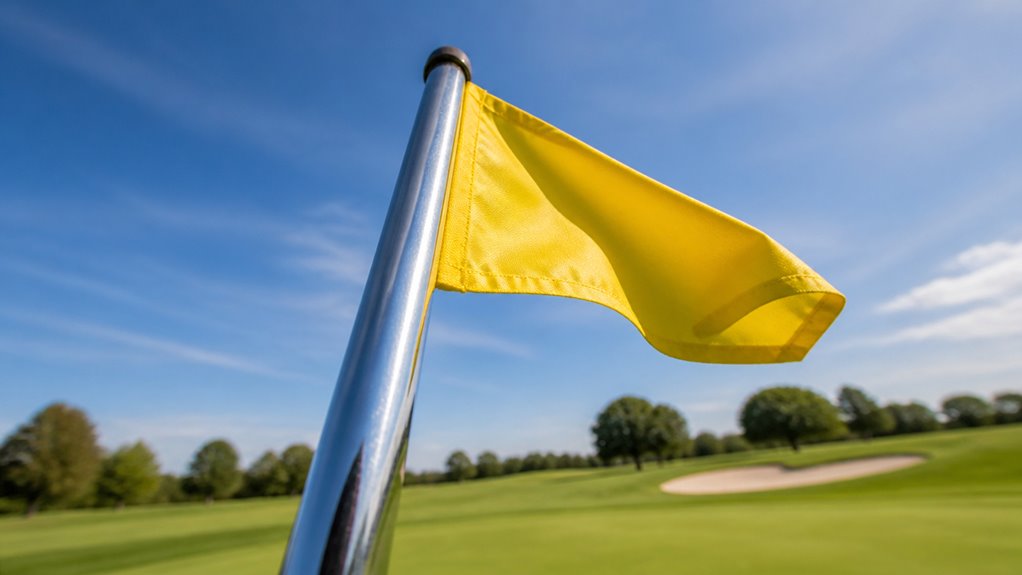
A standard golf flagstick measures about 7 to 8 feet tall, with approximately 6 feet 8 inches visible above the green to maximize visibility and stability.
The USGA recommends a minimum of 7 feet but sets no official maximum. Practical limits focus on avoiding instability or wind damage.
Materials like fiberglass guarantee strength without affecting play. Flagstick height varies based on course layout, wind, and ground conditions.
Understanding these factors reveals the balance between design, safety, and functionality.
- Key Takeaways
- How Tall Is a Standard Golf Flagstick?
- What Are the USGA Height Recommendations for Flagsticks?
- Why Do Flagstick Heights Vary on Different Golf Holes?
- How Do Wind and Course Conditions Affect Flagstick Height?
- What Materials and Sizes Make Up Golf Flagsticks?
- How Tall Are Golf Flagsticks on Professional Tours Like the PGA?
- Practical Limits and Risks of Tall Golf Flagsticks
- Frequently Asked Questions
- Final Thoughts on Golf Flagstick Height and Design
Key Takeaways
- A typical golf flagstick measures about 7 to 8 feet in total height.
- Approximately 6 feet 8 inches of the flagstick is visible above the green surface.
- PGA Tour flagsticks are usually standardized at 8 feet tall from the bottom in the hole to the top.
- No official maximum height exists, but practical limits generally keep flagsticks under around 10 feet.
- Height balances visibility and stability, with taller sticks used on uphill or long holes for better sightlines.
How Tall Is a Standard Golf Flagstick?
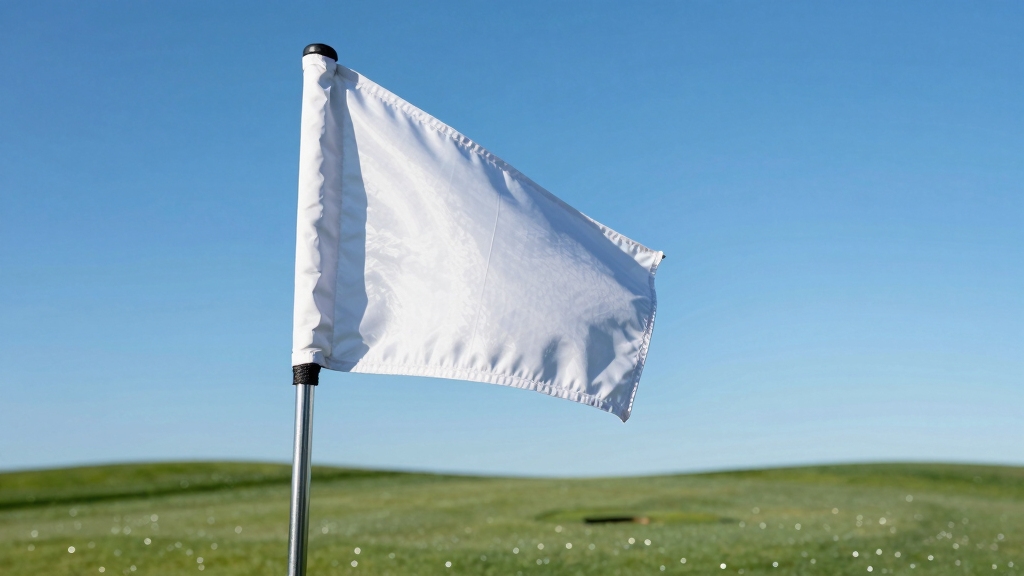
A standard golf flagstick typically measures around 7 to 8 feet in total height, with 6 feet 8 inches visible above the green surface.
You’ll find that this height balances visibility and stability, ensuring the flag is easily seen from a distance without compromising structural integrity. The portion embedded in the hole extends about 4 inches below the green to secure the stick firmly.
Materials like fiberglass dominate due to their strength and lightweight properties, conforming to strict diameter limits: no more than 2 inches near the top and tapering to 0.75 inches around the hole.
While shorter sticks exist for windy conditions, the standard range remains consistent across most courses, reflecting a consensus on ideal flagstick dimensions for playability and durability.
What Are the USGA Height Recommendations for Flagsticks?
While the USGA sets clear guidelines for flagstick height, it recommends a minimum length of 7 feet from the bottom inserted in the ground to the top. This ensures ideal visibility and standardization across all holes.
The USGA recommends a minimum 7-foot flagstick length for consistent visibility and standardization on all holes.
Typically, about 6 feet 8 inches of the flagstick extends above ground level. Although this minimum is advised, enforcement has relaxed in recent guidelines, allowing some variation.
The USGA doesn’t specify a maximum height, leaving practical limits to factors like wind stability and visibility. Flagsticks must maintain a circular cross-section, with diameters tightly regulated to prevent interference with ball movement.
Materials like fiberglass are preferred for durability. These recommendations apply universally across courses, aiming to balance visibility, consistency, and playability without compromising equipment integrity or player experience.
Proper flagstick display also contributes to clear course communication and helps improve pace of play on the golf course.
Why Do Flagstick Heights Vary on Different Golf Holes?
Because golf holes vary in terrain and visibility, flagstick heights adjust accordingly to guarantee peak sightlines for players.
You’ll notice taller flagsticks on uphill holes where the increased elevation demands greater height to remain visible from a distance.
Conversely, flatter holes typically use standard flagstick heights near the USGA’s recommended 7 feet.
You must also consider sightline obstructions like trees or undulating fairways; flagsticks may be taller to counteract these.
Additionally, shorter flagsticks appear on windy holes to enhance stability and reduce the risk of damage or movement.
Ultimately, flagstick heights are determined by balancing visibility requirements with practical constraints.
This ensures players can accurately locate the hole from their approach shots without compromising flagstick integrity or course conditions.
Properly aligning and staking flags into the ground is essential to maintain consistent flagstick positions and visibility throughout the course.
How Do Wind and Course Conditions Affect Flagstick Height?
When strong winds buffet a golf course, you’ll find flagstick heights adjusted downward to enhance stability and prevent damage.
Shorter flagsticks reduce wind resistance and minimize the risk of bending or breaking, ensuring they remain firmly anchored in the cup.
Reducing flagstick height lowers wind resistance and prevents damage, keeping them securely in place.
Conversely, on calm or sheltered holes, taller flagsticks improve visibility from a distance, aiding shot alignment.
Course topography also plays a critical role; uphill greens often warrant taller flagsticks to maintain line-of-sight over intervening terrain.
You must consider soil firmness and cup placement. Soft ground can compromise stability, prompting shorter sticks for secure installation.
Ultimately, wind intensity, course layout, and ground conditions dictate flagstick height adjustments, balancing visibility and durability while complying with practical constraints and equipment standards.
Golfers should also continuously monitor wind direction and strength as these factors influence how flagstick height adjustments impact playability and shot strategy.
What Materials and Sizes Make Up Golf Flagsticks?
When it comes to golf flagsticks, you’ll typically see them made from fiberglass, wood, or plastic. Among these, fiberglass is often the go-to choice because of its durability and performance on the course.
Now, let’s talk about the sizes. According to USGA regulations, the diameter of the flagstick can’t exceed 2 inches above the green. It then tapers down to 0.75 inches near the cup. This sizing is really important because it helps ensure that the flagstick remains uniform and doesn’t interfere with the movement of the ball during play. Proper sizing and material choice contribute to consistent play and course maintenance, similar to how golf grip size impacts swing mechanics and performance.
Common Materials Used
Golf flagsticks commonly combine materials such as fiberglass, wood, and plastic to balance durability, weight, and stability.
Fiberglass is the preferred choice by the USGA and PGA Tour due to its strength, lightweight nature, and resistance to weathering.
Wood, while traditional, offers sufficient rigidity but is heavier and more susceptible to environmental damage.
Plastic components often appear in caps or attachments rather than the main shaft, providing weather resistance and flexibility for accessories like reflectors or hole location indicators.
The construction must maintain a circular cross-section without shock-absorbing properties to avoid affecting ball movement.
You’ll find these materials engineered to guarantee the flagstick remains stable in varying wind conditions while conforming to precise physical specifications mandated for competitive play.
Additionally, regulatory guidelines specify that flagsticks must conform to USGA rules to ensure uniformity and fairness in competition.
Size And Diameter Limits
Although flagsticks vary in height and material, their size and diameter must adhere to strict specifications to guarantee consistent play.
You’ll find flagsticks have a circular cross-section with a diameter no greater than 2 inches from the top down to 3 inches above the green.
Between 3 inches above and 3 inches below the green surface, the diameter narrows to a maximum of 0.75 inches.
These limits make certain the flagstick doesn’t interfere with ball movement or stability.
Materials like fiberglass, wood, and plastic are common, but fiberglass is preferred for uniformity.
Additionally, no shock-absorbing materials are allowed, maintaining consistent interaction with the ball.
Attachments such as hole location indicators can only extend above 3 inches from the green, preserving the flagstick’s core dimensions.
Proper maintenance and adherence to measurement standards ensure the flagstick remains reliable and consistent during play.
How Tall Are Golf Flagsticks on Professional Tours Like the PGA?
How tall are flagsticks on professional tours like the PGA? On these tours, flagsticks are meticulously standardized to optimize visibility and comply with equipment rules. Here’s what you need to know:
Flagsticks on professional tours are carefully standardized to ensure optimal visibility and adherence to equipment regulations.
- PGA Tour flagsticks typically measure 8 feet tall from the bottom in the hole to the top of the stick.
- This height balances visibility for players and officials, especially on flat or gently sloping greens.
- Materials used are primarily fiberglass, assuring rigidity without affecting ball behavior upon contact.
- While no official maximum height exists, practical considerations limit flagstick length to prevent instability or wind damage.
You’ll find these precise specifications assure consistency and fairness in tournament play, reflecting the highest standards of golf equipment regulation.
Practical Limits and Risks of Tall Golf Flagsticks
When considering flagstick height, you must balance visibility with stability and durability. Taller flagsticks enhance sightlines on long or uphill holes but increase susceptibility to wind-induced bending or breakage.
Excessive height can cause instability in the cup, risking displacement when struck by balls or during retrieval. Physical constraints like material strength and cross-sectional diameter limit practical maximums; fiberglass is preferred for its rigidity and resilience.
While no official maximum height exists, flagsticks over 10 feet demand cautious evaluation to prevent damage and interference with play. In windy conditions, shorter, sturdier sticks guarantee consistent performance.
Ultimately, you must weigh the benefits of increased visibility against potential structural risks and operational challenges to maintain reliable, regulation-compliant flagsticks on the course. Similar to how shock absorption and cushioning protect golf turf and equipment, these factors also influence flagstick design to enhance durability and stability.
Frequently Asked Questions
How Are Flagstick Positions Indicated on the Flag Itself?
You’ll find flagstick positions indicated directly on the flag through color coding or markings. Typically, flags use different colors or symbols to show front, center, or back hole locations.
This helps you quickly assess pin placement from a distance, allowing you to adjust your approach shot accurately. The flag acts as a precise visual reference, improving your course strategy without needing additional aids or technology.
Are Flagsticks Ever Removed During Play, and Why?
Imagine you’re putting on a windy day; yes, flagsticks are often removed during play.
You remove the flagstick to avoid interference with the ball’s path and to improve your line of sight.
The USGA rules allow this, especially during putting.
Removing the flagstick reduces the chance of the ball bouncing off it or being deflected, ensuring precise play and adherence to official golf regulations.
Can Flagsticks Affect Ball Movement if Hit?
Yes, flagsticks can affect ball movement if hit, but regulations minimize this impact.
You’ll find flagsticks are rigid and non-shock-absorbing.
They mustn’t influence ball trajectory or speed upon contact.
The USGA mandates materials and construction that prevent altering the ball’s path.
While a ball striking the stick may deflect slightly, rules guarantee such interference is negligible.
This ensures fairness and consistent play across all courses.
What Tools Are Used to Measure Flagstick Height Accurately?
You use a calibrated measuring tape or laser distance measurer to gauge flagstick height accurately. For precision, a rigid ruler or a folding carpenter’s rule can help, especially when measuring from the bottom inserted in the hole to the top.
Digital calipers aren’t practical for full length but useful for diameter. Always make certain the flagstick is vertical and stable during measurement to avoid errors and adhere strictly to USGA specifications.
Are There Any Historical Changes in Flagstick Design?
You might be surprised to learn that flagstick design hasn’t exactly revolutionized golf despite centuries of play.
Historically, flagsticks started at a standard 7 feet, reflecting early simplicity.
Over time, materials evolved from wood to fiberglass for durability, and height adjusted for visibility, especially on uphill holes.
Though the USGA once strictly recommended sizes, modern rules relaxed these, prioritizing practicality over tradition.
Final Thoughts on Golf Flagstick Height and Design
When you step onto the green, remember the flagstick stands as your beacon. It typically measures between 7 to 8 feet tall, per USGA standards.
Its height isn’t arbitrary; it balances visibility with practicality, adapting to course challenges and wind’s whisper. Professional tours stick close to these specs, ensuring consistency.
Pushing the limits risks interference and unfair play. So, trust the flagstick’s measured stature; it’s engineered precision guiding your every putt.