
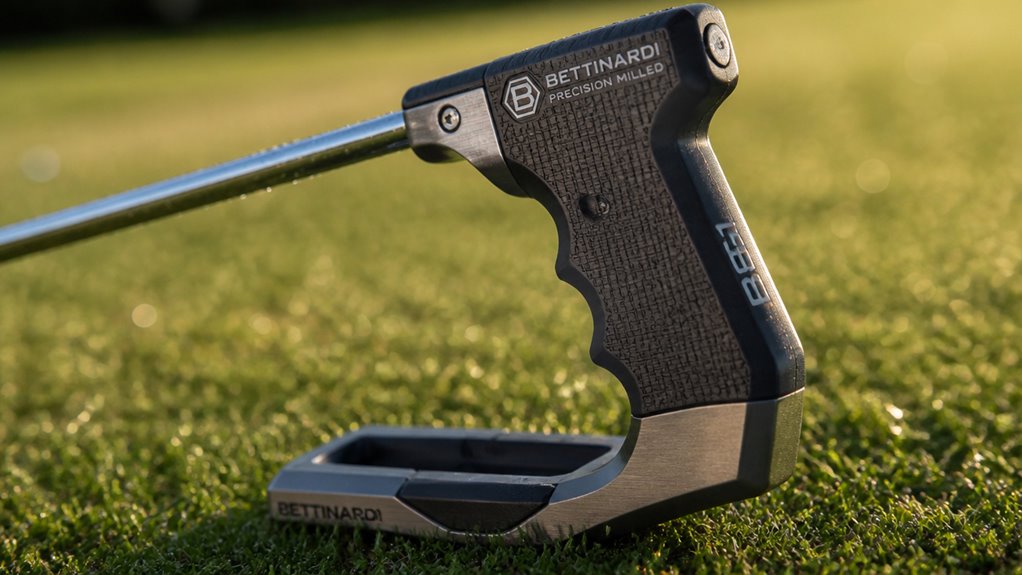
A pistol grip putter features an ergonomic, angled design that aligns your hands unevenly. Your upper hand rests higher, while your lower hand sits lower, enhancing wrist stability and control.
Its non-circular shape with a raised thumb ridge prevents slippage and promotes consistent pressure. This improves stroke repeatability and face control.
This design naturally encourages a slightly closed putter face at impact, reducing open-face tendencies and push misses. Understanding its sizes, stroke benefits, and performance impact can elevate your putting game noticeably.
- Key Takeaways
- What a Pistol Grip Putter Looks Like?
- How the Pistol Grip Design Fits Your Hands Ergonomically?
- How the Pistol Grip Shapes Your Hand Position?
- How a Pistol Grip Improves Your Putting Stroke?
- Stroke Styles and Tendencies for Pistol Grip Putters
- How the Pistol Grip Improves Wrist Control and Consistency?
- Pistol Grip Putters: Sizes and Styles
- Choose a Grip That Supports Better Face Control
Key Takeaways
- A pistol grip putter features an ergonomic design resembling a pistol grip to promote consistent hand placement during putting strokes.
- It has a non-circular, angled profile with a raised thumb ridge for enhanced thumb stability and tactile feedback.
- The grip encourages uneven hand height, improving control, wrist stability, and stroke precision.
- Its design helps close the putter face at impact, reducing open-face tendencies and improving accuracy.
- Pistol grips support smoother, more repeatable strokes with better distance control, especially on lag putts.
What a Pistol Grip Putter Looks Like?
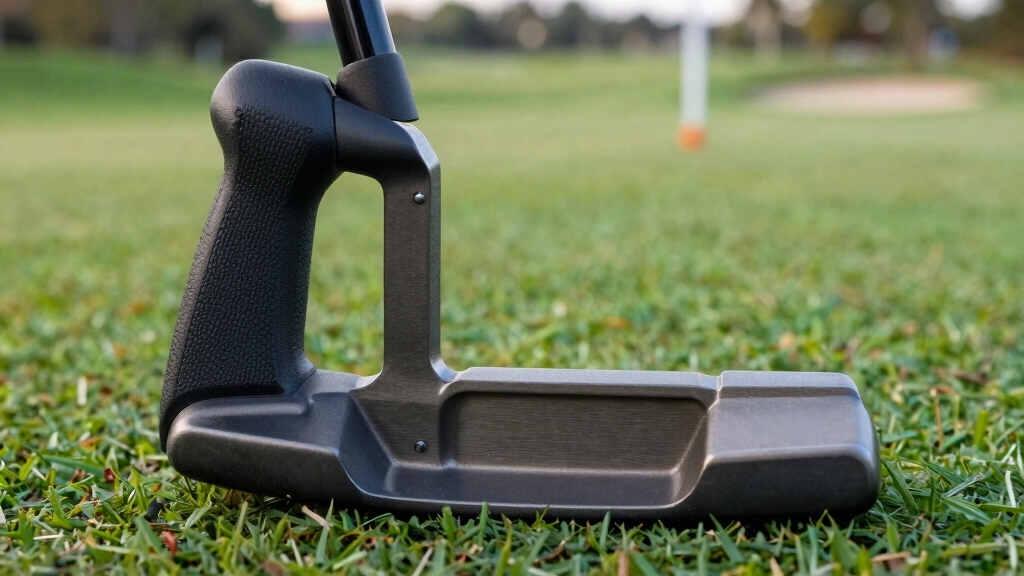
When you pick up a pistol grip putter, you’ll immediately notice its distinctive non-circular cross-section that broadens toward the butt end of the shaft.
The pistol grip putter’s unique non-circular shape widens toward the shaft’s butt end for distinct handling.
This widening creates a unique profile that tilts slightly toward you, distinguishing it from traditional straight grips.
The front face features a raised thumb ridge designed to stabilize your left thumb if you’re right-handed.
The underside narrows into an angled or pointed section, allowing your bottom fingers to wrap around comfortably.
This ergonomic shape belongs to one of six main grip profiles, setting the pistol grip apart with its angled form and enhanced tactile feedback.
Its complex geometry provides precise hand placement and control, making it a technically advanced design favored by golfers seeking reliable grip stability during the putting stroke.
Grip size and texture, such as those found in oversized textured grips, play a key role in reducing wrist rotation and improving stroke consistency.
How the Pistol Grip Design Fits Your Hands Ergonomically?
Optimizing hand positioning, the pistol grip’s angled shape guarantees your upper hand naturally rests higher while the lower hand sits lower on the shaft, creating a deliberate uneven height alignment.
This ergonomic configuration aligns with your natural hand anatomy, reducing tension and encouraging consistent placement.
The grip’s non-circular cross-section widens toward the butt end, allowing your bottom fingers to wrap securely around the angled undersize section, enhancing stability.
A raised thumb ridge stabilizes your upper thumb, preventing slippage and promoting precise control.
This tailored fit supports a balanced distribution of grip pressure, minimizing wrist strain during the stroke.
Choosing the right grip size, such as undersized grips, can further enhance comfort and control, especially when playing without a glove.
How the Pistol Grip Shapes Your Hand Position?
The pistol grip’s unique shape directly influences how your hands naturally position themselves on the shaft, encouraging an uneven hand height that enhances control.
The pistol grip’s design naturally positions your hands with uneven height, boosting control and precision.
Your upper hand rests higher on the grip, while your lower hand settles lower, creating a staggered alignment that optimizes leverage and stability.
The angled undersized section allows your bottom fingers to wrap securely and comfortably, improving grip consistency.
The raised thumb ridge guides your left thumb (for right-handed players) to maintain precise placement, minimizing slippage.
This ergonomic contour reduces the tendency for symmetrical hand placement seen in circular grips, enabling you to exert consistent pressure and better control wrist movement.
Consequently, your hands align more effectively with the putter’s center of gravity, setting the foundation for improved stroke consistency.
Many ergonomic grips, such as those with No Taper technology, help minimize grip pressure and ease hand tension for enhanced comfort during play.
How a Pistol Grip Improves Your Putting Stroke?
Consistently using a pistol grip enhances your putting stroke by promoting superior wrist control and a more stable face angle at impact.
The grip’s ergonomic shape positions your hands unevenly, which restricts excessive wrist breakdown and encourages a smooth hinge motion.
This controlled wrist action reduces unwanted face rotation, allowing for a repeatable stroke path.
Additionally, the larger grip end locks your hands into a consistent position, minimizing grip pressure and improving feel.
By aligning your hands relative to the putter’s center of gravity, the pistol grip supports a stable and consistent putter face through impact.
This mechanical advantage helps you maintain stroke stability, resulting in more accurate, reliable putts, especially on lag shots where touch sensitivity is critical.
Pistol grips are particularly beneficial for putters with face-balanced mallet designs, as they promote stability and minimize face rotation during the stroke.
Why Pistol Grips Help Close Your Putter Face?
Have you ever tried a pistol grip on your putter? You might find it pretty interesting!
The unique shape of the pistol grip actually helps align your hands in a way that makes it easier to close the putter face at impact. Pretty cool, right?
This ergonomic design really changes the game for your stroke path. It helps reduce those pesky open-face tendencies you often see with traditional grips. So, not only does it feel more comfortable, but it also gives you better control over the face angle.
In the end, using a pistol grip can lead to a more consistent stroke. And who doesn’t want that? It helps you deliver straighter, more accurate putts, which is always a win on the green!
Many golfers find that removing gloves during putting improves tactile feedback and feel, enhancing control over the putter face.
Face Angle Alignment
Because pistol grip putters feature an angled and ergonomic profile, they naturally encourage your hands to align in a way that closes the putter face at impact.
The grip’s tilted axis positions your hands so the putter face delivers more closed relative to setup, effectively correcting open face tendencies common with straight grips.
This alignment reduces effective toe hang by centering hand placement around the putter’s center of gravity, promoting consistent face angle control through the stroke.
As a result, you achieve a smoother, more repeatable path and reduce pushes caused by an open face.
Empirical data confirms pistol grips improve face angle stability at impact, making them ideal for golfers aiming to close the face and improve directional accuracy on their putts.
Additionally, the choice between milled and insert putters can complement the benefits of a pistol grip by influencing feel and control during the stroke.
Hand Position Influence
Although the pistol grip’s ergonomic design may seem subtle, it fundamentally alters how your hands position themselves on the putter. This directly influences face angle control.
The grip’s angled profile encourages your upper hand to sit higher and your lower hand to rest lower. This creates uneven hand heights that promote a natural, secure wrap of your bottom fingers around the undersized section.
This positioning stabilizes wrist action and aligns your hands relative to the putter’s center of gravity. It enables a more closed face angle at impact.
By reducing effective toe hang through this hand setup, you consistently deliver the putter face more squarely or slightly closed. This corrects tendencies to leave the face open.
This mechanical advantage enhances precision and helps prevent pushes, improving overall stroke consistency.
Additionally, combining this grip design with weight distribution and balance optimized putters can further improve the smoothness and stability of your stroke.
Stroke Path Control
When you employ a pistol grip, the unique shape naturally guides your stroke path to promote a more closed putter face through impact.
Its angled axis and ergonomic contours position your hands to align the face relative to the putter’s center of gravity, reducing effective toe hang.
This alignment mechanically favors a stroke that closes the face slightly, counteracting tendencies to leave it open at address.
Data confirms you deliver the putter face more closed with this grip, which helps correct pushes and right misses.
The design also enhances wrist hinge control, enabling a smoother, more repeatable stroke path.
Additionally, maintaining proper grip pressure is essential for maximizing the control benefits of a pistol grip and ensuring consistent putting performance.
Who Should Use a Pistol Grip Putter?
Thinking about trying a pistol grip putter? It could be a great fit for you, especially if your putting stroke has a nice, consistent arc and minimal wrist breakdown. The ergonomic design of this grip really helps with that.
It promotes uneven hand heights, which can give you better control over your putts.
Plus, the angled profile is a game changer. It encourages your lower hand to wrap around the grip securely, which stabilizes your wrist action throughout the stroke. This hand positioning is especially beneficial for players who want to close the putter face and minimize pushes.
Additionally, the use of counterbalance grips in pistol grip putters can enhance stability and control during the stroke.
Ideal Stroke Types
Since the pistol grip putter promotes a more closed face angle and improved wrist control, it suits golfers with a consistent arc stroke who experience minimal wrist breakdown during their putting motion.
You’ll find it especially effective if you want to reduce pushes caused by an open face at impact. Its design encourages a smoother, more repeatable stroke by stabilizing wrist action.
Consider using a pistol grip putter if you:
- Maintain a consistent arc stroke with limited wrist breakdown
- Tend to push putts right due to an open face angle
- Seek enhanced finger feedback for touch-sensitive lag putts
- Prefer a grip that promotes lighter pressure and improved stroke stability
This grip optimizes your mechanics for precise, controlled putting performance. Additionally, maintaining a relaxed grip tension improves comfort and stroke consistency with the pistol grip putter.
Player Hand Position
Building on how the pistol grip putter enhances stroke mechanics, its design directly influences your hand positioning to optimize control and stability.
The grip’s ergonomic shape places your upper hand higher while the lower hand sits lower, creating uneven hand heights that improve wrist control.
This positioning allows your bottom fingers to wrap securely around the angled undersize section, maintaining consistent pressure and reducing unwanted wrist breakdown.
You’ll experience enhanced feedback through finger contact, vital for touch-sensitive lag putts.
This grip suits you best if you have a consistent arc stroke and tend to push putts right, as it promotes a more closed face at impact.
However, if you struggle with severe wrist issues or the yips, a pistol grip may not provide the stability you need.
Stroke Styles and Tendencies for Pistol Grip Putters
Although pistol grip putters suit a wide range of players, they particularly enhance stroke mechanics for golfers who maintain a consistent arc and exhibit minimal wrist breakdown during their putting motion.
This grip style encourages a more closed face angle through impact, helping correct common push misses by promoting straighter putts. The ergonomic design also increases finger contact, improving tactile feedback on delicate lag putts. However, it’s less effective for those with severe wrist instability or yip tendencies.
Key stroke styles and tendencies with pistol grips include:
- Favoring smooth, controlled arcs with limited wrist hinge
- Delivering the putter face slightly closed relative to address
- Enhancing finger sensitivity for touch control
- Reducing push tendencies common in straight or weak wrists
How the Pistol Grip Improves Wrist Control and Consistency?
The pistol grip’s ergonomic profile directly influences how your wrists behave during the putting stroke, promoting enhanced control and consistency.
Its non-circular, angled design encourages uneven hand heights. Your upper hand sits higher while your lower hand wraps securely around the grip’s undersized angled section.
This positioning stabilizes your wrists, limiting unwanted hinge and reducing breakdown during the stroke.
The raised thumb ridge further anchors your left thumb for right-handers, providing tactile feedback that aids in maintaining consistent wrist angles.
By aligning your hands relative to the putter’s center of gravity, the pistol grip helps you deliver a more closed face angle at impact, improving stroke repeatability.
This biomechanical advantage leads to smoother wrist action and more reliable distance control on the greens.
Pistol Grip Putters: Sizes and Styles
When selecting a pistol grip putter, you’ll find a variety of sizes and styles designed to match different hand dimensions and personal preferences. These grips come in standard and midsize options to provide ergonomic comfort and ideal control.
The cross-sectional shape may vary slightly, affecting how your fingers wrap around the angled undersize portion. Additionally, the grip’s thumb ridge placement can differ, influencing thumb stabilization and hand positioning.
Understanding these variations is essential for maximizing stroke consistency and wrist control.
Standard vs. midsize diameters are tailored for hand size and pressure distribution. Variations in thumb ridge prominence enhance thumb placement.
Differences in grip length affect hand positioning and balance. Material and texture options influence tactile feedback and moisture management.
Pistol Grip Putters and Grips: Typical Costs
When it comes to pistol grip putters and grips, you can typically expect to pay anywhere from $15 to $50. The price really depends on the brand and the specific design features.
You’ll notice that there are various sizes available, like standard and midsize, which cater to different hand dimensions. This is all about optimizing your control and comfort on the course.
Price Range Overview
Several factors influence the price range of pistol grip putters and grips, with costs typically spanning from $15 to $50 depending on brand, size, and specific design features.
When selecting a pistol grip, you’ll notice prices reflect:
- Material quality and durability, such as premium rubber compounds or synthetic blends that affect feel and longevity.
- Brand reputation, where established manufacturers command higher prices due to proven performance and advanced ergonomics.
- Design complexity, including integrated thumb ridges, angled undersize sections, and enhanced texture for improved hand stability.
- Size variations, with midsize or oversized grips often priced differently due to additional material and manufacturing processes.
Understanding these cost drivers helps you balance performance benefits against budget constraints when choosing a pistol grip for your putter.
Size and Feature Variations
Although pistol grip putters maintain a consistent ergonomic design, they come in a range of sizes and feature variations that directly impact fit and performance.
You’ll find grips in standard, midsize, and oversized formats, each catering to different hand dimensions and stroke preferences. Features like thumb ridges, material composition, and textured surfaces influence control and comfort.
Pricing typically falls between $15 and $50, reflecting brand and design complexity. Choosing the right size and features guarantees optimal hand placement and stroke consistency.
| Size | Features | Typical Cost |
|---|---|---|
| Standard | Raised thumb ridge | $15 – $30 |
| Midsize | Textured grip surface | $25 – $40 |
| Oversized | Enhanced ergonomic shape | $35 – $50 |
Frequently Asked Questions
Can a Pistol Grip Putter Be Used Effectively by Left-Handed Golfers?
Yes, you can effectively use a pistol grip putter as a left-handed golfer, but you’ll need one specifically designed for left-hand orientation.
The ergonomic thumb ridge and angled undersized section are mirrored to fit your left hand’s natural positioning. This design maintains wrist control and face angle benefits, promoting a consistent stroke.
Using a mirrored pistol grip helps you replicate the same mechanical advantages right-handed players enjoy.
How Durable Are Pistol Grip Putters Compared to Other Grip Types?
Pistol grip putters are as durable as a well-forged chain, thanks to their robust materials and ergonomic design.
You’ll find their non-circular cross-section resists wear better than many traditional grips, maintaining shape under pressure.
Compared to other types, they offer consistent longevity without compromising feel.
While durability varies by brand and material, pistol grips generally withstand frequent use, ensuring you get reliable performance and stable hand positioning over time.
Are Pistol Grip Putters Compatible With All Putter Head Styles?
Yes, pistol grip putters are compatible with most putter head styles, including blade, mallet, and mid-mallet designs.
The grip’s ergonomic shape and angled profile don’t restrict head selection. Instead, they enhance control by promoting a more closed face angle at impact.
You’ll find that the grip works well across various head geometries. This allows you to maintain consistent wrist action and improved stroke stability regardless of your putter’s design.
What Materials Are Commonly Used in Pistol Grip Putter Construction?
Over 80% of pistol grip putters use rubber or synthetic compounds for their grips, giving you excellent tactile feedback and durability.
You’ll find materials like thermoplastic elastomers for a soft yet firm feel, often combined with a textured surface to enhance grip security.
Some premium models incorporate leather or urethane overlays for added comfort and moisture resistance.
This ensures your hands stay stable during the stroke regardless of weather or sweating conditions.
Can Pistol Grip Putters Help Reduce Hand Fatigue During Long Rounds?
Yes, pistol grip putters can help reduce hand fatigue during long rounds. Their ergonomic design promotes lighter grip pressure and encourages a comfortable hand position with uneven hand heights.
This configuration minimizes wrist tension and distributes force more efficiently. Additionally, the raised thumb ridge and angled undersized section stabilize your hands, allowing for a more natural, relaxed grip.
This ultimately lessens strain and improves endurance throughout extended play.
Choose a Grip That Supports Better Face Control
When you switch to a pistol grip putter, you’re tapping into a design proven to enhance control. Studies show it can reduce wrist movement by up to 30%, promoting a smoother, more consistent stroke.
This ergonomic grip aligns your hands naturally, helping you square the putter face more reliably. By improving wrist stability and encouraging a centered stroke, the pistol grip putter becomes an essential tool for precision and consistency on the green.