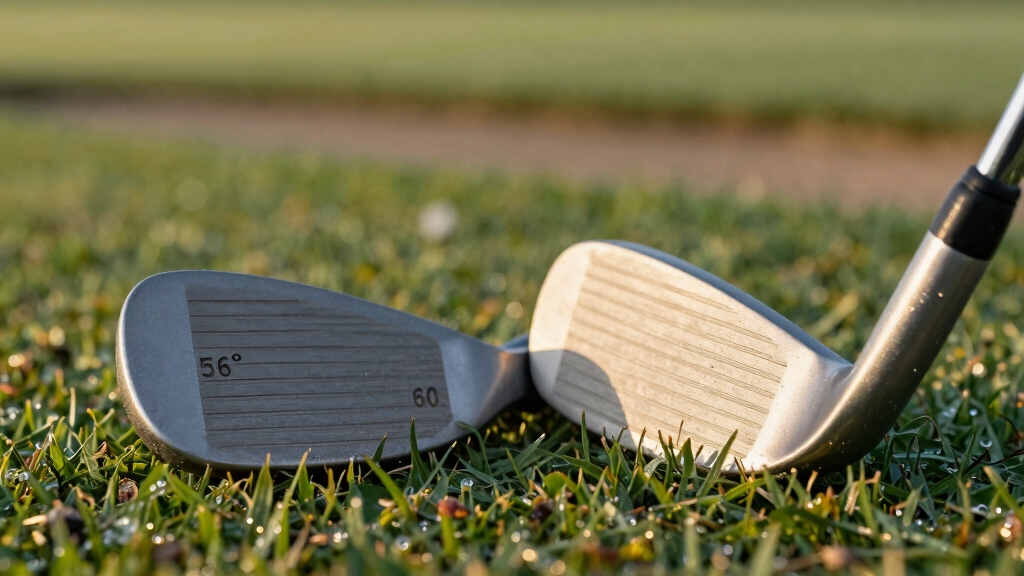
You need a 60-degree wedge if your short game requires maximum loft for higher launch angles and softer landings, especially around small greens or tricky bunkers.
It’s ideal for delicate, short-sided shots where rollout must be minimal. However, if you prioritize versatility and consistent full swings from 80 to 100 yards, a 56-degree wedge often suffices.
Understanding when and how course conditions influence your wedge choice can markedly improve your play. Exploring these details will enhance your decision-making.
- Key Takeaways
- How a 60-Degree Wedge Differs From a 56-Degree Wedge?
- When to Use a 56° vs. 60° Wedge on the Course?
- How Course Conditions Affect Your Wedge Choice?
- Who Should Carry a 56° or 60° Wedge?
- Choosing the Right Wedge Setup for Your Game
- Frequently Asked Questions
- How Do Different Brands Compare in Their 60-Degree Wedge Designs?
- Can a 60-Degree Wedge Help Improve Bunker Play Technique?
- What Grip Adjustments Work Best With a 60-Degree Wedge?
- How Does Shaft Length Affect Performance With a 60-Degree Wedge?
- Are There Recommended Practice Drills for Mastering the 60-Degree Wedge?
- Make Smarter Wedge Choices Around the Green
Key Takeaways
- A 60-degree wedge is ideal for short-sided shots requiring high loft and soft, stopping landings near small greens.
- Most golfers benefit more from a versatile 56-degree wedge for consistent full swings and longer chip shots.
- Skilled players often carry both 56- and 60-degree wedges for greater shot versatility and specialized short-game control.
- Beginners usually do not need a 60-degree wedge due to its touch requirement and specialized use.
- Course conditions like tight lies, thick turf, or small greens increase the usefulness of a 60-degree wedge.
How a 60-Degree Wedge Differs From a 56-Degree Wedge?
While both wedges serve the short game, a 60-degree wedge differs from a 56-degree wedge primarily in loft and intended shot profile.
The 60-degree lob wedge features higher loft, producing steeper launch angles and softer landings. This makes it ideal for shots requiring maximum height and stopping power.
In contrast, the 56-degree sand wedge offers lower loft, delivering more versatile shot options with greater control and consistency on full swings.
You’ll find typical wedge spacing places the 56-degree as a reliable all-purpose club for trajectory control, spin, and distance.
The 60-degree demands more touch and is suited for specialized shots around tight lies or obstacles.
Understanding these loft and role distinctions helps you select the right wedge to optimize your short-game precision and shot-making capabilities.
Additionally, the 56-degree wedge’s higher bounce makes it more forgiving in soft turf and sand conditions, enhancing consistency for many golfers.
When to Use a 56° vs. 60° Wedge on the Course?
Choosing between a 56-degree and a 60-degree wedge on the course depends largely on the specific shot requirements and course conditions you face.
Selecting a 56-degree or 60-degree wedge hinges on your shot needs and course layout.
Use the 56-degree wedge for versatile shots demanding distance control and consistency. It’s ideal for full swings within 80–100 yards or longer chip shots around 20–40 yards.
It excels in bunkers when there’s enough green to work with, providing predictable trajectory and rollout.
Opt for the 60-degree wedge when you need maximum height and stopping power on short-sided shots, particularly over hazards or tight greens with limited landing space.
This wedge suits shots requiring soft landings and minimal rollout, typically within 30–80 yards.
Keep in mind, the 60-degree demands more touch and practice, making the 56-degree the more broadly useful option for most players.
Due to its higher loft and lower bounce, the 60-degree wedge requires cleaner contact to avoid pop-ups and thin shots.
How Course Conditions Affect Your Wedge Choice?
Because course conditions directly influence shot difficulty and execution, you should tailor your wedge selection to factors like green size, bunker placement, and turf quality.
Small greens demand higher lofts, such as a 60-degree wedge, to guarantee the ball lands softly and stops quickly. Conversely, larger greens allow for a 56-degree wedge, which offers better distance control and versatility.
Bunkers positioned near the green, especially those guarding tight pin locations, often require the loft and trajectory control of a lob wedge. Turf quality and lie conditions also matter: firm or tight lies favor a 56-degree wedge for cleaner contact.
Softer or thicker turf may necessitate a higher loft to avoid digging in. By evaluating these course variables, you can optimize your wedge choice for precise, effective short-game shots. Incorporating an Approach Wedge can also help bridge distance gaps between your pitching and sand wedges, providing enhanced control on approach shots.
Who Should Carry a 56° or 60° Wedge?
Understanding who should carry a 56° or 60° wedge depends largely on your skill level, course conditions, and shot requirements.
Choosing between a 56° or 60° wedge depends on your skill, course, and shot needs.
If you’re developing strong short-game skills, carrying both wedges can enhance versatility and control. Beginners typically benefit most from a 56° wedge due to its easier use and broader shot application.
You should consider a 60° wedge if you face tight lies, small greens, or challenging bunker setups demanding high, soft shots.
Beginners usually start with a pitching wedge and 56° wedge.
Skilled players often carry both 56° and 60° wedges.
A 56° wedge offers more predictable distance control.
A 60° wedge excels in short-sided, high-loft shots.
Course layout and green size heavily influence wedge choice.
Additionally, mastering distance control with the 56° wedge through varied swing lengths can significantly improve your scoring around the greens.
Choosing the Right Wedge Setup for Your Game
Selecting the right wedge setup for your game hinges on analyzing your typical shot requirements, course conditions, and skill level.
If you need versatility and consistent distance control for full and longer chip shots, a 56-degree wedge is usually your best bet. It excels in bunker play and approach shots between 80–100 yards.
Conversely, a 60-degree wedge suits you if your course has small greens, tight lies, or bunkers demanding high, soft shots with limited rollout. It’s ideal for short-sided and lob shots requiring maximum height and spin.
Most golfers benefit from carrying a 56-degree wedge alone. However, skilled players who master delicate shots may add a 60-degree wedge for specialized situations.
Ultimately, your wedge setup should reflect the balance between control, trajectory, and course demands. The adjustability of lofts from 48° to 62° allows players to customize their wedges for improved versatility around the greens.
Frequently Asked Questions
How Do Different Brands Compare in Their 60-Degree Wedge Designs?
Different brands vary in their 60-degree wedge designs mainly through grind options, bounce angles, and face textures.
You’ll find Titleist offers versatile grinds for turf interaction. Callaway focuses on maximizing spin with advanced face milling.
Cleveland emphasizes forgiveness and shot versatility. TaylorMade often integrates innovative groove tech for control.
When choosing, consider how each brand’s design suits your typical lies and playing style to optimize height, spin, and stopping power.
Can a 60-Degree Wedge Help Improve Bunker Play Technique?
Yes, a 60-degree wedge can improve your bunker play technique by allowing you to hit higher, softer shots that stop quickly on the green.
Its higher loft helps you get the ball out of tight lies or over bunkers with less rollout.
However, it demands precise touch and practice to use effectively.
If you often face challenging bunkers or tight lies, incorporating a 60-degree wedge could enhance your short-game control.
What Grip Adjustments Work Best With a 60-Degree Wedge?
Think of your grip as the reins steering a wild stallion when wielding a 60-degree wedge.
You’ll want a slightly lighter grip pressure to maintain finesse and touch.
Position your hands a touch forward of the ball to promote clean contact and control.
Keep your wrists flexible, allowing the clubhead to hinge naturally for higher lofted shots.
These adjustments help you harness the wedge’s precision and softness effectively around the greens.
How Does Shaft Length Affect Performance With a 60-Degree Wedge?
Shaft length directly impacts your control and swing path with a 60-degree wedge. A shorter shaft enhances accuracy and allows better feel, pivotal for delicate, high-lofted shots.
Conversely, a longer shaft might increase swing speed but reduces precision and touch. Since the 60-degree wedge demands finesse, a slightly shorter shaft usually improves performance.
This promotes better contact and trajectory control, helping you execute soft, high shots with consistent stopping power.
Are There Recommended Practice Drills for Mastering the 60-Degree Wedge?
Don’t worry if you think mastering the 60-degree wedge is too tricky; targeted drills can help.
Try the landing spot drill: pick a precise target on the green and practice landing your ball there to improve control and touch.
The half-swing drill helps you refine distance with controlled swings. Incorporate bunker shots and flop shots to build confidence.
Consistent practice with these drills sharpens trajectory control and stopping power effectively.
Make Smarter Wedge Choices Around the Green
You might think a 60-degree wedge is just an extra club, but its specialized loft offers unique control for delicate shots around the green.
While a 56-degree wedge handles most approach shots, the 60-degree gives you that extra bounce and spin on tight lies or fluffy sand.
Your course conditions and shot preferences will reveal if it truly enhances your short game arsenal.
Don’t overlook its potential to sharpen your precision.