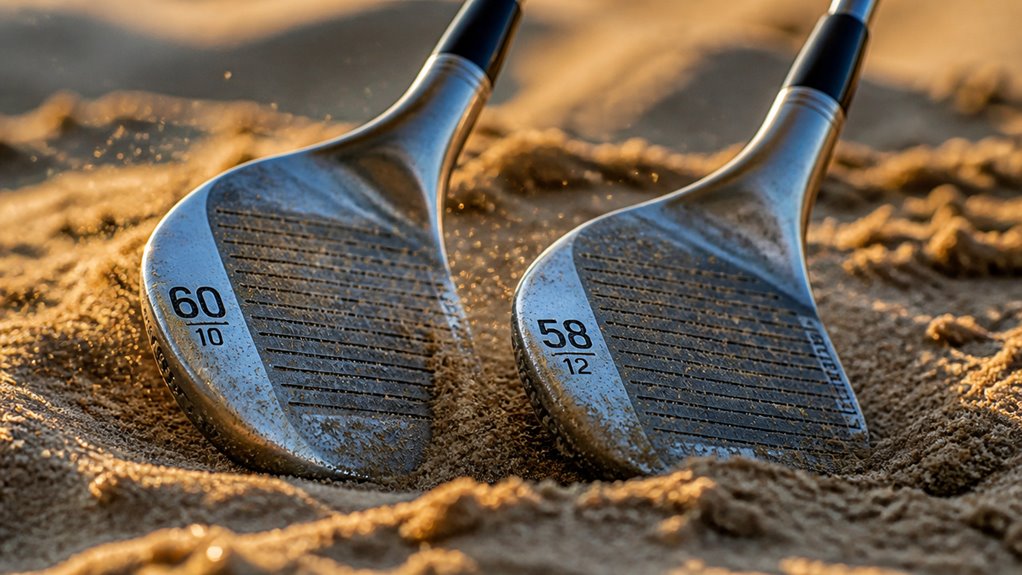
Choosing between a 58° and 60° wedge depends on your skill and shot needs.
The 58° offers more forgiveness, better bounce, and consistent partial swing distances. This makes it ideal for average golfers seeking control and versatility.
The 60° demands precision and offers higher trajectory and spin for delicate short-game shots. However, it risks mishits.
If you want to optimize your wedge setup and improve your short game performance, understanding loft, bounce, and distance gaps is essential.
- Key Takeaways
- 58° vs 60° Wedge: Complete Side-by-Side Comparison
- Why Loft Differences Matter for Forgiveness and Control?
- Comparing Distance and Performance of 58 Vs 60 Degree Wedges
- Which Wedge Offers Better Versatility for Short Game Shots?
- How Bounce Affects Turf Interaction and Shot Consistency?
- Fixing Wedge Gaps for Consistent Distance
- Why 58 Degree Wedges Are Easier for Average Golfers to Hit?
- When Should Better Players Use a 60 Degree Wedge?
- How to Choose the Right Wedge for Your Skill and Swing?
- Frequently Asked Questions
- Choosing Between a 58° and 60° Wedge for Better Scoring Performance
Key Takeaways
- A 58° wedge offers greater forgiveness and control with a more square clubface, reducing pop-ups and thin strikes.
- A 60° wedge provides higher loft for increased trajectory and spin, ideal for delicate short-side shots requiring precision.
- The 58° wedge delivers more consistent partial swing distances, aiding reliable distance control inside 100 yards.
- The 60° wedge has less bounce and demands precise mechanics, making it less forgiving on soft turf or thick sand.
- Choose 58° for versatility and forgiveness; select 60° if skilled enough for high, soft-landing shots around the green.
58° vs 60° Wedge: Complete Side-by-Side Comparison
| Feature | 58° Wedge | 60° Wedge |
|---|---|---|
| Best For | Most golfers seeking versatility | Skilled golfers seeking maximum loft |
| Forgiveness | Higher | Lower |
| Ease of Use | Easier to hit consistently | More demanding |
| Loft | Lower | Higher |
| Trajectory | High | Very high |
| Spin Potential | Excellent | Maximum spin potential |
| Distance Control | More consistent | Requires greater precision |
| Full Swing Distance | Around 80 yards | Around 74–100 yards |
| Partial Swing Performance | More reliable | Less forgiving |
| Turf Interaction | Better overall | Requires cleaner contact |
| Bounce Benefits | Typically higher bounce | Often lower bounce |
| Bunker Play | Excellent | Excellent for advanced shots |
| Flop Shots | Capable | Superior |
| Short-Sided Recovery Shots | Good | Excellent |
| Mishit Tolerance | More forgiving on thin and fat shots | Less forgiving |
| Versatility | Very versatile | Specialized shot-making tool |
| Skill Level | Beginner to advanced | Intermediate to advanced |
| Confidence for Average Golfers | Higher | Lower |
| Main Advantage | Forgiveness and consistency | Maximum height and stopping power |
| Main Drawback | Slightly less loft for extreme shots | Greater risk of mishits |
Why Loft Differences Matter for Forgiveness and Control?
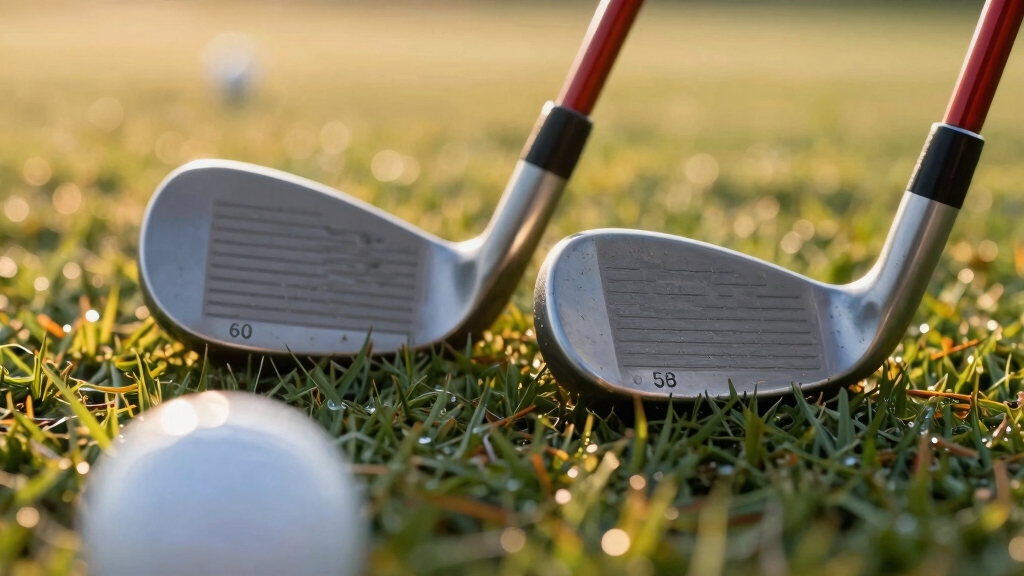
When you look closely at loft differences between 58-degree and 60-degree wedges, you’ll find they markedly impact forgiveness and control.
The 58-degree wedge, with its slightly lower loft, presents a more square clubface at impact. This enhances forgiveness by reducing the likelihood of pop-ups and thin strikes.
The 58-degree wedge offers a more square clubface, boosting forgiveness and minimizing pop-ups and thin shots.
This loft also improves turf interaction, allowing for more consistent contact across varied lies. In contrast, the 60-degree wedge demands greater precision due to its higher loft, increasing the risk of mishits and inconsistent spin rates.
Its steeper angle makes it less tolerant of swing flaws, requiring refined mechanics to control trajectory and distance effectively. Consequently, choosing between these wedges hinges on your ability to maintain consistent swing mechanics and desire for shot forgiveness versus heightened control.
Additionally, the 60° wedge’s lower bounce makes it less forgiving in heavy sand or thick grass, emphasizing the need for precise turf interaction.
Comparing Distance and Performance of 58 Vs 60 Degree Wedges
Understanding the impact of loft on forgiveness naturally leads to examining how it affects distance and overall performance.
When you swing a 58-degree wedge, you typically achieve around 80 yards with consistent control. This benefits from its lower loft and better turf interaction.
The 60-degree wedge, while capable of reaching up to 100 yards on a full swing, generally averages 74 yards due to the frequent use of partial swings.
You’ll find the 58-degree wedge offers more reliable distance control, especially for average players relying on half or three-quarter swings.
In contrast, the 60-degree demands greater precision; mishits often result in pop-ups or thin shots that compromise performance.
Therefore, if consistency and distance control are priorities, the 58-degree wedge typically outperforms the 60-degree in practical play.
Both wedges are best used for shots inside 100 yards, where precise distance control is crucial for scoring and versatility.
Which Wedge Offers Better Versatility for Short Game Shots?
When you’re deciding between a 58- and a 60-degree wedge, it’s important to think about how each one handles different types of shots and interacts with the turf.
The 58-degree wedge is actually pretty versatile. It tends to provide better contact consistency, which is super helpful when you’re dealing with a variety of lies. This means you can trust it more, no matter the situation.
On the other hand, the 60-degree wedge requires a bit more precision in your mechanics. While it can be great for certain shots, that need for accuracy can limit how adaptable it’s in different short game scenarios. So, if you’re looking for versatility, the 58-degree might be your best bet!
Additionally, understanding the bounce angle of each wedge can help you choose the right club for various turf conditions and shot types.
Shot Variety Handling
Mastering shot variety demands a wedge that adapts seamlessly across different situations. The 58-degree wedge excels in this regard.
It offers you greater forgiveness and control, reducing the risk of pop-ups common with the higher lofted 60-degree wedge. You’ll find it easier to execute delicate flop shots, bunker escapes, and chips with precision.
Here’s why the 58-degree stands out for shot variety handling:
- Its lower loft improves contact consistency, making various shot types more reliable.
- It suits a wider range of lies, including deep bunkers, thanks to ideal bounce design.
- It demands less swing precision, allowing you to confidently handle different short game scenarios.
Choosing the 58-degree wedge enhances your versatility and shot-making confidence. Additionally, the wedge’s wide sole design helps prevent digging and improves turf interaction for more consistent shots.
Turf Interaction Benefits
The 58-degree wedge not only broadens your shot-making capabilities but also excels in turf interaction, a key factor for consistent short game performance.
Its lower loft and typically higher bounce, around 12 degrees, enable cleaner contact with various lies, reducing the risk of digging or bouncing off the turf.
You’ll find it more forgiving on inconsistent swings, allowing better contact consistency and improved control.
In contrast, the 60-degree wedge, with higher loft and less bounce, demands precise mechanics to avoid thin or popped-up shots.
While the 60-degree can finesse delicate approaches, it’s less versatile across turf conditions.
Mizuno’s sole grind options further enhance turf interaction, allowing players to customize wedges for their preferred turf conditions and swing types.
How Bounce Affects Turf Interaction and Shot Consistency?
Although bounce often goes overlooked, it plays a critical role in how your wedge interacts with turf and affects shot consistency.
Bounce is the angle between the leading edge and lowest point of the sole, determining how the club glides through turf or sand.
Bounce measures the angle that helps your wedge smoothly navigate turf and sand.
With a 58-degree wedge typically featuring around 12 degrees of bounce, you gain versatility and forgiveness on various lies, especially softer turf.
Conversely, a 60-degree wedge often has less bounce, demanding cleaner contact.
Here’s why bounce matters:
- Prevents digging: Higher bounce reduces turf interaction depth, promoting cleaner strikes.
- Enhances consistency: Proper bounce stabilizes your wedge through impact, minimizing fat or thin shots.
- Adapts to conditions: Bounce choice should reflect turf firmness and shot type for peak performance.
Master bounce, and you’ll elevate both turf interaction and shot reliability.
Proper turf interaction also helps minimize damage to the playing surface, preserving course playability and turf health over time.
Fixing Wedge Gaps for Consistent Distance
To ensure you’re getting the most out of your wedges, it’s important to maintain proper loft spacing. This helps keep those distance gaps consistent between your clubs. When you optimize your wedge setup, you can reduce any overlap and really enhance the reliability of your shot selection. Including an Approach Wedge can effectively fill distance gaps between pitching and sand wedges for improved control.
Wedge Loft Spacing
When wedge lofts aren’t properly spaced, you’ll struggle to achieve consistent distance gaps. This disrupts your shot selection and distance control. Proper wedge loft spacing guarantees smooth distance progression and reliable club choices.
To optimize your setup, focus on these key points:
- Maintain 4-6 degree loft gaps between wedges to avoid overlap and maximize coverage.
- Consider your existing wedges. Adding a 58-degree wedge after a 56-degree can create a problematic gap, so adjust lofts accordingly.
- Make certain your wedge set complements your irons and sand wedge. This creates a uniform distance sequence throughout your bag.
Additionally, selecting irons and wedges with optimized center of gravity can help improve launch and distance consistency throughout your short game.
Distance Consistency Strategies
Consistently managing distance gaps between wedges remains a critical factor in achieving reliable shot execution and precise club selection.
You need to evaluate your existing wedge set to identify overlaps or excessive gaps, especially when choosing between 58- and 60-degree wedges.
The 58-degree wedge generally delivers more consistent partial swing distances, making it easier to control yardage increments.
To fix wedge gaps, adjust your swing length or consider loft adjustments to ensure each wedge covers a distinct distance range.
Avoid relying solely on a 60-degree wedge for multiple distance zones, as it demands greater precision and risks inconsistent contact.
Employing distance tracking during practice rounds helps you calibrate your wedge usage, maintaining predictable yardages and improving your scoring potential around the green.
Incorporating flighted wedge shots can further enhance distance control and consistency, especially on approach shots inside 100 yards.
Optimal Gap Setup
Best wedge spacing plays a pivotal role in maintaining consistent distance control and shot selection reliability.
When optimizing your wedge setup, you must address gaps that arise from tight loft differences, especially between 56°, 58°, and 60° wedges.
Proper spacing guarantees smooth distance progression and avoids overlapping yardages that confuse club selection.
To fix wedge gaps effectively, follow these steps:
- Analyze your current lofts and identify any 2- or 3-degree overlaps causing inconsistent distance intervals.
- Adjust lofts to create even spacing, typically 4 to 6 degrees between wedges, to promote reliable yardage gaps.
- Consider bounce and turf interaction characteristics alongside loft to maintain shot consistency and versatility.
Additionally, combining static loft measurements with dynamic loft analysis ensures your wedges perform optimally during actual swings.
Why 58 Degree Wedges Are Easier for Average Golfers to Hit?
A 58-degree wedge offers greater forgiveness and control, making it easier for average golfers to hit effectively. Its lower loft and square clubface reduce mishits. Improved bounce enhances turf interaction, ensuring consistent contact.
You’ll find distance control more reliable with a 58-degree wedge, especially using partial swings common among average players. In contrast, 60-degree wedges demand greater precision and risk pop-ups or thin shots on imperfect strikes.
| Feature | 58-Degree Wedge |
|---|---|
| Forgiveness | Higher due to lower loft and bounce |
| Distance Control | More consistent with partial swings |
| Turf Interaction | Better contact and less digging |
| Shot Versatility | Handles flops, chips, and bunker shots effectively |
Choosing a 58-degree wedge suits your game and reduces short-game complexity.
When Should Better Players Use a 60 Degree Wedge?
While 58-degree wedges provide average golfers with forgiveness and versatility, better players often benefit from the sharper loft and narrower margin for error offered by a 60-degree wedge.
You should consider using a 60-degree wedge when:
- You need precise, delicate shots around the green, especially short-side approaches requiring higher trajectory and softer landing.
- Your swing mechanics are consistent enough to handle the reduced forgiveness and increased risk of pop-ups or thin contact.
- You want to exploit the full loft for shots demanding maximum height and spin, enhancing control over distance and stopping power.
Ultimately, the 60-degree wedge suits skilled players who can manage its demanding mechanics to achieve specialized shot-making advantages unavailable with a 58-degree wedge.
How to Choose the Right Wedge for Your Skill and Swing?
Because your skill level and swing mechanics directly influence wedge effectiveness, choosing the right wedge demands a careful assessment of your consistency, shot requirements, and comfort with loft variations. If your swing is less consistent, a 58-degree wedge offers more forgiveness and turf interaction.
Conversely, better players with precise mechanics can exploit the higher loft of a 60-degree wedge for delicate shots. Consider how you control distance and shot versatility.
| Factor | 58-Degree Wedge |
|---|---|
| Forgiveness | Higher due to lower loft |
| Distance Control | More consistent with partial swings |
| Shot Versatility | Handles flops, chips, bunkers |
| Skill Level | Suitable for average/beginner golfers |
Choose wedges aligning with your mechanics for peak short game performance.
Frequently Asked Questions
How Does Wedge Weight Influence Swing Feel and Control?
Wedge weight directly influences your swing feel and control by affecting tempo and balance. A heavier wedge promotes a smoother, more controlled swing, helping you maintain rhythm and avoid over-swinging.
Conversely, a lighter wedge allows for quicker, more agile movements but can reduce stability, leading to inconsistent contact. Matching wedge weight to your natural swing tempo enhances precision, allowing you to execute delicate shots with better feel and improved distance control.
Can Wedge Shaft Length Impact Shot Accuracy?
Think of your wedge shaft length as the conductor’s baton guiding your swing’s orchestra. Too long or short, and harmony falters.
Yes, shaft length directly impacts shot accuracy by altering your swing arc and timing. A shorter shaft offers better control and precision, reducing dispersion.
A longer shaft can generate more distance but sacrifices accuracy. Optimizing shaft length guarantees consistent contact and shot reliability, essential for precise wedge play.
What Grip Options Improve Wedge Handling?
You should opt for grips with a tacky, soft rubber compound to improve wedge handling. They enhance control and feedback.
Consider midsize grips to reduce hand tension and promote a smoother release. This helps prevent wrist breakdown during short game shots.
Additionally, grips with textured patterns or raised ridges help maintain secure contact under varying weather conditions. This increases consistency.
Properly fitted grips tailored to your hand size and swing style will optimize wedge precision and feel.
How Often Should Wedges Be Re-Grooved for Optimal Spin?
You should re-groove your wedges once their sharpness drops by about 20%, which typically happens after 600-900 swings. This guarantees prime spin and control, as worn grooves reduce friction and ball bite.
Regular inspection and timely re-grooving maintain consistent performance, especially for delicate shots requiring precise spin. Neglecting this can lead to diminished stopping power and less reliable short-game execution.
Keep your wedges sharp to maximize your scoring potential.
Are There Specific Cleaning Tips to Maintain Wedge Performance?
You should clean your wedges after every round to maintain performance.
Use a soft-bristled brush and warm, soapy water to remove dirt and grass from grooves. This ensures peak spin and turf interaction.
Avoid harsh abrasives that can damage the clubface. Dry thoroughly to prevent rust.
Regular cleaning preserves groove sharpness and consistent contact, vital for precision shots and distance control in your short game.
Choosing Between a 58° and 60° Wedge for Better Scoring Performance
Choosing between a 58 and 60 degree wedge is like selecting the perfect key for your golf toolkit. The 58° offers smoother forgiveness, ideal for steady hands, while the 60° releases advanced control and versatility for sharper shots.
Understanding loft, bounce, and your swing’s rhythm guarantees you wield the right tool. This will help you close distance gaps and enhance precision. Master this choice, and you’ll command the short game with the authority of a true craftsman.