If you want a putting mat with a realistic, firm roll and authentic tactile feedback, PrimePutt delivers. Its nylon turf mimics real greens and provides clear, crisp sound cues.
Birdie Ball offers a softer, smoother roll with quieter, less green-like texture. It excels in durability and customization, including multiple sizes.
Your choice hinges on prioritizing realism or versatility. Explore how each mat’s surface, cup design, and feel impact your practice experience.
- Key Takeaways
- Prime Putt or Birdie Ball: Key Comparison
- How Prime Putt and Birdie Ball Rolling Surfaces Compare?
- How Sound and Feel Affect Putting Realism?
- How Mat Design Differences Affect Putting Performance?
- How Cup and Hole Features Impact Putting Accuracy?
- Which Putting Mat Is More Durable and Built to Last?
- Size and Customization Options for Your Space
- How Price and Value Compare Between PrimePutt and Birdie Ball?
- How to Choose the Right Putting Mat for Your Practice Goals?
- Summary: Which Putting Mat Best Fits Your Needs?
- Frequently Asked Questions
- From Feel to Longevity: Your Putting Decision Guide
Key Takeaways
- PrimePutt offers a realistic, firm nylon turf with authentic roll and tactile feedback, closely mimicking real greens.
- Birdie Ball features a softer foam surface with faster, smoother roll and multiple size/customization options.
- PrimePutt’s five-hole layout provides varied angles and immediate made/missed feedback with low-profile cups.
- Birdie Ball’s deeper cups and rubber backstop create adjustable difficulty and softer impact sound.
- PrimePutt favors realism and stroke development, while Birdie Ball excels in durability and customizable practice setups.
Prime Putt or Birdie Ball: Key Comparison
| Feature | PrimePutt | Birdie Ball |
|---|---|---|
| Surface Material | Nylon turf | Foam-like surface |
| Roll Feel | Firm, realistic, true-to-green | Softer, smoother, slightly faster |
| Stimpmeter Speed | Around 10 | Around 11–12 |
| Tactile Feedback | High, authentic feedback | Moderate, less realistic |
| Sound Feedback | Crisp, muted, green-like | Quieter but less natural |
| Realism Level | Very high (closest to real greens) | Moderate realism |
| Hole Design | 5 holes, low-profile cups | 3 holes, deeper cups with reducers |
| Practice Variety | Multiple angles and distances | Adjustable difficulty, less angle variety |
| Cup Feedback | Clear made/miss response | Softer, less immediate feedback |
| Backstop Type | Wood backstop (realistic stop) | Rubber backstop (softer impact) |
| Durability | High, long-lasting turf | Very high, but foam may wear/sink over time |
| Customization Options | Limited sizes (fixed length) | Multiple sizes and configurations |
| Best For | Realistic practice and stroke improvement | Durability and flexible setups |
| Overall Strength | Authentic feel and feedback | Versatility and longevity |
How Prime Putt and Birdie Ball Rolling Surfaces Compare?
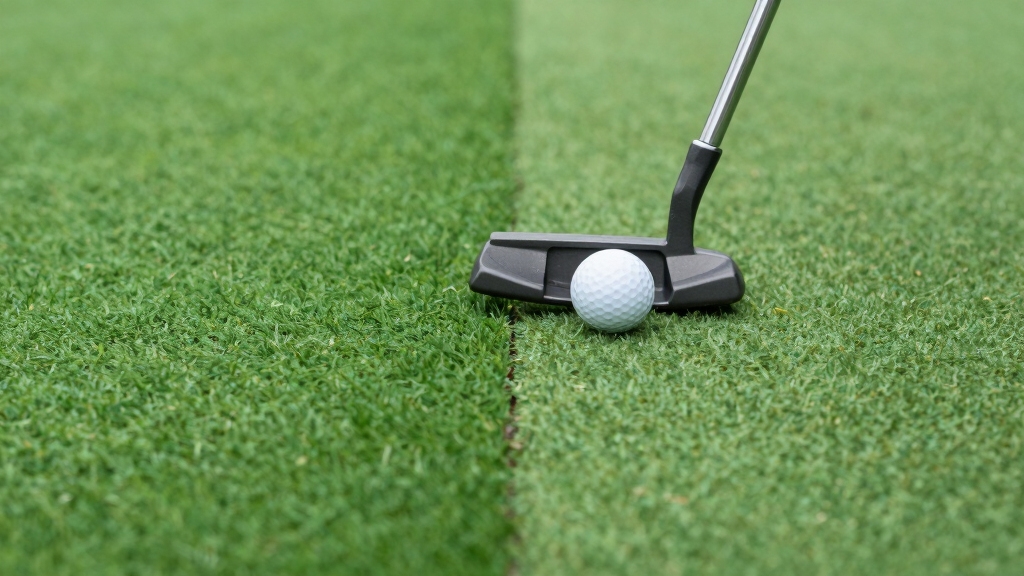
While both PrimePutt and Birdie Ball offer consistent ball behavior by eliminating bouncing, their rolling surfaces differ markedly in texture and performance.
PrimePutt uses nylon turf designed to replicate real putting greens, with a Stimpmeter rating around 10. This provides a true, consistent roll that many consider closest to actual green conditions.
Birdie Ball, on the other hand, employs a foam-like surface that produces a smooth roll but tends to run slightly faster, rated between 11 and 12 on the Stimpmeter.
This foam surface also generates a distinctive sound that some find less realistic. When you practice, PrimePutt’s turf gives you more authentic feedback on speed and roll.
Birdie Ball’s surface offers a faster, quieter experience with less green-like texture.
For golfers seeking realistic practice conditions, selecting a surface with realistic turf texture is essential to develop effective putting skills.
How Sound and Feel Affect Putting Realism?
When you putt on PrimePutt, you’ll quickly notice that the nylon turf creates a sound and feel that’s really close to what you’d experience on real greens. This adds a nice touch of authenticity to each stroke.
On the other hand, Birdie Ball’s foam surface gives you a smoother roll, but it also produces a unique noise. Some people find that sound a bit off, which can definitely change how you feel about your putts.
Simulators often use synthetic greens with adjustable slopes and breaks to mimic real putting challenges and enhance realism.
Ball Roll Sound
In evaluating putting mat realism, the sound produced by the ball rolling across the surface plays a crucial role in how you perceive feedback and control.
With PrimePutt’s nylon turf, you’ll notice a crisp, muted roll sound that closely mimics an actual green, reinforcing a natural feel.
In contrast, Birdie Ball’s foam-like surface generates a smoother but somewhat artificial sound, which some users find less convincing.
This difference stems from material density and texture, affecting auditory cues during your stroke.
The quieter, more authentic sound of PrimePutt may enhance your ability to judge roll speed and distance.
Meanwhile, Birdie Ball’s distinct roll sound could slightly alter your perception of ball behavior.
Both mats deliver consistent roll but differ especially in acoustic feedback, influencing your overall putting experience.
Choosing mats with dense turf quality can further improve the realism of sound and feel during practice.
Surface Texture Impact
Because the surface texture directly influences both the tactile feedback and auditory cues during putting, it plays a critical role in your perception of realism.
With PrimePutt’s nylon turf, you experience a firm, true roll that closely mimics real greens. This delivers consistent ball behavior and a natural sound.
Birdie Ball’s foam-like surface feels softer under the ball, producing a smoother roll but also a distinctive, less authentic sound that some find less convincing.
While both eliminate bouncing and maintain consistency, the difference in texture affects how you interpret ball speed and control.
If you prioritize tactile accuracy and realistic auditory feedback, PrimePutt’s surface better supports those needs.
However, Birdie Ball’s texture offers a unique feel that some users might prefer for different practice settings.
When setting up your indoor putting green, proper material selection and preparation ensures the surface texture performs optimally for realistic putting practice.
Realistic Putt Sensation
The tactile and auditory qualities of a putting mat do more than just influence your perception of surface texture. They shape the overall realism of your putting experience.
With PrimePutt, the nylon turf delivers a true-to-green feel and quiet, natural ball roll, closely mimicking actual putting conditions.
In contrast, Birdie Ball’s foam surface produces a distinctive, slightly louder sound during ball roll, which some users find less authentic.
You’ll notice PrimePutt’s wood backstop adds to the realistic feedback when the ball stops. Birdie Ball’s rubber backstop offers a softer impact.
Both mats guarantee consistent ball behavior, but if you prioritize authentic sound and tactile response, PrimePutt arguably provides a more convincing and immersive putting sensation.
Additionally, choosing accessories with durable indoor-suited materials can further enhance the longevity and performance of your putting setup.
How Mat Design Differences Affect Putting Performance?
You’ll definitely notice that the surface texture really affects how the ball rolls. For instance, PrimePutt uses nylon turf, which gives you a more realistic green feel. On the other hand, Birdie Ball has a faster foam surface that changes the way the ball interacts with it.
And then there’s the hole placement to think about. PrimePutt has five holes spread across the mat, which gives you more options for practice. Meanwhile, Birdie Ball has three holes, but you can adjust the difficulty level, which can be pretty fun if you’re looking to challenge yourself.
All these design differences really do make a difference in how you simulate real putting conditions. They can help you fine-tune your stroke in ways that are specific to your practice needs.
Additionally, choosing a mat with a durable construction ensures long-lasting performance for consistent practice sessions.
Surface Texture Impact
Surface texture plays a pivotal role in how each putting mat influences your stroke and ball behavior.
PrimePutt’s nylon turf mimics real greens with a Stimpmeter rating near 10, giving you a consistent, true roll.
Birdie Ball’s foam-like surface rolls a bit faster (11-12 rating), affecting speed control.
You may notice Birdie Ball produces a less realistic sound due to its foam texture, while PrimePutt feels more authentic.
| Feature | PrimePutt (Nylon Turf) | Birdie Ball (Foam Surface) |
|---|---|---|
| Stimpmeter Rating | ~10 | 11-12 |
| Roll Consistency | High | Moderate |
| Surface Sound | Realistic | Distinctive, less natural |
| Ball Bounce | None | None |
| Durability | High | High, but foam wears faster |
Both provide smooth roll, but texture distinctly shapes your putting experience. To maintain optimal grip and performance on these surfaces, using a hair dryer to dry your golf grips faster can be especially helpful after practice sessions.
Hole Placement Variations
Although both PrimePutt and Birdie Ball offer realistic drop-in hole mechanisms, their differing hole placements and designs influence how you practice various putting scenarios.
PrimePutt provides five holes spaced across the mat, allowing you to target multiple angles and distances without repositioning the mat. This setup closely mimics varied green conditions, enhancing your adaptability.
Birdie Ball, in contrast, features three holes clustered on one side, supplemented with hole reducers to adjust difficulty. While this limits lateral variation, it lets you focus on precision and control at shorter ranges.
Additionally, PrimePutt’s cups sit closer to the turf, giving you more accurate feedback on made versus missed putts. Birdie Ball’s deeper cups due to thicker mat construction may affect your perception of hole depth, subtly altering putting feel and confidence.
This emphasis on realistic hole interaction and tactile feedback aligns with the physical hole feedback approach seen in systems like PUTTR, which prioritize authentic roll and holing sensations for pace control and muscle memory development.
How Cup and Hole Features Impact Putting Accuracy?
When practicing putting, the design of the cups and holes directly influences your ability to gauge accuracy and improve stroke consistency.
PrimePutt’s cups sit closer to the mat surface, providing a more precise sense of whether your putt is made or missed. This sharpens your feedback loop.
Birdie Ball’s cups, set lower due to its thicker mat, might offer less immediate clarity on putt outcomes. Additionally, PrimePutt’s five-hole layout enables varied target practice, enhancing your adaptability.
Birdie Ball’s three holes combined with reducers allow you to adjust difficulty levels. Both use drop-in hole mechanisms for realistic ball capture, avoiding artificial returns.
These subtle differences affect how reliably you can assess putting accuracy and refine your stroke technique during training sessions.
The cup design and hole placement play a crucial role in developing distance control and direction precision during putting practice.
Which Putting Mat Is More Durable and Built to Last?
Evaluating durability is crucial when choosing a putting mat that can withstand frequent use and maintain performance over time. The Birdie Ball excels in durability due to its robust foam construction. However, it may show wear and sinking under heavy foot traffic.
PrimePutt uses nylon turf, offering long-lasting surface integrity without degradation. It ranks slightly below Birdie Ball in overall durability. Both maintain structural soundness, but materials affect longevity differently.
| Feature | PrimePutt | Birdie Ball |
|---|---|---|
| Surface Material | Nylon turf | Foam-like texture |
| Durability Ranking | Second | First |
| Wear Resistance | High | Susceptible under pressure |
| Structural Integrity | Maintained | Maintained |
You’ll want to take into account your usage intensity and surface preference when deciding. Choosing accessories like durable golf simulator tees with reinforced support can also enhance the longevity of your practice setup.
Size and Customization Options for Your Space
Durability sets the foundation for long-term use, but fitting your practice setup into your available space is equally important.
Birdie Ball offers multiple width options and long strip configurations, including a 3×10-foot mat ideal for extended putt practice in larger rooms. This flexibility makes it easier to customize your setup to specific spatial constraints.
PrimePutt, on the other hand, provides a fixed 12-foot length mat that fits well in more compact areas. It supports longer-range putting without requiring excessive floor space. However, PrimePutt’s size options are more limited compared to Birdie Ball’s variety.
If you prioritize customizable dimensions to match unique spaces, Birdie Ball’s offerings may suit you better. Conversely, if you prefer a reliable, compact length, PrimePutt delivers consistent performance in a straightforward size format.
How Price and Value Compare Between PrimePutt and Birdie Ball?
Although both PrimePutt and Birdie Ball offer quality putting mats, the price and value they provide cater to different priorities and budgets.
PrimePutt delivers strong performance and realistic roll at a competitive price, making it an excellent value for those focused on accuracy and green-like feel.
Birdie Ball’s standard version is priced similarly but offers greater size options and durability, appealing if you need customizable dimensions or long-term wear resistance.
The higher-priced Birdie Ball Tour Turf targets users seeking premium surface quality, though it comes at a significant cost.
Ultimately, if you prioritize authentic roll and features relative to investment, PrimePutt offers superior value.
If customization, durability, or multiple configurations matter more, Birdie Ball might justify its price despite some foam wear concerns.
Both remain popular, reflecting their balanced price-to-performance ratios.
How to Choose the Right Putting Mat for Your Practice Goals?
Selecting the right putting mat involves matching its features to your specific practice goals and environment. If you want realistic roll and shot feedback, a PrimePutt with its nylon turf and multiple holes suits focused skill refinement. For durability and varied size options, Birdie Ball’s foam surface and customizable lengths may fit better.
| Feature | PrimePutt | Birdie Ball |
|---|---|---|
| Rolling Surface | Realistic, Stimpmeter ~10 | Smoother, faster roll ~11-12 |
| Size Options | Limited, compact 12-foot mat | Multiple widths & lengths |
| Cup Setup | Multiple holes, low-profile | Fewer holes, higher cups |
Match the mat’s characteristics with your space, practice style, and preference for realism versus durability to optimize your training.
Summary: Which Putting Mat Best Fits Your Needs?
When choosing between PrimePutt and Birdie Ball, you’ll want to weigh how each mat’s unique features align with your practice priorities.
If realistic green simulation and precise ball roll matter most, PrimePutt’s nylon turf and accurate cup design provide a superior putting experience.
Conversely, if durability and customizable size options are essential, Birdie Ball’s foam construction and extended length models offer versatility despite a slightly less authentic feel.
Consider also the ball feedback: PrimePutt delivers true-to-green response, while Birdie Ball’s foam surface produces a distinct sound and faster roll.
Your choice hinges on whether you prioritize authentic feel and accuracy or durability and customization.
Both mats offer consistent performance and solid value, so identifying your specific needs will guide you to the best fit.
Frequently Asked Questions
Can Either Mat Be Used Outdoors Without Damage?
Neither mat is designed for regular outdoor use without risking damage.
You’ll find that PrimePutt’s nylon turf holds up better against moisture, but prolonged exposure to sun and rain could degrade its quality.
Birdie Ball’s foam surface is more vulnerable to wear, sinking, and weather damage outdoors, especially underfoot pressure.
If you want to use either outside, you should limit exposure, keep them dry, and store them indoors after use to maintain durability.
Are Replacement Parts Available for Holes and Backstops?
Picture a smooth ball dropping cleanly into a pristine cup. You’ll want replacement parts to keep that feeling alive.
Yes, both mats offer replacement holes and backstops, ensuring your practice surface stays sharp. PrimePutt’s drop-in holes and wood backstop can be swapped out, maintaining accuracy.
Birdie Ball’s rubber bumpers and cups are also replaceable, though its foam surface may influence part longevity. Having spares helps you sustain consistent play quality over time.
How Easy Is It to Clean and Maintain Each Mat?
You’ll find both mats fairly easy to clean and maintain.
PrimePutt’s nylon turf wipes down well with a damp cloth and resists dirt buildup, maintaining its true roll over time.
Birdie Ball’s foam surface also cleans easily but can show wear faster, requiring more frequent care to prevent sinking or deformation.
Neither demands special cleaners, but regular gentle cleaning helps preserve performance and appearance on both mats.
Do Either Mat Options Support Left-Handed Putting Practice?
Yes, both mats support left-handed putting practice since their flat, ramp-free designs allow you to approach and putt from either side without restriction.
PrimePutt’s straight putting lines and multiple hole placements give you flexibility in stance and angle.
Birdie Ball’s wider options and hole reducers also accommodate varied practice positions.
Neither mat limits your ability to practice left-handed strokes, ensuring you can train effectively regardless of handedness.
Are There Any Accessories Compatible With Primeputt or Birdie Ball?
Yes, you’ll find compatible accessories for both mats.
PrimePutt supports additional hole reducers to vary difficulty and can pair with alignment guides and putting mirrors for technique improvement.
Birdie Ball offers hole reducers too, along with rubber bumpers to keep balls on the surface.
Both brands can integrate with standard putting aids like training cups and ball markers, enhancing your practice without altering the mat’s core design or performance.
From Feel to Longevity: Your Putting Decision Guide
If you’re aiming to improve your putting with realistic feedback, PrimePutt’s true-to-green surface and responsive cup design might suit you better.
For example, a golfer practicing at home found PrimePutt’s sound and feel closely mimicked on-course conditions, enhancing muscle memory.
However, if durability and customization matter most, Birdie Ball could be your pick.
Analyze your priorities, whether it’s feel, design, or longevity, to choose the mat that best matches your practice goals.