
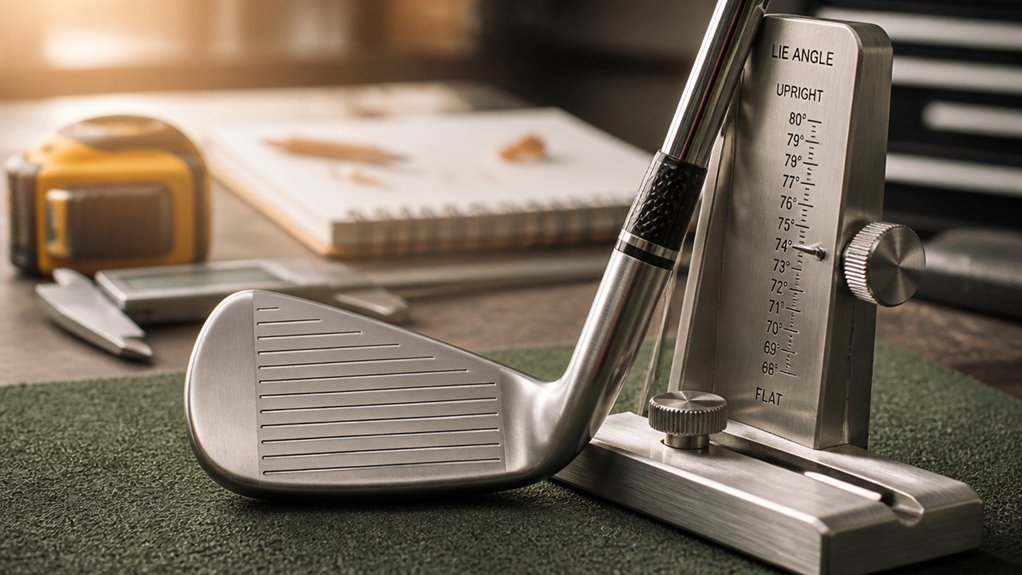
To determine your iron’s correct lie angle, start by measuring your wrist-to-floor length in your usual stance while wearing golf shoes.
Use this measurement alongside standard reference charts to estimate a baseline lie angle.
Then, perform a ball impact ink test or check sole wear to see if the club’s toe is too high or low, causing shots to veer left or right.
Proper lie guarantees square sole contact and accurate ball flight.
Further insights reveal how to refine and confirm these adjustments precisely.
- Key Takeaways
- Why Your Golf Iron Lie Angle Matters?
- How to Measure Your Wrist-to-Floor Length for Lie Angle?
- Using Ink Transfer and Sole Wear Marks to Diagnose Lie Angle
- Reading Ball Flight to Identify Lie Angle Issues
- Check and Adjust Your Iron Lie Angle at Home
- Understanding Standard Lie Angles for Men’s and Women’s Irons
- Frequently Asked Questions
- How Does Lie Angle Affect Shot Distance and Trajectory?
- Can Lie Angle Adjustments Improve My Consistency in Different Weather?
- How Often Should I Have My Iron Lie Angles Checked Professionally?
- Do Lie Angles Vary Significantly Between Different Golf Club Brands?
- Is It Possible to Adjust Lie Angles on Graphite Shaft Irons?
- Final Steps to Find the Right Iron Lie Angle
Key Takeaways
- Measure wrist-to-floor length in golf stance and use a wrist-to-floor chart to estimate proper lie angles for each iron.
- Perform the Ball Impact Ink Test by striking a ball with a vertical ink line to check clubface contact and lie angle correctness.
- Examine sole wear patterns on a lie board; wear toward the toe indicates a flat lie, while wear toward the heel indicates an upright lie.
- Use launch monitor data to observe dynamic lie angle and face angle for precise lie angle verification.
- Adjust lie angle by flattening or raising the clubhead to center sole wear and correct ball flight deviations.
Why Your Golf Iron Lie Angle Matters?

Because the lie angle directly affects the clubface’s orientation at impact, it markedly influences your shot accuracy and ball flight.
If the lie is too upright, the club’s toe points upward, causing shots to veer left of your target.
Conversely, a lie that’s too flat causes the toe to tilt downward, pushing shots to the right.
This misalignment alters the vertical contact between clubface and ball, leading to inconsistent strikes and directional errors.
Proper lie angle guarantees the sole of the club rests squarely on the ground at impact, promoting centered contact and a true ball flight path.
For peak performance, you must understand and adjust your irons’ lie angles to match your swing mechanics and posture, minimizing directional bias and maximizing shot precision.
Adjusting lie angle often goes hand-in-hand with customizing club length to optimize swing path and control.
How to Measure Your Wrist-to-Floor Length for Lie Angle?
To accurately determine your ideal iron lie angle, start by measuring your wrist-to-floor length with precision. This measurement is essential because it directly influences how your club interacts with the ground during your swing.
Accurately measuring your wrist-to-floor length is key to finding the perfect iron lie angle for your swing.
Follow these steps for an exact reading:
- Stand upright in your usual golf stance wearing your golf or street shoes.
- Let your arms hang relaxed by your sides and look straight ahead.
- Measure from the major crease on your wrist down to the floor on both arms.
- Adjust your posture until both wrist-to-floor measurements match exactly.
Use this measurement with a wrist-to-floor chart to find the correct lie angle for your irons. Remember, women’s standard lie angles are generally one degree less than men’s. Accurate wrist-to-floor measurement is critical for selecting club length and ensuring proper club fitting.
Using Ink Transfer and Sole Wear Marks to Diagnose Lie Angle
After determining your wrist-to-floor measurement and estimating your ideal lie angle, you can verify and fine-tune this setting using ink transfer and sole wear mark techniques.
Start by drawing a vertical ink line on the back of the ball. Position it carefully on a short tee and strike it. Check the ink transfer on the clubface: if the line tilts toward the toe, your lie angle is too upright and needs flattening; if it tilts toward the heel, it’s too flat.
Next, apply black electrical tape to the sole and hit shots on a lie board. Examine the wear marks: marks toward the toe indicate the club is too flat, while marks toward the heel mean it’s too upright.
Centered marks confirm correct lie angle settings. For the most reliable results, ensure your club has a consistent heel placement during these tests to avoid measurement errors.
Reading Ball Flight to Identify Lie Angle Issues
You can spot lie angle issues by paying attention to how your ball flies in relation to the target line. For instance, if your shots keep drifting left, that might be a sign that your lie angle is too upright.
On the flip side, if the ball tends to veer right, it’s likely that the lie is too flat.
Adjusting the lie angle can also affect swing dynamics, including swing weight and overall club performance.
Ball Flight Patterns
Frequently, analyzing your ball flight patterns provides critical insight into whether your iron lie angles suit your swing dynamics.
By observing how the ball travels relative to your target line, you can detect subtle misalignments between your clubs and your swing.
Consider these key ball flight indicators:
- Shots consistently left of target often mean your irons are too upright.
- Shots consistently right of target typically indicate your irons are too flat.
- A neutral, straight ball flight suggests your lie angles are well matched.
- Use a launch monitor to confirm dynamic lie angle alongside club path and face-to-path data for precise diagnostics.
Pay close attention to these patterns to inform whether your clubs need adjustment, ensuring ideal contact and directional control.
Additionally, matching your shaft flex to your swing speed and tempo is essential to maintain proper energy transfer and optimize ball flight control.
Correcting Lie Angle
When your ball consistently veers off target, it signals that your iron’s lie angle might need adjustment.
Shots curving left typically indicate an upright lie angle, causing the toe to lift and the face to close at impact.
Conversely, shots drifting right suggest a flat lie, with the toe dipping and the face opening.
To confirm, use a launch monitor to observe dynamic lie angle relative to club path and face angle.
You can also apply the ball impact line technique, checking ink transfer on the clubface for toe-up or toe-down tilt.
Once identified, adjust the lie angle accordingly.
Flatten upright clubs or raise flat ones to center your sole wear and optimize ball flight.
This ensures your irons connect squarely and direct shots accurately.
For precise adjustments, it is recommended to consult a professional clubmaker who can measure lie angle using specialized loft and lie machines.
Check and Adjust Your Iron Lie Angle at Home
You can easily check your iron lie angle at home! First, measure your wrist-to-floor distance while standing naturally in your usual shoes. Once you have that measurement, grab a wrist-to-floor chart to help estimate the correct lie angle for your irons.
Now, to really fine-tune things, you’ll want to perform the ball impact ink test. Just take a ball and mark it with a vertical ink line. After you strike it, check out how the ink transfers onto the clubface.
This will give you a clear idea of whether your lie angle is spot on or if it needs a little adjustment. Proper fitting integrates height, arm length, and wrist-to-floor measurements to optimize posture, swing mechanics, and control. Happy golfing!
Wrist-To-Floor Measurement
Measuring your wrist-to-floor distance provides a reliable starting point for determining the correct iron lie angle at home. To do this accurately, follow these steps:
- Stand naturally in golf or street shoes with your arms relaxed by your sides. Look straight ahead.
- Measure from the major crease of each wrist to the floor, ensuring both sides have identical measurements.
- Use a wrist-to-floor chart to find the standard lie angle for each iron number based on your measurement.
- If you’re fitting women’s irons, subtract one degree from the men’s standard lie angle values for proper adjustment.
This method offers a precise baseline for lie angle customization before you proceed to more dynamic verification tests. Proper golf grip sizing also plays a crucial role in improving control and comfort during play, complementing equipment adjustments like lie angle.
Ball Impact Ink Test
Apply a thick vertical ink line on the back of a golf ball using a Sharpie pen to perform the Ball Impact Ink Test. Position the ball on a short tee on closely mown grass, ensuring the ink line is perfectly vertical and faces the clubface.
Strike the ball with your iron and immediately check the ink transfer on the clubface. If the ink line transfers parallel and perpendicular to the club’s score lines, your lie angle is correct.
A line tilting toward the toe indicates the toe is too high, meaning the lie is too upright and needs flattening. Conversely, a line tilting toward the heel means the toe is too low and the lie is too flat.
This test offers a quick, visual way to assess and adjust your iron’s lie angle at home. For the best results, ensure your grip is properly fitted and aligned, as proper grip fitting directly influences swing mechanics and shot accuracy.
Understanding Standard Lie Angles for Men’s and Women’s Irons
Standard lie angles serve as essential reference points when fitting irons for both men and women golfers. These angles guarantee proper contact and optimize ball flight.
Men’s irons follow a standardized lie angle progression. Women’s irons typically subtract one degree from these values to accommodate differences in height and swing dynamics.
Here are key standard lie angles to remember:
- Men’s 1-iron lies at 56.0 degrees; women’s at 55.0 degrees.
- Men’s 7-iron standard is 62.0 degrees; women’s is 61.0 degrees.
- Men’s 9-iron and wedges (PW, SW) are usually set at 64.0 degrees; women’s at 63.0 degrees.
- Adjustments beyond these standards depend on wrist-to-floor measurements and swing characteristics.
Use these baselines to guide your fitting process accurately. Proper shaft installation and alignment during club assembly are crucial to maintain these lie angles and ensure consistent performance.
Frequently Asked Questions
How Does Lie Angle Affect Shot Distance and Trajectory?
Lie angle directly influences your shot’s direction and consistency, which impact distance and trajectory.
If the lie angle is too upright, your shots tend to go left and may reduce distance due to inefficient contact.
Conversely, a lie angle that’s too flat causes shots to veer right, also compromising distance and flight path.
Proper lie angle guarantees solid, centered strikes, optimizing launch angle, ball speed, and overall distance control for consistent trajectory.
Can Lie Angle Adjustments Improve My Consistency in Different Weather?
Think of your lie angle as the compass needle for your shots. Adjusting it sharpens your directional consistency, even when weather throws curveballs.
Yes, proper lie angle adjustments help you maintain precise contact and predictable ball flight in varying wind or wet conditions.
How Often Should I Have My Iron Lie Angles Checked Professionally?
You should have your iron lie angles professionally checked at least once a year or after any significant change in your swing or posture.
Additionally, if you notice consistent ball flight issues, such as shots curving left or right, or uneven sole wear on your clubs, get them assessed sooner.
Regular checks make certain your lie angles match your current swing mechanics, maintaining accuracy and consistency on the course.
Do Lie Angles Vary Significantly Between Different Golf Club Brands?
Think of lie angles like a guitar’s tuning. Each brand strikes a slightly different note.
Yes, lie angles can vary between golf club brands due to design philosophy, manufacturing tolerances, and target player profiles.
While differences aren’t usually drastic, even a degree or two can affect ball flight and accuracy.
To guarantee peak performance, you should verify and adjust lie angles based on your swing and feedback, regardless of brand.
Is It Possible to Adjust Lie Angles on Graphite Shaft Irons?
Yes, you can adjust lie angles on graphite shaft irons, but you need to be cautious.
Graphite shafts are more delicate than steel and can be damaged if bent improperly.
Typically, a professional club fitter uses specialized equipment to make precise adjustments without harming the shaft.
Avoid DIY attempts, as excessive bending or incorrect techniques may compromise shaft integrity and club performance.
Always consult a qualified fitter for safe, accurate lie angle modifications.
Final Steps to Find the Right Iron Lie Angle
Mastering your iron’s lie angle is like tuning a finely crafted instrument. It guarantees every shot sings with precision.
By measuring your wrist-to-floor length, analyzing sole wear, and reading ball flight, you’ll strike a perfect balance between control and distance.
With these technical insights, adjusting your irons becomes second nature, releasing your best performance on the course.
Remember, a well-fitted lie angle is the silent partner behind every consistent, accurate swing.