
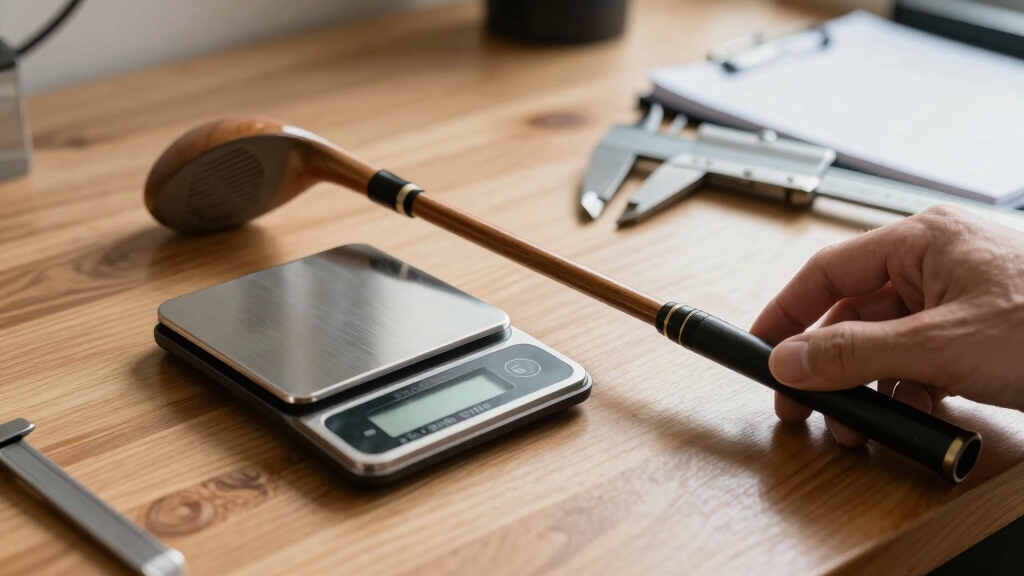
To calculate swing weight, first weigh your entire club accurately using a scale.
Then, find the balance point by balancing the club on a narrow edge and measuring from the grip end to this point with precision within 6 mm.
Use the formula Torque = Total Weight × (Balance Point − 14 inches) to calculate torque in inch-ounces and convert it to the Lorythmic scale.
Precise measurements are essential, and understanding adjustments to grip, shaft, or head will refine your results further.
- Key Takeaways
- What Swing Weight Is and Why It Matters to Your Swing?
- How to Find Your Club’s Swing Weight Balance Point?
- How to Measure Your Club’s Weight and Length?
- Calculating Swing Weight: Formula and Online Tools
- Tools You Can Use to Measure Swing Weight at Home
- How Grip, Shaft, and Head Adjustments Affect Swing Weight and Feel?
- Swing Weight Variations in Golf, Tennis & Pickleball
- Tips to Improve Your Swing Weight for Better Performance
- Frequently Asked Questions
- Small Adjustments, Big Impact: Elevate Your Swing Performance
Key Takeaways
- Measure the total club weight precisely using a postal or kitchen scale in ounces or grams.
- Find the balance point by resting the club on a narrow edge and measure distance from the butt end accurately within 6 mm.
- Calculate torque as Total Weight multiplied by (Balance Point − 14 inches) to quantify swing weight torque.
- Convert the torque value into the Lorythmic scale (A0 to E9) using online calculators or reference charts.
- Ensure accurate measurements and recalibrate after any grip, shaft, or head adjustments to maintain consistent swing weight.
What Swing Weight Is and Why It Matters to Your Swing?
Understanding swing weight is essential for optimizing your golf club’s performance. It directly affects how the club feels during your swing.
Swing weight measures the torque or moment the club generates around a fulcrum located 14 inches from the grip end. It quantifies the head’s heaviness relative to the club’s overall weight distribution.
Expressed on the Lorythmic scale from A0 (lightest) to E9 (heaviest), it reflects balance rather than static weight. This measurement influences your ability to control swing tempo, timing, and clubhead speed.
A properly balanced swing weight allows for consistent, repeatable swings, improving shot accuracy and distance. Conversely, an ill-suited swing weight can cause fatigue or erratic ball striking.
This underscores why precise understanding and measurement are vital for tailoring clubs to your unique swing dynamics. Adjustments to swing weight through components like shaft length, grip weight, and clubhead mass allow golfers to customize their clubs for optimal performance and feel.
How to Find Your Club’s Swing Weight Balance Point?
Finding your club’s swing weight balance point requires careful measurement of where the club balances horizontally on a narrow edge or rod.
Position the club so it rests without tipping. Then measure from the butt end to this balance point with precision. Errors over 6mm can shift swing weight by more than one point. Use a ruler or tape measure for accuracy.
| Step | Action | Note |
|---|---|---|
| 1 | Place club on narrow rod | Find exact horizontal balance |
| 2 | Measure from butt end | Use mm or inches, avoid parallax |
| 3 | Record measurement | Precision critical for torque calc |
This balance point is essential for calculating swing weight torque accurately. The SHUJUKU tool combines this balance point measurement with length and weight data to provide a more precise swing weight calculation.
How to Measure Your Club’s Weight and Length?
Before calculating swing weight, you’ll need to accurately measure your club’s total weight and overall length.
Use a postal or kitchen scale to weigh the entire club, recording the weight in ounces or grams with a precision of at least one decimal place.
Weigh your entire club using a postal or kitchen scale, noting the weight to one decimal place.
Next, measure the club’s length from the butt end of the grip to the tip of the clubhead using a rigid ruler or tape measure.
Accuracy here is critical, as even a 1/4-inch error affects swing weight calculations markedly.
Make certain the club is fully assembled and straightened during measurement.
Avoid flexing the shaft to prevent length distortion.
Accurate weight and length measurements form the foundation for precise swing weight determination in subsequent steps.
Keep in mind that length adjustments typically range from -1 inch to +1 inch and influence swing weight and control.
Calculating Swing Weight: Formula and Online Tools
Calculating swing weight is pretty straightforward.
You start by taking the club’s total weight and multiplying it by the distance from its balance point to a 14-inch fulcrum. This gives you the torque, which you then convert into the standardized letter-number scale.
If you’re feeling a bit overwhelmed, don’t worry! There are online tools that can make this process a breeze.
All you need to do is input the total weight and the balance point, and they’ll quickly give you accurate swing weight values.
Just a quick note: even tiny errors in your weight or balance distance can really change the final swing weight, so accuracy is key!
For best results, ensure your club is properly prepped and balanced before measuring, as monitoring torque and feel helps maintain performance.
Swing Weight Calculation Formula
Calculate swing weight by multiplying the club’s total weight by the difference between its balance point and the 14-inch fulcrum from the grip end.
This torque value, expressed in inch-ounces or gram-inches, converts to the standard Lorythmic letter-number scale (A0 to E9). For example, a club weighing 11.5 oz with a 29-inch balance point yields 172.5 inch-ounces, approximately D0.
Use this formula precisely, as small measurement errors cause significant swing weight shifts.
| Parameter | Description |
|---|---|
| Total Weight | Mass of club (oz or grams) |
| Balance Point | Distance from grip end (inches) |
| Fulcrum | Fixed 14-inch point from grip end |
| Swing Weight Torque | Weight × (Balance – 14 inches) |
Apply this formula for accurate, consistent swing weight calculation. Understanding the role of dynamic loft in club performance can complement swing weight considerations for optimal results.
Using Online Calculation Tools
Understanding the swing weight formula sets the foundation for leveraging online calculation tools that simplify this process.
These tools require you to input total club weight and the measured balance point from the grip end. The calculator applies the formula Torque = Weight × (Balance Point − 14 inches) instantly, converting torque values into the standardized letter-number swing weight scale.
This eliminates manual chart referencing and reduces calculation errors. Many calculators also allow component-level inputs, such as head, shaft, and grip weights, enabling precise swing weight estimation before assembly.
While the formula remains consistent, online tools streamline iterations when adjusting parameters like grip weight or shaft length. By using these calculators, you ensure accurate, repeatable swing weight values quickly, aiding club fitting or customization with technical precision.
Additionally, understanding how club length affects swing weight helps users make informed adjustments during the calculation process.
Input Parameters And Accuracy
Although the swing weight formula is straightforward, the accuracy of your results heavily depends on precise input parameters.
These include the total club weight and the balance point measured from the grip end. Small errors in these measurements markedly affect the calculated swing weight.
To guarantee accuracy, focus on:
- Total Club Weight: Use a calibrated postal or kitchen scale. A 3-gram error can shift swing weight by over one point.
- Balance Point Measurement: Measure from the butt end with a ruler or tape. Aim for precision within 6 mm or 1/4 inch to avoid significant deviations.
- Consistent Reference Fulcrum: The standard 14-inch fulcrum from the grip end is critical for correct torque calculation. This matches the Lorythmic scale.
Additionally, ensuring that the club length is measured accurately with a calibrated rigid measuring stick will help maintain consistency in input parameters.
Tools You Can Use to Measure Swing Weight at Home
When measuring swing weight at home, you can rely on a combination of common tools rather than specialized equipment.
Start by using a ruler or tape measure to find the balance point from the grip end, ensuring accuracy within 6mm to avoid significant errors.
Then, weigh the entire club with a postal or kitchen scale to get total weight in grams or ounces.
For torque calculation, apply the formula: torque equals total weight multiplied by the distance from the 14-inch fulcrum to the balance point.
If you want direct swing weight values, online calculators can convert these inputs into the Lorythmic scale.
While a dedicated swing weight scale offers convenience, these basic tools provide precise, reliable measurements suitable for DIY adjustments without the need for professional gear.
To maintain accuracy during modifications, remember that a 1″ butt trim can substantially lower swing weight with only minor stiffness changes, making butt trimming effects an important consideration.
How Grip, Shaft, and Head Adjustments Affect Swing Weight and Feel?
When you add 4 grams to the grip, you actually reduce the swing weight by about one point. This shift balances things more toward the handle, which can change how the club feels in your hands.
Now, if you’re thinking about extending the shaft length by half an inch, that’s a different story. You’re looking at an increase in swing weight of roughly three points, which makes the club feel heavier at the head.
Understanding these little adjustments is key! They really help you fine-tune the feel and performance of your clubs, giving you that precise control you want on the course.
Adjusting shaft flex can also significantly impact swing weight and overall club performance by influencing energy transfer during your swing.
Grip Weight Impact
Adjusting grip weight directly influences your club’s swing weight by shifting the balance point and altering torque around the 14-inch fulcrum.
When you add mass to the grip, the club’s balance moves closer to the butt end, reducing the torque and lowering the swing weight number. Conversely, a lighter grip shifts the balance toward the head, increasing swing weight.
Consider these key impacts:
- Adding 4 grams to the grip typically decreases swing weight by 1 point (e.g., from D2 to D1).
- Removing weight from the grip increases swing weight proportionally.
- Grip composition and thickness can affect feel without markedly changing total weight, influencing perceived swing weight.
Choosing the correct golf grip size based on hand and club measurements can also impact the overall feel and control of the club.
Understanding grip weight’s role helps you fine-tune club balance for peak performance and feel.
Shaft Length Changes
Lengthening or shortening the shaft directly alters your club’s swing weight by changing the leverage around the 14-inch fulcrum.
When you lengthen the shaft by half an inch, you increase the moment arm, raising swing weight by approximately three points on the Lorythmic scale. Conversely, shortening the shaft reduces leverage and swing weight similarly.
This change affects the torque your hand feels during the swing, influencing clubhead control and timing. Keep in mind, even small length changes cause measurable swing weight shifts, so precision matters.
Adjustments to grip or head weight interact with shaft length, complicating balance. To maintain your desired feel, recalculate torque using the formula: Torque = Total Weight × (Balance Point − 14 inches).
Use accurate measurements to make certain your club’s performance matches your expectations.
Swing Weight Variations in Golf, Tennis & Pickleball
Although swing weight fundamentally measures the balance and feel of a sports implement, its calculation and interpretation vary markedly across golf, tennis, and pickleball due to differences in measurement methods, units, and sensitivity.
In golf, you use a 14-inch fulcrum and the Lorythmic scale, emphasizing torque in inch-ounces.
Tennis relies on timing the racquet’s oscillations for swing weight input, focusing on dynamic feel rather than static balance.
Pickleball estimates swing weight through regression formulas incorporating static weight, balance, and length in kg·cm².
- Golf: precise torque measurement, sensitive to millimeter errors, letter-number scale (A0 to E9).
- Tennis: dynamic timing method, less standardized scale, emphasizes player feel.
- Pickleball: regression-based estimate, metric units, focuses on overall moment of inertia.
Tips to Improve Your Swing Weight for Better Performance
Optimizing your swing weight can materially enhance control and power during play by tailoring the club or racquet’s balance to your unique swing dynamics.
Begin by accurately measuring your current swing weight using a calibrated scale and precise balance point measurement.
To reduce swing weight, add grams to the grip, which shifts the balance point closer to the handle, decreasing torque.
Conversely, adding lead tape to the head or lengthening the shaft increases swing weight, amplifying moment of inertia and power potential.
Adjust incrementally; small changes, like 3–4 grams or 0.5-inch shaft extensions, can shift swing weight by one point on the Lorythmic scale.
Always verify adjustments with a reliable scale and re-measure balance point to ensure the swing weight matches your performance goals precisely.
Frequently Asked Questions
Can Swing Weight Affect Injury Risk During Play?
Imagine swinging a hammer that feels heavier on one end. It strains your wrist more.
Similarly, if your club’s swing weight is off, you risk injury by overloading muscles and joints.
Studies show improper swing weight alters your tempo and forces, increasing stress on elbows and shoulders.
How Does Temperature Impact Swing Weight Measurements?
Temperature affects swing weight measurements by altering material density and stiffness. This influences torque and balance point.
When you measure in colder conditions, the club may feel slightly heavier due to material contraction. This shifts the balance point closer to the grip.
Conversely, heat can expand components, reducing swing weight slightly. For precise readings, measure in consistent, controlled temperatures to minimize errors caused by thermal expansion or contraction.
Is Swing Weight Relevant for Left-Handed Players?
Swing weight matters just as much to you if you’re left-handed. It’s like the compass needle pointing true north regardless of your grip.
The balance and torque sensed at the 14-inch fulcrum don’t discriminate between left or right. Your club’s feel depends on the same physics: mass distribution and balance point.
You’ll benefit from measuring and optimizing swing weight to enhance control and consistency, no matter which side you play from.
Can Swing Weight Influence Club Durability?
Swing weight itself doesn’t directly influence club durability, but it affects how you manage stress on the club.
A heavier swing weight increases torque during your swing, potentially causing more strain on the shaft and head connection.
If you consistently use a club with a high swing weight without proper technique or club design, you risk accelerated wear or damage.
How Often Should I Recheck My Club’s Swing Weight?
You should recheck your club’s swing weight whenever you make modifications like changing grips, adding lead tape, or adjusting shaft length.
Also, measure after significant wear or damage, as small errors in weight or balance point can shift swing weight by over one point.
Regular checks every few months guarantee consistency, especially if you frequently customize or regrip.
Precision matters, so avoid relying solely on feel for accuracy.
Small Adjustments, Big Impact: Elevate Your Swing Performance
Understanding and calculating swing weight is like tuning a fine instrument. It guarantees your club feels balanced and responsive. By accurately measuring your club’s weight, length, and balance point, you can make informed adjustments to optimize performance.
Whether you use formulas or home tools, precise swing weight calibration enhances control and power. Remember, even small changes to grip, shaft, or head can markedly impact your swing’s efficiency and consistency on the course.