
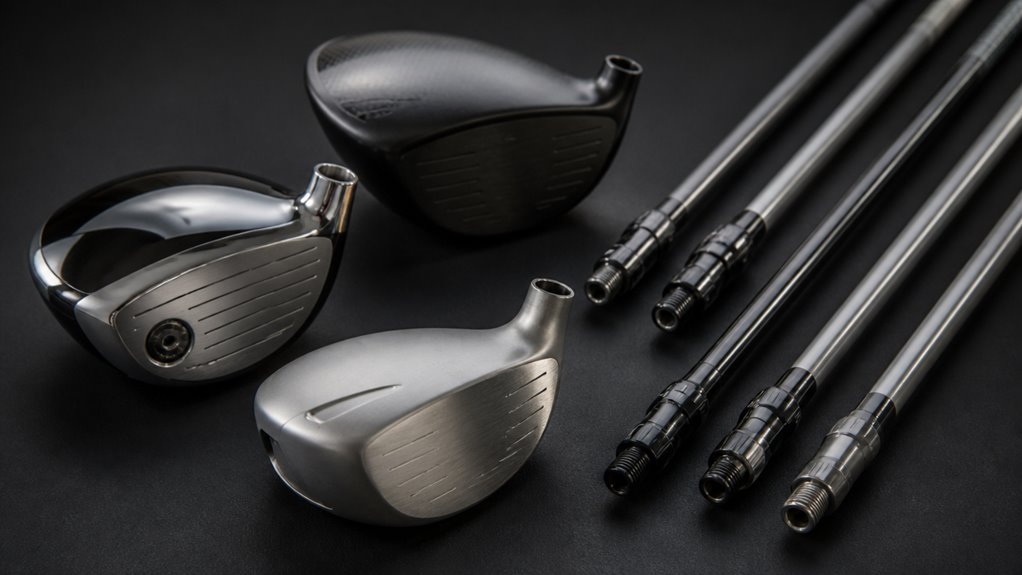
You can’t just fit any driver shaft to every head because shaft tips usually share a standard .335-inch diameter but differ in dimensions, locking mechanisms, and adapter requirements.
Each manufacturer uses proprietary adapters tailored to their specific hosels, preventing direct swaps without proper matching.
Universal adapters like ALL-FIT offer solutions, but precision installation remains critical to maintain performance and structural integrity.
Understanding brand-specific systems and adapter compatibility is key to optimizing your setup and shaft-head pairing.
- Key Takeaways
- Understanding Driver Shaft and Head Connections via Adapters
- Why Driver Shafts Aren’t Universally Compatible Without Adapters
- Brand-Specific Adapter Systems and Their Impact on Shaft Swapping
- Universal Adapters Like ALL-FIT That Simplify Shaft Swaps
- How Shaft Tip Sizes Affect Driver Head Fit
- How Driver Shafts Influence Performance and Swing Characteristics
- Why Professional Installation Matters for Adapter Swaps
- Model-Specific Driver Shaft and Adapter Compatibility Explained
- Choosing the Right Driver Shaft and Adapter for Your Setup
- Frequently Asked Questions
- Final Answer: Do All Driver Shafts Fit All Heads?
Key Takeaways
- Most driver shafts share a standard .335-inch tip diameter but do not universally fit all driver heads without proper adapters.
- Proprietary adapters are required to match unique hosel designs and locking mechanisms of different manufacturers and models.
- Cross-brand shaft-to-head compatibility typically requires removing and replacing brand-specific adapters to ensure secure fit and performance.
- Universal adapters like ALL-FIT enable broader compatibility but still need precise installation and curing for reliable attachment.
- Incorrect or missing adapters cause improper seating, affecting swing mechanics, shot accuracy, and club stability during play.
Understanding Driver Shaft and Head Connections via Adapters
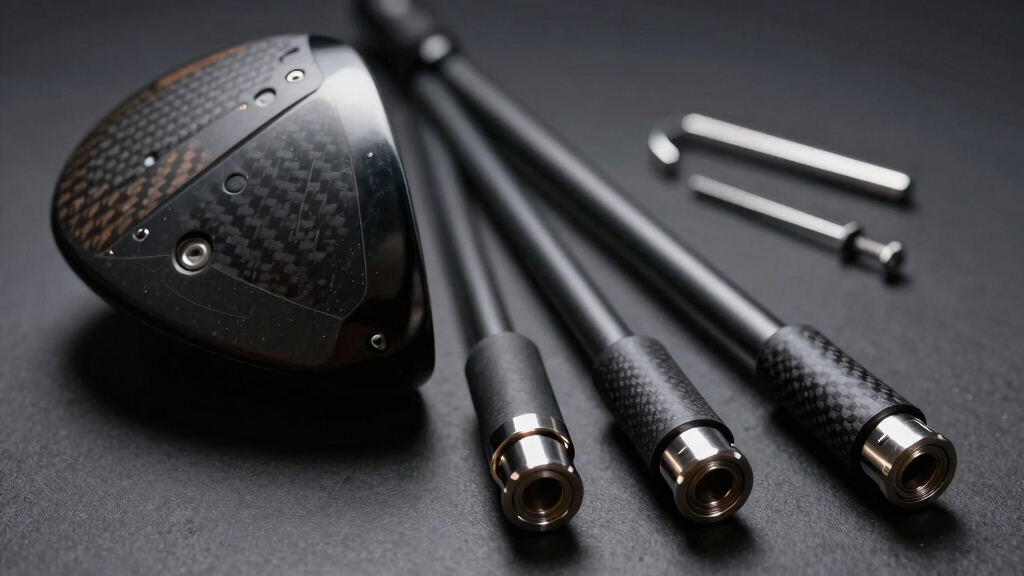
When you connect a driver shaft to a driver head, the key element you need to understand is the role of adapters. Adapters serve as the precise interface enabling compatibility between components.
They bridge the physical and mechanical differences between shaft tips and hosels, allowing shafts to fit heads across brands. Although shafts themselves are largely universal, each manufacturer designs unique adapters to match their specific head geometries.
Using the correct adapter guarantees secure attachment and preserves club performance characteristics. Universal adapters like ALL-FIT facilitate cross-brand compatibility by accommodating variations in shaft tip design.
Without the appropriate adapter, direct installation is impossible due to differing dimensions, locking mechanisms, and fit tolerances. Recognizing the critical function of adapters is essential for successful shaft-head integration and ideal club function.
Proper preparation of the shaft tip, including measuring hosel depth and masking the insertion line, is crucial to ensure a smooth, secure fit with the adapter and clubhead, preventing damage during assembly and preserving performance. hosel depth measurement
Why Driver Shafts Aren’t Universally Compatible Without Adapters
Although driver shafts share a standard tip diameter of .335 inches, they won’t fit every driver head without the correct adapter. Each manufacturer employs proprietary connection systems tailored to their hosel designs. You must use brand-specific adapters to guarantee a secure fit and preserve performance characteristics.
Without them, shafts from one brand won’t physically or mechanically engage with heads from another.
| Brand | Adapter Type |
|---|---|
| Callaway | OptiFit |
| TaylorMade | Inverted Cone |
| Titleist | SureFit |
| Ping | G2 |
| Cobra | E9 |
Adapters accommodate subtle differences in hosel geometry and locking mechanisms, making universal compatibility impossible without these intermediary components. Proper adapter fitment also ensures adjustable hosel settings remain functional without limiting loft and lie adjustability.
Brand-Specific Adapter Systems and Their Impact on Shaft Swapping
Understanding the proprietary adapter systems each brand uses reveals why shaft swapping isn’t straightforward. Each manufacturer designs unique adapters that control how shafts interface with driver heads, preventing direct cross-brand compatibility.
For instance, swapping a TaylorMade shaft onto a Callaway head requires removing and replacing the adapter to ensure proper fit and performance. Furthermore, adapter compatibility varies within brand model lines; older TaylorMade drivers demand different adapters than newer releases, while Titleist’s SureFit system spans multiple models.
These adapters differ in physical dimensions and locking mechanisms, impacting installation and clubhead performance. Without the correct brand-specific adapter, the shaft tip won’t mate securely, risking damage or suboptimal playability.
Therefore, understanding and sourcing the precise adapter is essential before attempting any shaft swap across brands or even different models within the same brand. Properly securing the driver head with the correct adapter is crucial to prevent wobble and ensure a safe, stable connection during play.
Universal Adapters Like ALL-FIT That Simplify Shaft Swaps
You can really simplify shaft swaps with universal adapters like ALL-FIT. They take away those pesky brand-specific restrictions that can be such a hassle.
So, how does ALL-FIT work? It provides a standardized connection point. This means it fits a wide range of driver heads and shafts, no matter the manufacturer. Pretty cool, right?
This flexibility not only cuts down on the need for multiple proprietary adapters but also makes the installation process a breeze. Who doesn’t love a little extra convenience?
Many premium shafts come with adapter pre-installed options to make this process even smoother and ensure perfect compatibility with drivers like the TSR2.
Benefits of Universal Adapters
Several universal adapters, such as ALL-FIT, streamline the process of swapping driver shafts by enabling seamless compatibility across multiple brands and models.
This eliminates the need to source brand-specific adapters for each head-shaft combination, reducing complexity.
By using a universal adapter, you gain:
- Cross-brand interchangeability without removing or replacing adapters.
- Simplified inventory management when testing multiple shafts.
- Reduced installation errors by standardizing the adapter interface.
- Cost efficiency by minimizing adapter purchases and installation fees.
These benefits allow you to optimize shaft and head combinations analytically.
This ensures you focus on performance characteristics rather than fit issues.
Universal adapters therefore provide a precise, reliable solution for shaft swaps, enhancing flexibility and consistency in equipment customization.
Proper installation and curing of epoxy are essential to ensure a durable and reliable bond when using universal adapters during shaft swaps, as outlined in the epoxy curing process.
How ALL-FIT Works
When you fit an ALL-FIT adapter, it locks onto the shaft and driver head interface, creating a standardized connection that bypasses brand-specific constraints.
This adapter replaces the proprietary fittings, enabling you to interchange shafts and heads across different manufacturers seamlessly.
ALL-FIT’s design accommodates the common .335-inch shaft tip diameter, ensuring physical compatibility with most modern drivers.
By standardizing the interface, it eliminates the need to source brand-specific adapters when swapping shafts, reducing complexity and cost.
However, precise installation is critical; the adapter must be securely mounted to maintain shaft alignment and optimize performance.
ALL-FIT effectively decouples shaft and head compatibility, giving you the flexibility to experiment with various combinations without being limited by proprietary adapter systems.
To ensure optimal club performance after installation, golfers can use swing weight measurement tools like the SHUJUKU scale to verify balance and feel.
How Shaft Tip Sizes Affect Driver Head Fit
When you’re thinking about how to fit a driver head, the shaft tip size is something you really can’t overlook. Most modern drivers have a standard shaft tip diameter of about .335 inches. But here’s the catch: different brands and models can have variations in their adapter sizes. This means that even though the standard tip size is .335 inches, it doesn’t always guarantee a perfect fit. Additionally, selecting the right shaft length based on your height and wrist-to-floor measurements is crucial for optimizing performance and control.
Standard Tip Diameter
A golf shaft’s tip diameter plays a critical role in ensuring a secure and proper fit with a driver head.
Most modern driver shafts feature a standard tip diameter of .335 inches, designed to fit snugly into corresponding hosels.
This dimension is vital because:
- It aligns with the majority of current driver heads, providing stability and consistent performance.
- Deviations in tip diameter can cause improper seating, affecting swing mechanics and shot accuracy.
- Older or brand-specific adapters may require different tip sizes, limiting direct shaft-to-head compatibility.
- Consistent tip diameter simplifies shaft replacement but still necessitates adapter compatibility verification.
Understanding these technical standards helps you select shafts that physically fit your driver head.
This maintains structural integrity and optimizes performance.
Additionally, considering adapter compatibility is essential when matching shafts to driver heads to ensure optimal fit and function.
Adapter Size Variations
While the standard shaft tip diameter of .335 inches fits most modern driver heads, variations in adapter size can markedly impact compatibility. Each manufacturer designs proprietary adapters, causing differences in shaft-to-head fit despite uniform tip diameters.
For example, Callaway and Titleist shafts require brand-specific adapters; you can’t simply interchange them without swapping adapters. Even within a single brand, adapter sizes evolve. Older TaylorMade drivers use different adapters than current models.
Additionally, you’ll find that adapter dimensions vary between drivers, fairways, and hybrids, affecting direct shaft fitment. To guarantee proper installation and maintain performance characteristics, you must verify the exact adapter size and model compatibility.
Relying solely on the .335-inch tip standard overlooks the critical role adapters play in seamless shaft and driver head integration.
Shafts like the PROJECTX Denali TX come with TaylorMade-style adapters pre-installed to ensure compatibility with specific driver heads.
How Driver Shafts Influence Performance and Swing Characteristics
Understanding how driver shafts influence performance requires analyzing the dynamic interaction between the shaft’s physical properties and the clubhead’s mechanics during the swing.
Shaft characteristics directly affect energy transfer, timing, and ball launch conditions. Consider these factors:
- Flex and Torque: They govern shaft bending and twisting, impacting accuracy and feel.
- Weight Distribution: Influences swing tempo and clubhead speed; heavier tips can delay release.
- Kick Point: Alters launch angle; a higher kick point typically lowers trajectory.
- Shaft Stiffness: Must match your swing tempo; too stiff or too soft disrupts energy transfer.
Additionally, the low kick point shaft design is engineered to increase launch angle and carry distance by locating the bend closer to the clubhead.
Why Professional Installation Matters for Adapter Swaps
Because adapter swaps require precise alignment and secure fitting, you shouldn’t attempt the installation yourself unless you have specialized tools and expertise.
Improper installation risks damaging the shaft tip, adapter, or clubhead hosel, compromising structural integrity and performance.
Professionals use calibrated torque settings and alignment jigs to guarantee the adapter seats correctly, preserving the intended flex and launch characteristics.
They also verify compatibility between shaft, adapter, and head dimensions to prevent fitment issues that could affect swing mechanics.
Additionally, professionals handle epoxy application or retainers with precision to avoid loosening during play.
Model-Specific Driver Shaft and Adapter Compatibility Explained
When selecting a driver shaft, you need to account for the specific adapter system each model employs. Compatibility varies even within the same brand.
For example, TaylorMade’s SIM and SIM 2 shafts fit differently than older models like R-15 or M5. Titleist’s SureFit adapters unify compatibility across their 910 to TSi series. However, other brands may require distinct adapters per model series.
To clarify:
- Not all shafts within one brand fit every model; adapter design changes over time.
- Shaft tip dimensions are generally standard (.335 inches), yet adapter shape and fit differ.
- Some shafts require adapter swaps even within the same manufacturer.
- Model-specific incompatibilities necessitate verification before installation.
Understanding these nuances guarantees proper fit and peak performance.
Choosing the Right Driver Shaft and Adapter for Your Setup
Although driver shafts may appear interchangeable, selecting the right shaft and adapter requires careful consideration of your clubhead model, swing characteristics, and manufacturer-specific adapter systems.
You must confirm adapter compatibility since each brand uses proprietary systems. Some models even differ within the same brand. Additionally, matching shaft flex, weight, and torque to your swing optimizes performance beyond mere physical fit.
| Factor | Consideration |
|---|---|
| Adapter Type | Match brand and model-specific adapter system |
| Shaft Specifications | Weight, flex, torque tailored to swing dynamics |
| Installation | Professional fitting recommended for precision |
Ensuring these align prevents performance loss and mechanical incompatibility. This enables optimized ball flight and control in your setup.
Frequently Asked Questions
Can I Use the Same Shaft for Fairway Woods and Hybrids?
You generally can’t use the same shaft for fairway woods and hybrids without adjustments.
Although shaft tip diameters are often similar, fairway woods and hybrids usually require different adapters due to unique hosel designs.
Even within the same brand, adapters differ between club types.
For peak performance and fit, you’ll need the correct adapter for each club or a shaft specifically designed with compatible tip specifications for both woods and hybrids.
How Do Shaft Weight Differences Affect Swing Speed?
You can increase your swing speed by about 1 mph for every gram you reduce in shaft weight.
Lighter shafts require less effort to accelerate, allowing you to swing faster and generate more clubhead speed.
However, you must balance this with control and feel, as an overly light shaft can reduce stability and accuracy.
Matching shaft weight carefully to your swing mechanics optimizes both speed and performance.
Are Graphite Shafts Better Than Steel for Drivers?
Graphite shafts generally outperform steel for drivers because they’re lighter, allowing you to generate higher swing speeds and greater distance.
They also absorb more vibration, reducing fatigue and enhancing feel. However, steel shafts offer more control and consistency, favored by players prioritizing accuracy.
Ultimately, your choice depends on your swing characteristics and performance goals. Lighter graphite aids speed and comfort, while steel provides precision and shot-shaping ability.
What Maintenance Is Required for Driver Shafts and Adapters?
You should regularly inspect your driver shaft and adapter for cracks, corrosion, or loose fittings to maintain peak performance.
Clean both components with a damp cloth, avoiding harsh chemicals that can degrade materials.
Make certain the adapter remains securely attached; if you notice looseness, have a professional tighten or replace it.
Avoid DIY adjustments, as improper handling can damage the connection and affect swing dynamics.
Routine checks extend lifespan and preserve club integrity.
Can Shaft Flex Impact Accuracy and Distance?
When it comes to your swing, the shaft flex can make or break your game. A shaft that’s too stiff or too flexible throws off timing, reducing accuracy and distance.
It affects how energy transfers to the ball, influencing launch angle and spin rate. Matching flex to your swing speed and tempo guarantees peak performance.
Precision here isn’t just important; it’s the name of the game for consistent, powerful shots.
Final Answer: Do All Driver Shafts Fit All Heads?
Think of your driver setup as a finely tuned engine, where each shaft and head must align like perfectly meshed gears. Without the right adapter, your key to compatibility, this mechanism won’t perform at peak precision.
Shaft tip size and brand-specific fittings act like unique puzzle pieces. Forcing mismatches can disrupt your swing’s harmony. Choosing the correct combination and professional installation sharpens your performance, ensuring every swing strikes with engineered accuracy and consistency.