
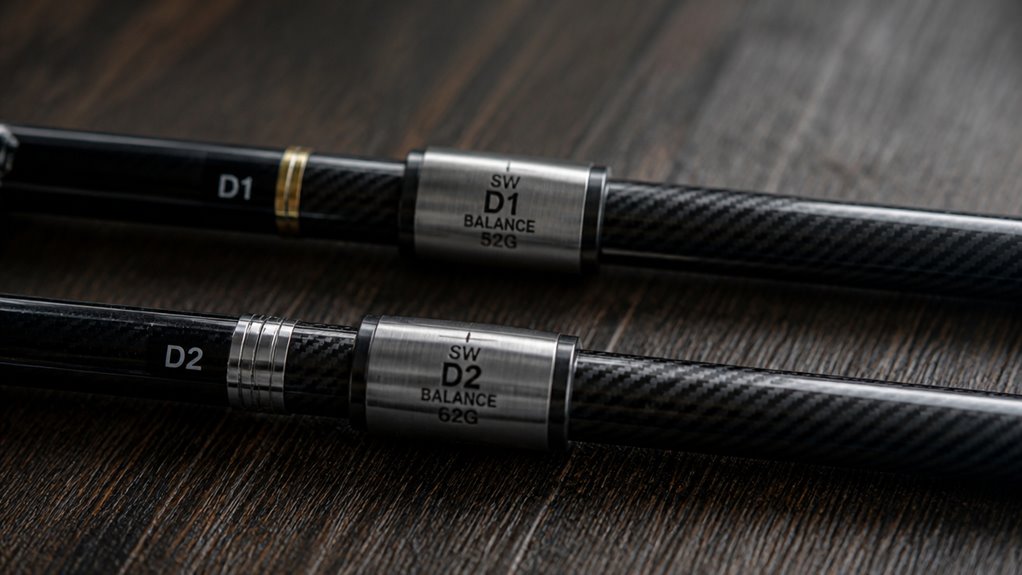
When comparing D1 and D2 swing weights, you’re dealing with a precise 1.75 inch-ounce difference that shifts club balance slightly toward the head at D2.
This change enhances tempo control and impact feedback, while D1 offers a lighter, quicker swing feel. Your shaft, grip, and length also affect this balance point.
Typically, D2 suits stronger, faster swings, whereas D1 favors smoother tempos.
Understanding these nuances helps optimize your club’s performance and feel for your game.
- Key Takeaways
- D1 vs D2 Swing Weight: Key Differences in Club Balance, Feel, and Performance
- Swing Weight Basics: Comparing D1 and D2
- How Shaft, Grip, and Club Length Influence Swing Weight?
- Why D2 Swing Weight Is the Standard Target in Men’s Club Fitting?
- Effect of a One-Point Swing Weight Difference on Feel and Control
- Choosing D1 or D2 Based on Swing Tempo and Strength
- Frequently Asked Questions
- D1 vs D2 Swing Weight: Final Verdict
Key Takeaways
- D2 swing weight is about 1.75 inch-ounces heavier than D1, shifting balance slightly toward the clubhead.
- D1 offers a lighter, easier swing feel promoting faster clubhead acceleration and tempo.
- D2 provides a firmer, more connected feel with better feedback and stability through impact.
- Faster, stronger swings typically benefit from D2; smoother, less forceful swings favor D1.
- Small changes in shaft, grip, or length can shift swing weight, affecting the choice between D1 and D2.
D1 vs D2 Swing Weight: Key Differences in Club Balance, Feel, and Performance
| Comparison Factors | D1 Swing Weight | D2 Swing Weight |
|---|---|---|
| Swing Weight Classification | D1 on the standard swing weight scale | D2, one point above D1 |
| Balance Measurement | Slightly lower swing weight reading | Slightly higher swing weight reading |
| Swing Weight Difference | One point below D2 | One point above D1 |
| Moment Difference | Approximately 1.75 oz-in less than D2 | Approximately 1.75 oz-in more than D1 |
| Perceived Clubhead Weight | May feel slightly lighter | May feel slightly more head-heavy |
| Swing Feel | Potentially quicker or less head-dominant | Potentially more noticeable clubhead presence |
| Swing Tempo | May suit golfers preferring a lighter balance | May suit golfers preferring greater head awareness |
| Clubhead Feedback | Slightly less pronounced head sensation | Slightly more pronounced head sensation |
| Control Characteristics | Depends on golfer and club configuration | Depends on golfer and club configuration |
| Swing Speed Impact | No guaranteed increase in speed | No guaranteed decrease in speed |
| Shot Consistency | May suit individual timing preferences | May suit individual timing preferences |
| Common Club Applications | Irons, drivers, and other fitted clubs | Irons, drivers, and other fitted clubs |
| Club Fitting Considerations | Shaft, grip, length, and head mass | Shaft, grip, length, and head mass |
| Adjustment Method | Can be achieved through suitable balance changes | Can be achieved through suitable balance changes |
| Total Club Weight | Not determined by the D1 designation | Not necessarily heavier overall than D1 |
| Best Suited For | Golfers who prefer a slightly lighter head feel | Golfers who prefer a slightly stronger head feel |
| Overall Recommendation | Choose based on tested feel and performance | Choose based on tested feel and performance |
Swing Weight Basics: Comparing D1 and D2
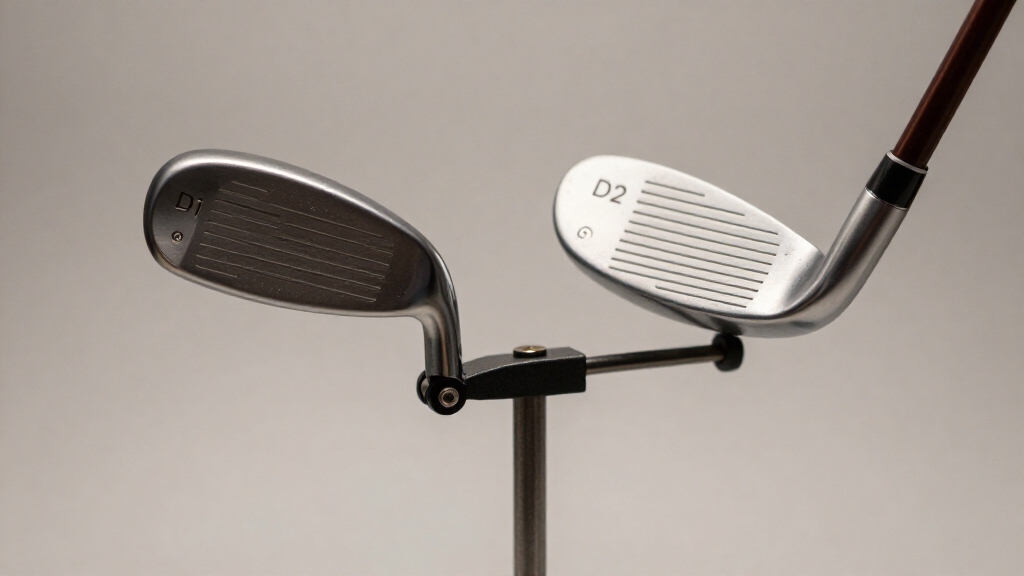
Although the difference between D1 and D2 swing weights is subtle, understanding their specifics is crucial for optimizing club performance.
Swing weight measures the balance of a golf club based on a 14-inch fulcrum from the grip end, not the total weight. The scale ranges from A0 to G9, with D1 and D2 adjacent points representing a 1.75 inch-ounce increase from approximately 215.25 to 217.00 inch-ounces.
This increment shifts the balance slightly toward the clubhead, affecting feel and tempo control. D1 offers a lighter, easier swing feel, while D2 provides a firmer, more connected head sensation.
Recognizing this precise numerical and experiential difference helps you select the appropriate swing weight tailored to your swing dynamics and shot consistency.
Because small changes in weight or balance point can shift swing weight by over one point, precise measurement and calibration are essential to maintain consistent swing weight accuracy.
How Shaft, Grip, and Club Length Influence Swing Weight?
Because swing weight depends on the club’s balance point relative to a 14-inch fulcrum from the grip end, changes in shaft weight, grip mass, and club length directly alter that balance measurement.
Adding a heavier shaft shifts the balance point slightly toward the grip, reducing swing weight. A lighter shaft moves it toward the head, increasing swing weight. Grip mass functions similarly; heavier grips move the balance point closer to the grip end, lowering swing weight.
Club length amplifies these effects: lengthening the club increases the moment arm beyond the 14-inch fulcrum, raising swing weight.
Conversely, shortening reduces it.
Consequently, even subtle adjustments in shaft, grip, or length can shift swing weight by fractions of a point, affecting the feel and performance between D1 and D2 swing weights.
For precise tuning, using a balance point detection method combined with measuring tools ensures accurate swing weight calculations.
Why D2 Swing Weight Is the Standard Target in Men’s Club Fitting?
When you aim for a balance that suits the average male golfer’s strength and swing tempo, D2 swing weight often emerges as the ideal target in club fitting.
This is because D2 provides a slightly increased head-heaviness, about 1.75 inch-ounces more than D1, striking a balance between control and feel.
You’ll find most men’s irons and many stock clubs built around D2, making it a consistent baseline for fitting.
It offers a firmer connection to the clubhead, aiding players who generate moderate to fast swing speeds without sacrificing tempo.
Additionally, D2 accommodates the typical shaft, grip, and length combinations used in men’s clubs, ensuring predictable performance.
Ultimately, it’s this balance of measurable swing weight and practical playability that establishes D2 as the standard fitting target.
Adjusting to D2 swing weight helps optimize club feel and control for consistent shot performance.
Effect of a One-Point Swing Weight Difference on Feel and Control
Understanding the impact of a one-point swing weight difference, such as moving from D1 to D2, is essential for fine-tuning your club’s feel and control. The shift of about 1.75 inch-ounces moves balance slightly toward the clubhead, increasing perceived head weight. This subtle change affects tempo, feedback, and stability during your swing.
| Swing Weight | Feel | Control Impact |
|---|---|---|
| D1 | Lighter, easier | Faster swing speed, less feedback |
| D1 to D2 | Noticeably heavier | Improved tempo control, enhanced connection |
| D2 | Firmer, solid | Better feedback, more stable through impact |
Selecting between D1 and D2 hinges on how this small balance shift influences your swing rhythm and precision, not on drastic weight changes. Proper swing weight selection, combined with matching shaft flex to your swing speed, can further optimize control and shot consistency.
Choosing D1 or D2 Based on Swing Tempo and Strength
The subtle increase in head heaviness from D1 to D2 influences how your swing tempo and strength interact with the club’s balance.
If you have a faster, more aggressive tempo and greater strength, you’ll likely benefit from the D2’s slightly higher swing weight. This provides increased clubhead awareness and helps regulate your shift.
Faster swings and greater strength gain from D2’s higher swing weight for better control and balance.
Conversely, if your swing tempo is smoother and less forceful, the lighter D1 can facilitate quicker clubhead acceleration and reduce fatigue.
Because the 1.75 inch-ounce difference subtly shifts the balance point, your ability to control the club through impact depends on matching swing weight with your physical input.
Ultimately, choosing between D1 and D2 requires analyzing how your tempo and strength influence club loading, release timing, and consistent strike location.
Properly matching swing weight helps prevent shaft overloading and improves shot consistency, especially for aggressive swingers.
Frequently Asked Questions
How Does Swing Weight Affect Putting Performance?
Swing weight affects your putting performance by influencing the club’s balance and feel during the stroke.
A heavier swing weight can provide more stability and control, helping you maintain a consistent tempo and smooth stroke.
Conversely, a lighter swing weight may feel easier to accelerate but can reduce feedback and precision.
You’ll want to match swing weight to your stroke style, ensuring the putter loads and releases effectively for better distance control and accuracy.
Can Changing Swing Weight Reduce Injury Risk?
Think of your golf club like a lever in a machine; adjusting its balance changes the stress on your muscles and joints.
Yes, changing swing weight can reduce injury risk by optimizing load distribution during your swing.
For example, a slight decrease in swing weight lessens torque on your wrists and elbows, lowering strain.
Tailoring swing weight to your strength and tempo secures smoother mechanics, preventing overuse injuries effectively.
Does Swing Weight Impact Ball Spin Rates?
Yes, swing weight can impact ball spin rates indirectly.
When you adjust swing weight, you alter the club’s balance and feel. This affects your swing tempo and release timing.
These changes influence how you strike the ball, potentially modifying clubface angle and loft at impact.
Consequently, your spin rates might increase or decrease. However, swing weight itself doesn’t directly change spin; it’s your resulting swing mechanics that do.
How Do Women’s Clubs Typically Differ in Swing Weight?
Think of women’s clubs as finely tuned instruments designed for lighter hands.
Typically, they’ve lower swing weights than men’s clubs, often ranging from B7 to C9. This provides a more manageable balance.
This lighter swing weight helps you generate smoother tempo and better control without extra effort.
The difference arises from shorter club lengths, lighter shafts, and grips. These factors shift the balance point closer to the grip end for enhanced ease of swing.
Is Swing Weight Adjustment Possible for Used Clubs?
Yes, you can adjust swing weight on used clubs by altering head, shaft, or grip weight.
Adding lead tape to the clubhead increases swing weight, while lighter grips or shorter shafts reduce it.
Be precise: small changes affect balance more than total weight. Measure swing weight after modifications to guarantee desired feel.
Keep in mind that adjustments influence tempo and control, so tailor them to your swing dynamics for peak performance.
D1 vs D2 Swing Weight: Final Verdict
When deciding between D1 and D2 swing weights, you’re basically fine-tuning your golf club’s balance to match your tempo and strength.
A single point difference might seem small, but it can shift your control and feel like a subtle gear change in your swing mechanics.
By understanding how shaft, grip, and length influence swing weight, you can precisely tailor your club for peak performance.
This ensures every shot feels both powerful and controlled.