
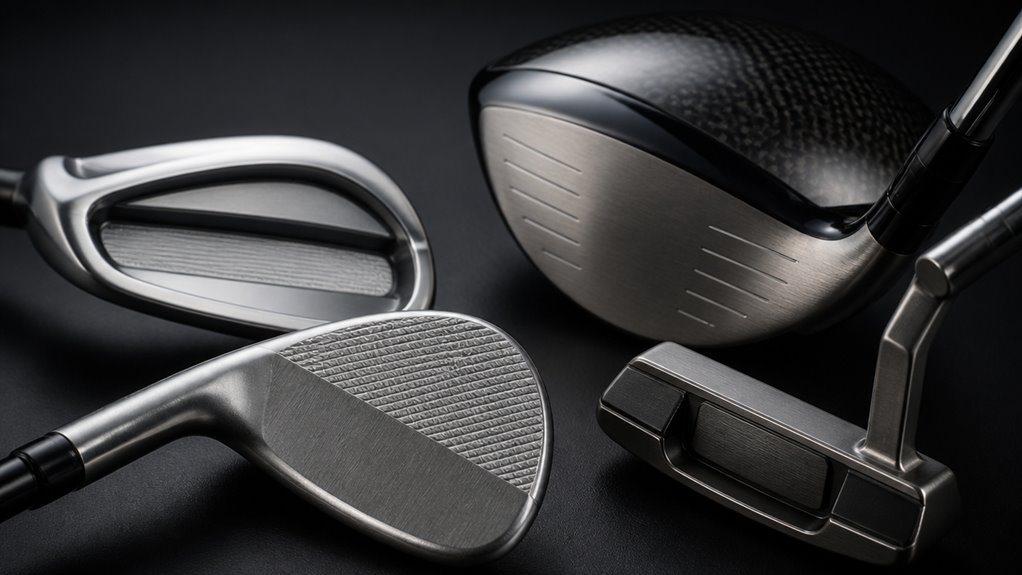
You’ll find golf club heads made from carefully chosen metals and composites tailored for performance.
Irons and putters mainly use stainless steel alloys like 431 for durability and precise control.
High-end drivers often feature lightweight titanium alloys to maximize strength-to-weight and forgiveness.
Beginners may prefer zinc or aluminum for affordability and ease of use, sacrificing some durability.
Advanced clubs employ carbon fiber and multi-material designs to enhance weight distribution, energy transfer, and stability.
Exploring these materials reveals how engineering elevates your game.
- Key Takeaways
- How Golf Club Head Materials Have Changed Over the Years?
- Why Titanium Is Perfect for High-End Golf Club Drivers?
- When and Why Beginners Use Lightweight Metals Like Zinc and Aluminum?
- How Different Materials Compare for Golf Club Performance and Cost?
- Choose Club Head Materials That Match Your Game
Key Takeaways
- Golf club heads are made from materials like hardwood, stainless steel, titanium, and advanced composites depending on the club type and performance needs.
- Early clubs used hardwoods such as persimmon, while modern drivers utilize lightweight titanium alloys for larger, stronger heads.
- Stainless steel, especially 431 and 17-4 alloys, is common in irons and putters for durability, control, and ease of customization.
- Beginner clubs often use cost-effective materials like zinc and aluminum, offering lightweight, forgiving heads but lower durability and performance.
- Premium drivers incorporate multi-material designs with carbon fiber and titanium to optimize weight distribution, increase forgiveness, and maximize distance.
How Golf Club Head Materials Have Changed Over the Years?
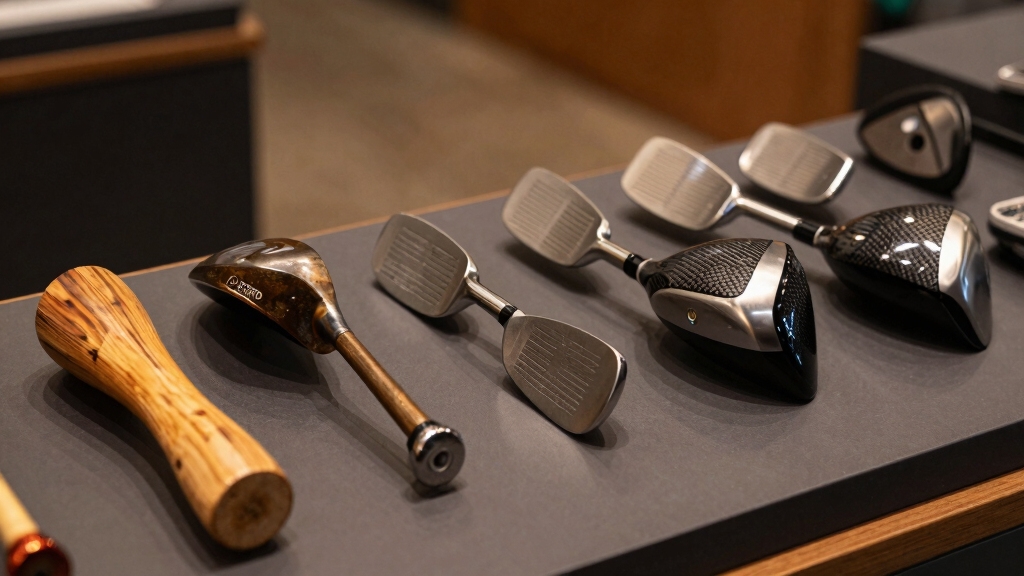
Although golf club heads began as simple wooden constructions carved from apple, pear, and hickory, they’ve undergone significant material transformations to enhance performance and durability.
Golf club heads evolved from simple wooden carvings to advanced materials for better performance and durability.
Initially, hardwoods like persimmon dominated due to their density and workability.
The 1980s marked a turning point with zinc and aluminum alloys introducing the metal age, providing greater consistency and strength.
The early 1990s saw titanium’s aerospace-inspired adoption, offering a superior strength-to-weight ratio. This enabled larger club heads with optimized weight distribution.
Today, modern drivers incorporate carbon fiber composites, reducing weight while enhancing forgiveness and distance.
More recently, irons have incorporated advanced materials like forged carbon steel bodies fused with stainless steel face cups to optimize distance and precision.
This evolutionary trajectory reflects a continuous shift from organic to engineered materials, balancing weight, strength, and durability to meet the precise demands of golfers seeking improved control and performance on the course.
Why Stainless Steel Dominates Golf Club Heads for Irons and Putters?
You know why stainless steel is the go-to choice for irons and putters? It’s all about its impressive strength and resistance to corrosion. This means you can count on it to hold up, even after countless swings.
Take alloys like 431 stainless steel, for example. They strike the perfect balance between being hard enough to withstand impact while still being flexible enough for precise shots. That’s a game-changer when you’re aiming for accuracy.
Plus, let’s not forget about the weight of stainless steel. It really helps with control and feel during your swing. You can actually notice the difference in your shot execution, giving you that extra edge on the course.
Many irons, such as the Cleveland TA5, utilize stainless steel in combination with design features like perimeter weighting to enhance forgiveness and stability during impact.
Strength and Durability Benefits
Stainless steel offers a compelling combination of strength, durability, and corrosion resistance that makes it the preferred choice for golf club heads in irons and putters.
When you handle a stainless steel club, you benefit from its high tensile strength, which resists deformation under repeated impact, maintaining consistent performance.
Its resilience against rust and corrosion guarantees longevity, even in varied weather conditions.
You’ll also notice its toughness accommodates precise manufacturing tolerances, allowing better control over weight distribution and shot accuracy.
Compared to softer metals, stainless steel’s durability reduces wear and surface damage over time, preserving club integrity.
This balance of mechanical properties, cost-effectiveness, and ease of maintenance explains why stainless steel remains dominant for irons and putters in golf.
Additionally, stainless steel’s ability to bend more easily than softer forged steels makes it preferable for custom fitting and adjustments, enhancing club versatility through lie and loft modifications.
Preferred Alloys for Irons
Many golfers prefer irons crafted from specific stainless steel alloys due to their ideal balance of mechanical properties and workability.
Stainless steel, especially types 17-4 and 431, dominates because it offers superior strength, corrosion resistance, and a consistent feel.
Type 431 is favored for irons due to its softer bending characteristics, allowing precise shaping without compromising durability.
Carbon steel also appears in premium irons, prized for its soft feel and toughness.
The following table summarizes key alloy features:
| Alloy Type | Key Attributes |
|---|---|
| 17-4 SS | High strength, corrosion resistant |
| 431 SS | Softer, easier to shape |
| Carbon Steel | Soft feel, durable |
| Zinc | Budget-friendly, less durable |
| Aluminum | Lightweight, less common |
This technical approach makes certain irons meet performance and manufacturing demands efficiently. Many top Japanese irons incorporate advanced materials like Maraging steel to enhance ball speed and durability without adding weight.
Weight and Control Advantages
Achieving ideal weight distribution is crucial for iron and putter performance, and this is where stainless steel excels. Its relatively high density allows you to benefit from precise mass positioning, enhancing control and shot consistency.
Stainless steel’s strength and durability let manufacturers design club heads that optimize balance without sacrificing resilience. Consider these key advantages:
- Higher mass concentration in the club head provides better inertia control.
- Enhanced weight distribution improves shot accuracy and feel.
- The material’s rigidity supports consistent energy transfer on impact.
- Rust resistance guarantees long-term structural integrity and performance.
Regularly protecting shafts with car wax and avoiding scratches helps maintain the structural integrity of stainless steel clubs over time.
Why Titanium Is Perfect for High-End Golf Club Drivers?
Titanium revolutionizes high-end golf club drivers by combining exceptional strength with remarkably low weight. This allows you to maximize club head size without sacrificing control.
You benefit from a large 460 cm³ head volume, which increases the moment of inertia (M.O.I.) and enlarges the sweet spot for consistent strikes. The 6/4 titanium alloy’s composition—90% titanium, 6% aluminum, 4% vanadium—offers peak strength-to-weight ratio. This enables perimeter weighting and improved launch angles.
| Property | Specification | Benefit |
|---|---|---|
| Alloy Composition | Ti-6Al-4V (90/6/4) | High strength, low weight |
| Head Volume | Up to 460 cm³ | Larger sweet spot |
| M.O.I. | Elevated | Greater forgiveness |
| Launch Angle | Optimized | Enhanced distance |
Titanium’s performance edge makes it the preferred choice for premium drivers. Adjustments in swing weight due to changes in club head mass or shaft length can significantly affect your control and swing tempo, making swing weight an essential factor to consider in driver customization.
When and Why Beginners Use Lightweight Metals Like Zinc and Aluminum?
While titanium dominates high-end drivers for its strength-to-weight advantages, beginners often benefit more from materials like zinc and aluminum in their first clubs.
These lightweight metals provide practical benefits tailored to novice needs:
- Cost Efficiency: Zinc’s affordability lowers entry barriers for new golfers by reducing equipment expense.
- Weight Management: Aluminum’s lightness aids in swing control, helping you develop proper mechanics without fatigue.
- Forgiveness: Larger hosel diameters in zinc heads increase stability, mitigating mishits during skill acquisition.
- Durability Trade-Off: Although less durable than steel or titanium, these metals suffice for occasional play and gradual improvement.
Choosing zinc or aluminum allows you to focus on technique and consistency. This prioritizes accessibility and ease over advanced performance features. Proper maintenance, such as safe removal of worn shafts, ensures these beginner clubs remain reliable as skills develop.
How Different Materials Compare for Golf Club Performance and Cost?
Because golf club materials directly influence performance characteristics and cost, understanding their comparative advantages helps you make informed equipment choices.
Choosing golf club materials wisely impacts both your game performance and investment value.
Stainless steel, especially 431 alloy, balances durability and affordability. It offers weight that enhances control, making it ideal for irons and putters.
Titanium alloys, particularly 6/4 Ti, deliver lightweight strength. This enables larger driver heads with higher moment of inertia, boosting distance and forgiveness, but at a premium price.
Zinc and aluminum provide economical, lightweight options for beginners. However, they sacrifice durability and advanced performance features.
Advanced composites like carbon fiber reduce weight further. This allows strategic mass distribution to optimize launch conditions, though they come at a higher cost and are mostly used in premium drivers.
Selecting your club head material requires weighing durability, weight, cost, and performance. This helps you match your skill level and playing style effectively.
How Multi-Material Construction Enhances Golf Club Head Performance?
You know, multi-material construction really takes golf club head performance to the next level. By mixing different materials, like titanium and carbon fiber, manufacturers can tap into the unique strengths of each. This combination helps with weight distribution, which is crucial for improving things like moment of inertia and launch characteristics. Using materials such as ultra-high modulus carbon fiber enhances clubhead moment of inertia, leading to greater stability and accuracy.
Material Synergy Benefits
Releasing the true potential of golf club heads hinges on the strategic integration of multiple materials. Each contributes distinct mechanical properties that enhance overall performance.
When manufacturers combine metals like titanium and stainless steel with composites such as carbon fiber, you experience benefits that single-material heads can’t match. This synergy allows you to:
- Maximize strength-to-weight ratio, improving durability without adding bulk.
- Enhance energy transfer at impact, boosting ball speed and distance.
- Optimize vibration dampening for better feel and reduced hand shock.
- Achieve precise structural reinforcement, increasing forgiveness on off-center hits.
Advanced multi-material constructions, such as those featuring a carbon crown and sole, also enable optimized weight distribution to increase forgiveness and stability.
Weight Distribution Optimization
Although golf club head materials have evolved markedly, the true performance leap comes from how manufacturers strategically distribute weight using multi-material construction.
By combining titanium alloys with carbon fiber composites, you get a lightweight crown paired with a dense metal base, optimizing the center of gravity (CG) for higher launch and increased forgiveness.
You’ll find tungsten inserts in irons and hybrids to precisely shift mass low and deep, enhancing moment of inertia (MOI).
This approach improves stability on off-center hits, allowing more consistent ball speeds.
For drivers, perimeter weighting enabled by multi-material designs expands the sweet spot without compromising overall head size.
When you analyze these innovations, you see that controlled weight placement—not just material choice—fundamentally elevates club performance, enabling you to maximize distance, accuracy, and feel.
Many modern irons also incorporate variable sole thickness and hollow body designs to expand the effective sweet spot and improve forgiveness on off-center strikes.
Frequently Asked Questions
How Does Tungsten Improve Golf Club Performance?
Tungsten improves golf club performance by adding strategic weight in specific areas, increasing the club’s moment of inertia (M.O.I.). This boosts stability and forgiveness on off-center hits, helping you maintain shot accuracy.
Its high density allows precise weight distribution without increasing overall club size, enhancing control and feel. By optimizing balance, tungsten helps you generate better launch conditions and consistency, especially in irons and hybrids where precision is vital for your game.
What Role Does Maraging Steel Play in Golf Clubs?
Maraging steel plays a critical role in golf clubs by providing exceptional strength and durability, especially in faceplates of high-performance woods and hybrids.
You’ll benefit from its high tensile strength, which allows for thinner, more resilient faces, enhancing ball speed and distance.
Its toughness also guarantees consistent performance under impact.
Using maraging steel signifies your club heads can achieve better energy transfer without sacrificing structural integrity.
Are Ceramic Golf Club Heads Available Commercially?
Ceramic golf club heads aren’t widely available commercially yet.
While ceramics offer high hardness and wear resistance, their brittleness limits use in impact-heavy components like club heads.
You’ll find ceramics more as coatings or inserts rather than full heads.
Manufacturers focus on materials like titanium, stainless steel, and composites that balance strength, weight, and durability.
As technology advances, ceramic-based heads may emerge, but currently, they remain experimental rather than mainstream.
How Do Carbon Fiber Crowns Affect Driver Durability?
Carbon fiber crowns enhance driver durability by providing a high-strength, lightweight layer that resists impact and stress without adding bulk.
You’ll find this material improves structural integrity, reducing deformation during swings and impacts. Its stiffness combined with lightness allows manufacturers to redistribute weight strategically, maintaining overall durability while optimizing performance.
However, the composite’s long-term wear depends on manufacturing quality and bonding with metal components. Thus, durability varies across models.
What Manufacturing Advances Enable Multi-Material Golf Club Heads?
You might think combining materials weakens club heads, but advanced bonding and layering techniques actually enhance strength and performance.
Precision manufacturing processes like CNC machining, laser welding, and adhesive bonding let you merge titanium alloys with carbon fiber accurately.
These advances allow weight optimization, durability, and tailored flex in drivers and hybrids.
Multi-material construction now leverages metal base plates with composite crowns, pushing golf club technology beyond traditional single-material limitations.
Choose Club Head Materials That Match Your Game
Choosing the right golf club head material is like selecting the perfect engine for a high-performance car. It directly impacts your game’s efficiency and power.
Stainless steel offers durability and control. Titanium delivers lightweight strength for drivers. Beginner-friendly metals like zinc and aluminum balance ease and cost.
Multi-material designs combine these strengths, maximizing performance. Understanding these materials helps you make a precise, informed choice that matches your skill level and playing style.