
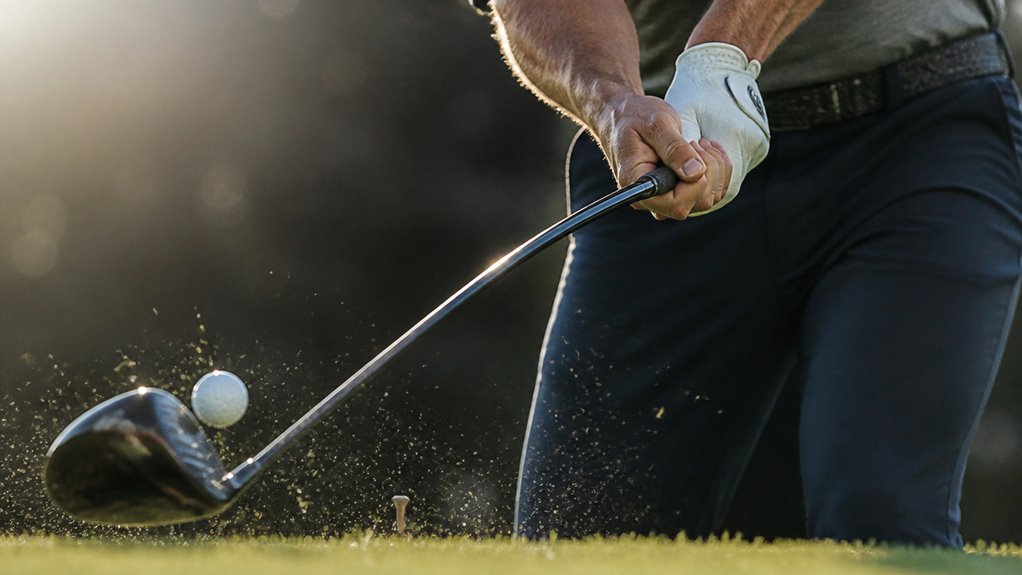
You need an X-stiff shaft if your driver swing speed consistently exceeds 105 mph. This flex provides the rigidity required to control aggressive swings and fast releases.
If your speed is near 100–105 mph but your tempo is quick or you feel shaft whippiness, X-stiff may still suit you. Using 3-wood and iron speeds can confirm this need.
Proper shaft weight and profile also optimize ball flight and consistency. Exploring these factors can enhance your shaft selection strategy.
- Key Takeaways
- What Driver Swing Speeds Mean You Need an X-Stiff Shaft
- Using 3-Wood and Iron Speeds to Confirm X-Stiff Shaft Needs
- How Tempo and Swing Release Affect Your Shaft Flex Choice?
- Matching Shaft Weight and Profile to Your Swing Speed
- When Players Between 100–105 MPH Should Consider X-Stiff Flex?
- Consequences of Using Shafts That Are Too Flexible or Too Stiff
- How Carry Distance Indicates the Need for an X-Stiff Shaft?
- Why Pros and Manufacturers Recommend X-Stiff Shafts Above 105 MPH?
- Testing Shafts: Finding the Right X-Stiff Flex for Your Game
- Improving Ball Flight and Consistency With the Proper Shaft Flex
- Frequently Asked Questions
- Find the Right Shaft Flex for Maximum Distance
Key Takeaways
- X-stiff shafts are recommended for driver swing speeds above 105 mph to provide necessary rigidity and control.
- Players swinging between 100–105 mph with aggressive tempo or fast release may benefit from X-stiff shafts.
- Consistent carry distances beyond 260 yards generally indicate swing speeds over 110 mph, confirming X-stiff shaft suitability.
- Secondary indicators like 3-wood speeds over 101 mph and 6-iron speeds above 92 mph support the need for X-stiff flex.
- Tempo and release patterns can override speed metrics, with quick, aggressive swings requiring stiffer shafts even near 100 mph.
What Driver Swing Speeds Mean You Need an X-Stiff Shaft
When your driver swing speed consistently exceeds 105 mph, you’ll likely need an X-stiff shaft to optimize performance. This threshold is widely accepted in the industry, with manufacturers like Mitsubishi recommending X-stiff flex starting at 105 mph and strongly endorsing it above 110 mph.
For driver speeds over 105 mph, an X-stiff shaft is essential for optimal performance.
Speeds between 100–105 mph may still benefit from X-stiff if you have an aggressive tempo or quick release. Below 105 mph, stiff shafts usually suffice, but players with rapid tempo shifts might find X-stiff advantageous.
X-stiff shafts typically weigh 65–80 grams and feature mid-to-high kick points to produce low spin and launch. Using an X-stiff shaft at or above this speed range reduces shaft whip, tightens dispersion, and enhances shot consistency.
These factors are critical for maximizing distance and control at higher swing velocities. It is important to monitor swing speed closely to maintain swing path stability despite added shaft stiffness and weight.
Using 3-Wood and Iron Speeds to Confirm X-Stiff Shaft Needs
Although driver swing speed remains the primary factor for shaft flex selection, analyzing your 3-wood and iron speeds provides valuable confirmation for whether you need an X-stiff shaft.
If your 3-wood speed exceeds 101 mph, it strongly suggests your swing generates enough force to benefit from an X-stiff flex in your woods.
Similarly, iron speeds offer precise benchmarks: a 3-iron speed over 97 mph or a 6-iron speed above 92 mph aligns with X-stiff shaft requirements.
These metrics serve as secondary indicators, especially if your driver speed hovers near the 100–105 mph borderline.
Cross-referencing these speeds helps validate your shaft choice, ensuring stability and control.
Using this data reduces guesswork and optimizes performance, particularly for aggressive swingers whose clubhead speeds demand a stiffer shaft profile for consistent ball flight.
Professional fitting with launch monitors and certified PING-authorized fitters is recommended to precisely match the flex profile to your swing characteristics.
How Tempo and Swing Release Affect Your Shaft Flex Choice?
Confirming your shaft flex through 3-wood and iron speeds offers a solid foundation, but tempo and swing release materially influence the shaft’s performance and suitability.
If your tempo is quick and aggressive, you may need an X-stiff shaft even at swing speeds near 100 mph to prevent shaft overloading and maintain shot consistency.
Conversely, a smooth, slower tempo at speeds above 105 mph might benefit from a stiff flex to aid launch and feel.
Fast swing releases demand stiffer shafts to reduce whip and minimize dispersion.
Feeling shaft whippiness at impact signals you should move to a stiffer flex and possibly a heavier shaft by 10–15 grams.
Ultimately, tempo and release patterns can override speed metrics in determining the best shaft flex for control and consistency.
Because transition force affects shaft bending more than swing speed alone, matching your shaft to your changeover style is crucial for optimal performance.
Matching Shaft Weight and Profile to Your Swing Speed
Selecting the right shaft weight and profile is crucial to optimizing performance at your specific swing speed. For swing speeds exceeding 100 mph, shafts in the 65–80+ gram range offer the necessary stability to control clubhead movement and reduce dispersion.
Choosing the proper shaft weight and profile is key to stability and improved accuracy at higher swing speeds.
If you hover near 110 mph, lighter X-stiff shafts around 65 grams, like the HZRDUS, help maintain swing tempo without sacrificing stiffness. Heavier mid-70 gram shafts suit players with consistent speeds above 120 mph, providing enhanced control.
Additionally, mid-to-high kick points in X-stiff profiles promote lower launch angles and reduced spin, matching aggressive swing dynamics. Adjusting shaft weight and profile ensures you avoid excessive whippiness or overloading, which can degrade accuracy and distance.
Ultimately, precise matching optimizes ball flight consistency and shot shape at your measured swing speed. Choosing a shaft with the proper torque rating around 3.0 degrees or less further stabilizes the clubhead during fast swings to improve shot accuracy.
When Players Between 100–105 MPH Should Consider X-Stiff Flex?
If your driver swing speed is between 100 and 105 mph, the tempo of your swing really matters when it comes to choosing the right flex. If you have a quick, aggressive swing, you might find that an X-stiff shaft works best for you. This can help you maintain better control and reduce dispersion.
Also, consider the weight of your shaft. Going for something heavier—over 65 grams—can provide the stability you need to handle those forces effectively. By prioritizing both weight and stiffness, you can improve your consistency and avoid overloading the shaft during those rapid shifts in your swing. It’s all about finding that sweet spot for your game!
For added protection and longevity of your equipment, using custom golf bag dividers can help keep your clubs secure and well-organized during transport.
Tempo Impact On Flex
Because tempo markedly influences shaft performance, players swinging between 100 and 105 mph should evaluate their swing characteristics before settling on flex.
If your tempo is quick and aggressive, an X-stiff shaft often provides the necessary stability to prevent shaft overloading, reducing shot dispersion.
Conversely, if your tempo is smooth and controlled, a stiff flex may better optimize launch conditions and energy transfer.
Fast release patterns especially benefit from X-stiff shafts, which help maintain ball flight consistency by minimizing shaft whip at impact.
You should monitor feel and shot outcomes closely. Shaft whippiness or inconsistent ball flight suggests moving up to a stiffer flex or heavier weight in the X-stiff category.
Ultimately, tempo impacts flex selection as much as swing speed, making a professional fitting essential for precise matching.
Proper fitting ensures the right flex, which enhances control, distance, and accuracy, helping golfers unlock their full potential through optimal shaft flex.
Aggressive Swing Benefits
Understanding how an aggressive swing style interacts with shaft flex can help players in the 100–105 mph range optimize their equipment choice.
If you have a fast, aggressive tempo with quick shift and release, an X-stiff shaft can better handle your swing dynamics. This minimizes shaft deflection and reduces shot dispersion.
This stiffer flex prevents the shaft from overloading at impact, improving consistency and ball flight control. While players with smooth tempos may benefit from stiff flex at these speeds, aggressive swingers often gain tighter dispersion and more reliable launch conditions with X-stiff.
Ultimately, choosing X-stiff flex in this range aligns the shaft’s resistance with your swing’s demands. This enhances performance by stabilizing the clubhead through impact and reducing the risk of hooks, slices, and ballooning shots.
Selecting the correct shaft flex matching your swing speed is crucial to avoid timing issues and erratic ball flight.
Weight And Stability
Prioritize shaft weight when deciding on X-stiff flex for swing speeds between 100 and 105 mph. Heavier shafts above 65 grams provide the stability needed to control aggressive swings.
At these speeds, a shaft weighing 65 grams or more reduces excessive whip and improves energy transfer, helping you maintain consistent ball flight. Lighter shafts may feel faster but can lead to instability, causing shot dispersion and loss of control.
Opting for a mid-to-high kick point shaft complements the weight, producing a lower launch and spin profile ideal for aggressive players in this speed bracket. If your tempo is quick with a fast release, a heavier X-stiff shaft further minimizes shaft deflection, enhancing directional accuracy.
This balance between weight and stiffness is essential for maximizing performance without sacrificing feel or control. Additionally, weight distribution and balance play a critical role in achieving a smooth and consistent stroke at these swing speeds.
Consequences of Using Shafts That Are Too Flexible or Too Stiff
When your shaft flex doesn’t match your swing speed and tempo, you’ll likely experience noticeable performance issues.
Mismatched shaft flex and swing speed often lead to clear performance problems on the course.
Using a shaft that’s too flexible causes excessive shaft deflection, leading to inconsistent clubhead lag and timing. This often results in hooks, slices, or ballooning shots due to erratic face angles at impact.
Conversely, a shaft that’s too stiff limits the natural load and release, reducing energy transfer and potentially causing lower ball speed and carry distance. You may also notice increased vibration and a harsh feel, which can disrupt swing rhythm.
Both extremes compromise shot dispersion and consistency. Matching shaft flex precisely to your swing speed and tempo guarantees optimal energy transfer, stable ball flight, and tight shot grouping.
This emphasizes the importance of professional fitting and testing. Additionally, understanding how torque affects face squaring can be crucial in selecting the right shaft for your swing dynamics.
How Carry Distance Indicates the Need for an X-Stiff Shaft?
Carry distance often directly reflects your swing speed and can signal the need for an X-stiff shaft.
For instance, a carry distance around 240 yards typically corresponds to a driver speed near 108 mph, placing you in the X-stiff range.
If you consistently carry the ball beyond 260 yards, your swing speed likely exceeds 110 mph, confirming the necessity of an X-stiff shaft to maintain control and reduce dispersion.
Using carry distance as a benchmark helps identify whether your current shaft flex matches your speed and tempo.
If you notice inconsistent ball flights or excessive shot dispersion at these distances, upgrading to an X-stiff shaft can stabilize your launch conditions and optimize performance, especially when paired with the appropriate shaft weight and kick point for your swing characteristics.
Proper technique and strength training should also be prioritized to complement equipment choices and increase clubhead speed effectively.
Why Pros and Manufacturers Recommend X-Stiff Shafts Above 105 MPH?
Understanding how carry distance aligns with swing speed sets the stage for why professionals and major manufacturers consistently recommend X-stiff shafts for drivers exceeding 105 mph.
At these speeds, an X-stiff shaft delivers the necessary rigidity to control shaft deflection, minimizing twisting and maintaining clubface stability throughout the swing.
This precision reduces shot dispersion and enhances ball flight consistency, vital for competitive play.
Manufacturers like Mitsubishi and data from TrackMan fitting sessions validate that above 105 mph, the shaft must handle higher loads without excessive whip to prevent hooks, slices, or ballooning.
Additionally, X-stiff shafts with mid-to-high kick points optimize launch conditions by producing lower spin and more penetrating trajectories.
This matches aggressive tempo and fast release profiles common in this speed range.
This technical synergy guarantees peak performance for skilled golfers.
Testing Shafts: Finding the Right X-Stiff Flex for Your Game
Selecting the right X-stiff shaft for your game requires thorough testing beyond just matching swing speed numbers. To find the ideal shaft flex, you should:
- Measure ball flight and dispersion. Look for reduced shot dispersion and consistent launch angles rather than just distance gains.
- Evaluate shaft load and feel. Test shafts with varying weights and kick points to identify the profile that minimizes shaft whipping and enhances energy transfer.
- Analyze tempo and release patterns. A quick tempo might demand a stiffer shaft even if your speed is slightly below 105 mph. A smooth tempo can benefit from a slightly softer profile.
Improving Ball Flight and Consistency With the Proper Shaft Flex
To really get the most out of your ball flight, choosing the right shaft flex is key. It plays a huge role in controlling your launch angle and spin rates.
If you’re swinging at a high speed, going with an X-stiff shaft can make a big difference. It helps reduce shot dispersion, which means your shots are more likely to land where you want them.
And let’s be honest, nobody likes those errant shots that ruin a good round. With the right flex, you’ll find that your trajectory becomes much more stable.
This consistency not only boosts your confidence but also enhances your overall performance on the course. So, take the time to figure out your ideal shaft flex—it can really pay off!
Ball Flight Optimization
When you match your shaft flex to your swing speed and tempo, you noticeably enhance ball flight stability and shot consistency.
An X-stiff shaft minimizes shaft deflection during the swing, producing a more controlled launch angle and reduced spin rates. This leads to a straighter, more penetrating ball flight, critical for speeds above 105 mph.
To optimize ball flight with an X-stiff shaft, focus on:
- Selecting a shaft weight (65–80g) that complements your tempo and power, stabilizing the clubhead through impact.
- Choosing a mid-to-high kick point to promote lower launch and spin, which reduces ballooning and maximizes carry.
- Matching shaft stiffness precisely to swing speed and release to prevent shaft overloading or excessive whip, which can degrade accuracy.
Proper shaft flex tuning improves trajectory predictability and shot dispersion control.
Enhancing Shot Consistency
Although many golfers focus on swing speed alone, enhancing shot consistency demands matching your shaft flex precisely to both your speed and tempo.
If your driver speed exceeds 105 mph and your tempo is aggressive, an X-stiff shaft stabilizes the clubhead through impact, reducing unwanted shaft whip that causes dispersion.
Conversely, if your tempo is smooth, a slightly softer flex may improve launch without sacrificing control.
Proper shaft flex minimizes shot dispersion by controlling ball flight patterns and preventing hooks, slices, and ballooning.
Testing shafts in real conditions is essential since even slight mismatches in flex or weight, typically 65–80+ grams for X-stiff, impact your repeatability.
Ultimately, consistency hinges on selecting a shaft that balances stiffness with your swing characteristics, ensuring tighter shot groupings and optimized performance.
Frequently Asked Questions
Can X-Stiff Shafts Benefit Players With Slower Swing Speeds?
X-stiff shafts generally don’t benefit slower swing speeds because they require higher energy to load and release properly.
If your swing speed is below 100 mph and you have a smooth tempo, you’ll likely lose distance and feel harsh feedback with an X-stiff shaft.
However, if you have a quick, aggressive tempo near 100 mph, you might still gain control and consistency by trying an X-stiff.
Professional fitting is essential.
How Does Shaft Torque Affect Feel in X-Stiff Shafts?
Torque in X-stiff shafts feels like a tiny whisper of twist, almost nonexistent.
You’ll notice that lower torque means less shaft twisting during your swing, delivering a more stable, precise impact.
This enhances your feedback, letting you sense exactly where you hit the ball.
Too much torque causes that sloppy, mushy feel, making shots inconsistent.
In an X-stiff shaft, low torque sharpens control and tightens shot dispersion for aggressive swings.
What Role Does Shaft Length Play in Choosing X-Stiff Flex?
Shaft length directly influences your shaft’s effective flex.
Longer shafts increase bending load, effectively making the shaft feel softer. You might need an X-stiff flex to maintain control.
Conversely, shorter shafts reduce bending, potentially allowing a stiffer shaft to feel firmer.
When choosing X-stiff flex, consider your shaft length carefully. Longer shafts often require stiffer flexes to prevent excessive whip and ensure consistent ball flight and accuracy.
Are There Specific Brands Better Known for Quality X-Stiff Shafts?
You’ll find that Mitsubishi and Project X are widely recognized for their high-quality X-stiff shafts, favored by players swinging above 105 mph.
Mitsubishi’s TX shaft, for example, is explicitly designed for these speeds, offering stability and low spin.
Project X provides precise flex consistency and weight distribution.
Both brands use advanced materials and fitting data, ensuring you get the stiffness and control needed to optimize your performance at higher swing speeds.
How Often Should X-Stiff Shafts Be Replaced or Re-Gripped?
You should replace or re-grip x-stiff shafts based on wear and performance, not just time.
Grips typically wear out every 40–60 rounds or annually, depending on usage and conditions.
Shafts last longer but inspect them regularly for cracks, dents, or loss of stiffness, especially after impacts.
If you notice reduced accuracy or feel changes, consider professional evaluation.
Maintaining grips and shafts guarantees consistent performance and durability.
Find the Right Shaft Flex for Maximum Distance
If your driver swing speed hits 105 mph or above, you’re in the prime zone for an X-stiff shaft to maximize control and distance.
Research shows that players swinging over 110 mph see up to a 15% improvement in ball speed with the right X-stiff flex.
Remember, matching your shaft flex to your exact tempo and release is critical. It’s not just speed but consistency that drives performance gains.
Test thoroughly to dial in your ideal setup.