
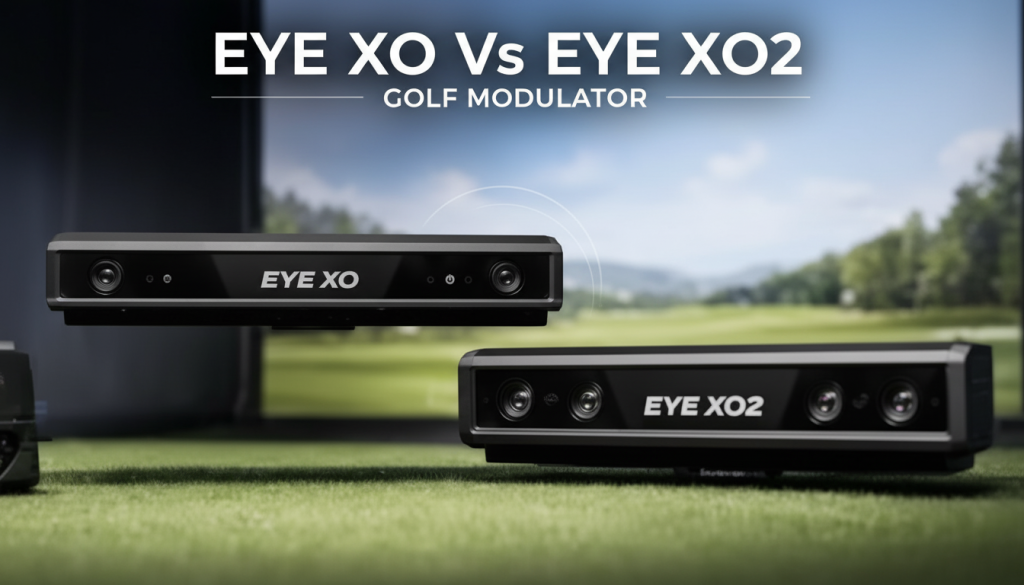
If you need higher precision and easier setup, Eye XO2 outperforms Eye XO with three 3,000 fps cameras and stickerless club data capture.
Its 300% larger hitting zone allows more flexible ball placement, supporting various ball types and trouble mats.
Eye XO requires clubface stickers and precise alignment, making setup more complex.
Both use dual Doppler radar, but XO2’s enhanced diagnostics suit high-traffic or instructional use.
For deeper insights and feature differences, keep exploring the details.
- Key Takeaways
- Eye XO vs Eye XO2: Comparing Camera Technology
- Eye XO vs Eye XO2: Hitting Zone Size and Impact on Play
- Eye XO vs Eye XO2: Key Data Points and Their Importance
- Club Data Capture: Stickers vs Stickerless Technology
- Ball and Club Compatibility in the Hitting Zone
- Software Compatibility and Features With Eye XO and XO2
- Eye XO vs Eye XO2: Pricing, Setup, and Value Compared
- Which Model Should You Choose? Accuracy and Use Cases?
- Frequently Asked Questions
- What Maintenance Is Required for the Eye XO and Eye XO2 Systems?
- How Durable Are the Eye XO and Eye XO2 Units in Outdoor Conditions?
- Can the Eye XO and Eye XO2 Be Used Simultaneously in One Setup?
- What Warranty Options Are Available for Eye XO and Eye XO2?
- Are There Any Additional Accessories Recommended for Optimal Eye XO2 Performance?
- Eye XO vs Eye XO2: Making the Right Choice for You
Key Takeaways
- Eye XO2 uses three 3,000 fps cameras and captures 24 data points; Eye XO uses two cameras at a lower frame rate and 21 data points.
- XO2 enables stickerless club data capture and supports any ball type in a larger hitting zone; XO requires clubface stickers and precise ball placement.
- XO2’s hitting zone is about 300% larger (28”x21”) versus XO’s smaller zone (~12”x16”), allowing more setup flexibility and trouble mat support.
- XO2 offers advanced diagnostics, trouble-mat recognition, and Performance Optix software, ideal for high-traffic and instructional use; XO suits simpler casual setups.
- XO2 commands a higher price with complex setup but greater precision; XO is more affordable with simpler configuration and fewer setup demands.
Eye XO & Eye XO2: Side-by-Side Comparison
| Feature | Eye XO | Eye XO2 |
|---|---|---|
| Performance | Reliable and consistent | Faster and more optimized |
| Design | Standard, functional build | Sleeker and more modern design |
| Features | Core essential features | Enhanced and upgraded features |
| User Experience | Smooth but basic | More refined and responsive |
| Technology | Previous-gen components | Latest-generation improvements |
| Value for Money | Budget-friendly option | Better long-term investment |
| Best For | Beginners or casual users | Advanced users and professionals |
Eye XO vs Eye XO2: Comparing Camera Technology
When comparing the camera technology between the Eye XO and Eye XO2, you’ll notice that the XO2 employs three high-speed cameras, while the XO uses two.
This additional camera in the XO2 enhances data capture, allowing for 24 precise data points versus the XO’s 21. You’ll benefit from improved club data acquisition with the XO2, which doesn’t require clubface stickers, a necessity for the XO to obtain full club metrics.
Both systems capture ball speed, spin, launch angle, club path, and smash factor, but the XO2’s camera arrangement enables more exhaustive swing diagnostics. The overhead positioning of the XO2 cameras in front of the tee facilitates better coverage and accuracy.
Regular calibration is essential to maintain the tracking accuracy and ensure the reliability of the data provided by both models.
Eye XO vs Eye XO2: Hitting Zone Size and Impact on Play
Although both Eye XO and Eye XO2 provide accurate ball tracking, the XO2’s hitting zone is markedly larger, measuring 28” wide by 21” deep compared to the XO’s roughly 12” wide by 16” deep area.
This 300% increase in hitting zone size allows you far more freedom in ball placement, reducing the need for deliberate alignment.
The XO2’s overhead positioning and expanded zone accommodate trouble mats and rough or bunker simulations, enhancing practice realism.
By contrast, the XO’s smaller zone restricts ball positioning, limiting play scenarios and requiring precise tee alignment.
The larger XO2 hitting zone also supports any ball type and simplifies session setup, improving efficiency during high-volume or instructional use.
Ultimately, the XO2’s hitting zone advances play versatility and reduces operational constraints relative to the XO.
This improvement parallels innovations seen in other golf simulators that emphasize indoor accuracy and ease of setup for enhanced practice experiences.
Eye XO vs Eye XO2: Key Data Points and Their Importance
Since data points directly influence the quality of swing analysis, understanding the distinctions between Eye XO and Eye XO2 metrics is essential. Eye XO2 delivers 24 precise data points, whereas Eye XO offers 21, reflecting enhanced measurement capabilities.
The XO2’s ability to capture club data without stickers marks a significant advancement, reducing setup complexity and potential error.
Key differences to note include:
Eye XO2’s expanded data set enhances diagnostic depth.
Stickerless club data capture improves workflow efficiency.
Both systems track ball speed, spin, launch angle, club path, and smash factor.
XO2’s additional metrics support complex swing analysis.
Enhanced data fidelity in XO2 aids high-traffic and instructional environments.
The XO2’s improvements parallel advancements seen in devices with multi-camera systems, which provide more detailed and reliable club and ball data for superior swing diagnostics.
Club Data Capture: Stickers vs Stickerless Technology
Understanding club data capture methods is essential for optimizing your swing analysis workflow. The Eye XO requires clubface stickers to deliver full club data, ensuring precise measurement of club path and face angle.
Conversely, the Eye XO2 employs advanced stickerless technology, capturing complete club data without physical markers. This reduces setup time and potential interference.
| Feature | Eye XO (Stickers) | Eye XO2 (Stickerless) |
|---|---|---|
| Club Data Capture | Requires stickers | No stickers needed |
| Setup Complexity | Higher due to application | Lower, faster setup |
| Data Precision | High, dependent on sticker placement | High, uses multi-camera tracking |
Choosing stickerless technology simplifies your process while maintaining data integrity for precise swing diagnostics. Proper calibration and consistent setup conditions further enhance the measurement accuracy of both systems.
Ball and Club Compatibility in the Hitting Zone
When selecting a launch monitor, you need to take into account the compatibility of both ball types and clubs within the hitting zone.
The Eye XO2 offers a markedly larger hitting zone of 28”W x 21”D compared to the Eye XO’s 12”W x 15.5”D.
This expansion allows you to use any golf ball type without concern for placement precision.
Additionally, the Eye XO2 supports trouble mats and rough or bunker recognition, enhancing your practice realism.
The Eye XO requires clubface stickers for accurate club data, whereas the Eye XO2 captures club data stickerless, simplifying setup.
Consider these factors:
- Eye XO2’s 300% larger hitting zone
- Compatibility with all ball types on Eye XO2
- Trouble mat and rough/bunker support only on Eye XO2
- Stickerless club data capture with Eye XO2
- Eye XO demands precise ball placement and stickers for clubs
This technical compatibility directly affects your training efficiency. The Eye XO2’s advanced sensors provide high-precision tracking that enhances data accuracy and realism during practice.
Software Compatibility and Features With Eye XO and XO2
In integrating launch monitors with simulation and analysis platforms, both Eye XO and Eye XO2 provide broad software compatibility to support diverse training needs. You’ll find both models compatible with Refine, Refine+, GameDay, TGC, E6, and GSPro software, requiring a PC for operation.
The Eye XO2 enhances immersion by supporting Performance Optix, while the Eye XO uses Dimple Optix, compatible with any golf ball. Both support third-party software, expanding your options for data analysis and practice scenarios.
Functionally, Eye XO2 delivers advanced features with deeper swing diagnostics and supports trouble mats and rough/bunker recognition, improving training precision. Eye XO offers a streamlined experience with slightly fewer data points and club data requiring stickers.
Your choice depends on the required depth of data and immersive simulation features. For users focused on detailed indoor practice, devices with a tri-camera system provide high accuracy and tour-level club and ball metrics.
Eye XO vs Eye XO2: Pricing, Setup, and Value Compared
Though both the Eye XO and Eye XO2 serve as advanced launch monitors, their pricing and setup reflect distinct value propositions tailored to different user needs.
Eye XO starts at around $8,000, offering a simpler, cleaner setup with two cameras and requires clubface stickers for full club data.
Eye XO2 commands a higher premium, featuring three cameras, a 300% larger hitting zone, and club data capture without stickers, enhancing convenience.
Consider these points: Eye XO2’s overhead positioning simplifies ball placement.
The larger hitting zone reduces setup frustration.
Eye XO’s lower complexity suits straightforward use.
Bundles include advanced software like Refine+ and GameDay.
Eye XO2’s value aligns with intensive, immersive training environments.
You’ll weigh cost against setup complexity and functional depth accordingly.
Both systems benefit from real-time swing analysis to provide immediate feedback and improve practice efficiency.
Which Model Should You Choose? Accuracy and Use Cases?
When you’re trying to decide between the Eye XO and Eye XO2, it’s important to look at accuracy differences. The Eye XO2 really stands out because it provides enhanced data points and deeper swing diagnostics. So, if precision is a key factor for you, this model might be the better choice.
Now, think about how you plan to use it. The Eye XO2 is particularly great for instructional settings and high-traffic environments. Why? Well, it has a larger hitting zone and comes packed with advanced features. This makes it super user-friendly in those busy situations.
Ultimately, your decision will come down to balancing your needs for precision with how complex the setup is and what your budget looks like. It’s all about finding the right fit for you! Additionally, both models utilize dual Doppler radar technology to ensure highly accurate tracking of ball and club data.
Accuracy Comparison Overview
When evaluating the accuracy between the EYE XO and EYE XO2, you’ll find that the XO2 delivers enhanced precision through its three high-speed cameras operating at 3,000 frames per second. This surpasses the XO’s two-camera setup.
This upgrade translates into more thorough data collection and improved shot diagnostics. The XO2 captures 24 data points, including club data without stickers, whereas the XO records 21 data points but requires clubface stickers for full metrics.
Consider these factors: the XO2’s larger hitting zone reduces shot setup constraints. The higher frame rate guarantees finer motion capture, and direct measurement of launch angle and spin axis enhances validity.
The XO2 supports multiple ball types and trouble mats. User data aligns XO2’s accuracy closely with premium models like GC3.
This makes the XO2 technically superior for precision-driven environments. Additionally, the XO2’s high accuracy and advanced measurement modes ensure reliable performance across diverse conditions, similar to top beginner rangefinders of 2025.
Ideal User Scenarios
Since the choice between the EYE XO and EYE XO2 hinges on specific use cases and accuracy demands, understanding their distinct capabilities is essential.
Choose the EYE XO if you require a streamlined setup with solid accuracy for individual or casual use. It offers a simpler configuration and a lower price point.
However, if you need thorough swing diagnostics, a markedly larger hitting zone, and compatibility with trouble mats or diverse ball types, the EYE XO2 is superior.
Its three-camera system and enhanced data points deliver deeper insights without requiring clubface stickers. The XO2 excels in environments demanding high throughput accuracy, such as busy facilities or detailed analysis scenarios.
Your decision should align with the balance between budget constraints, data granularity, and operational complexity you can manage.
For those carrying their devices regularly, considering portable protection features ensures your rangefinder remains safe and accessible during use.
Performance In Instructional Settings
Although both the EYE XO and EYE XO2 provide reliable data for golf instruction, the enhanced accuracy and expanded hitting zone of the EYE XO2 make it the preferred choice in high-demand instructional environments.
The EYE XO2’s three-camera system delivers 24 precise data points without requiring clubface stickers, streamlining your analysis. Its 28”W x 21”D hitting zone reduces ball placement constraints, enabling efficient lesson flow.
You’ll appreciate deeper swing diagnostics for nuanced feedback, compatibility with trouble mats and varied ball types, and overhead positioning for ideal data capture.
Enhanced software immersion via Performance Optix ensures reliable performance in high-traffic settings. If accuracy and all-encompassing data are paramount, the EYE XO2 justifies its premium positioning for serious coaching scenarios.
Frequently Asked Questions
What Maintenance Is Required for the Eye XO and Eye XO2 Systems?
You’ll need to regularly clean the camera lenses on both systems to ensure peak image clarity.
Keep firmware and software updated for accurate data capture and compatibility.
Check sensor alignment periodically to maintain measurement precision.
For the Eye XO, inspect clubface stickers for wear or replacement.
Eye XO2 requires less physical maintenance but demands careful handling of its overhead positioning.
Store both in a dust-free environment to prevent hardware degradation.
How Durable Are the Eye XO and Eye XO2 Units in Outdoor Conditions?
Like a fortress built to withstand storms, both Eye XO and Eye XO2 are engineered with durable materials suited for controlled outdoor use.
They resist dust and moisture but aren’t fully waterproof, so you should avoid heavy rain or extreme weather exposure.
Proper installation and maintenance extend their lifespan.
Eye XO2’s design slightly enhances protection due to its overhead position, minimizing direct exposure to debris and ball impact in outdoor settings.
Can the Eye XO and Eye XO2 Be Used Simultaneously in One Setup?
You can’t operate the Eye XO and Eye XO2 simultaneously within a single setup due to hardware and software integration constraints.
Each system requires exclusive access to its cameras and processing unit, preventing concurrent use.
Additionally, their differing data protocols and calibration parameters complicate synchronization.
To optimize performance and data accuracy, you should deploy one device per setup, ensuring proper system configuration and avoiding conflicts in data capture and processing.
What Warranty Options Are Available for Eye XO and Eye XO2?
Imagine your gear backed by a safety net. Both Eye XO and Eye XO2 come with a standard one-year limited warranty covering defects in materials and workmanship.
You can extend coverage through additional service plans, depending on your retailer or dealer. This guarantees your investment stays protected against unforeseen issues, letting you focus on precise performance without worry.
Always check specific terms for coverage details and claim procedures.
Are There Any Additional Accessories Recommended for Optimal Eye XO2 Performance?
Yes, for peak Eye XO2 performance, you should consider using compatible trouble mats and rough/bunker mats to fully leverage its advanced ball and lie recognition capabilities.
Overhead mounting hardware is essential for proper camera positioning. Additionally, make certain you have a reliable PC with sufficient processing power to run software like Refine+, GameDay, or Performance Optix smoothly.
Calibration tools and high-quality lighting can further enhance measurement accuracy and data consistency.
Eye XO vs Eye XO2: Making the Right Choice for You
Choosing between Eye XO and Eye XO2 isn’t just a decision; it’s a pivotal moment that could redefine your entire golf simulation experience.
The XO2’s advanced camera technology and expansive hitting zone might feel like having a supercomputer analyzing every swing. Meanwhile, the XO’s proven precision keeps things reliably sharp.
In your hands, these subtle differences become monumental, influencing accuracy, setup complexity, and ultimately the very essence of your game’s data integrity.
Choose wisely; your performance depends on it.