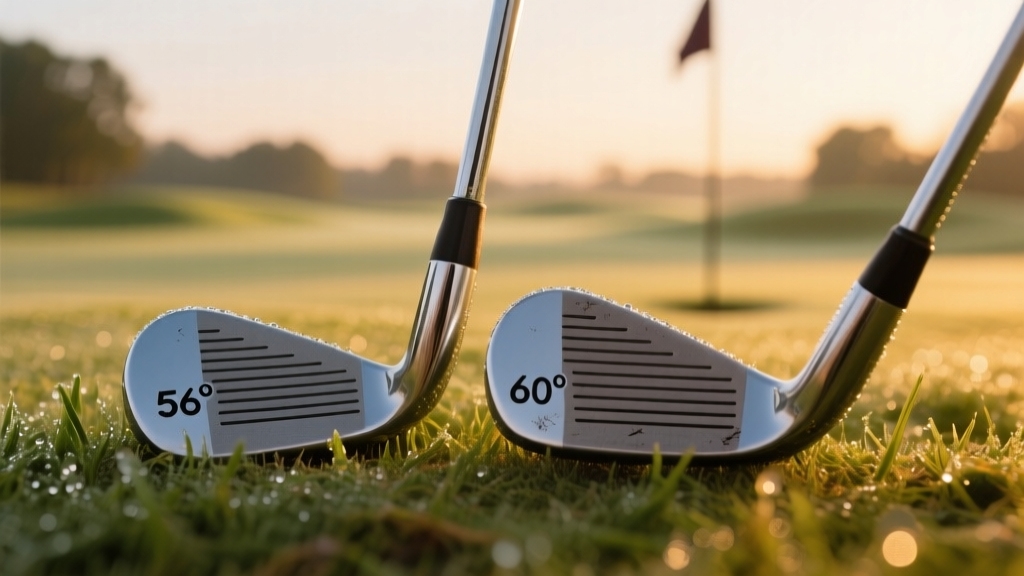
You’ll find the 56° wedge offers more versatile distance, forgiveness, and easier turf interaction. This makes it ideal for approach shots around 80-100 yards and bunker play with higher bounce.
The 60° wedge delivers higher launch, sharper spin, and steeper trajectory for delicate, short-range shots needing precise control. However, it demands advanced skill and firmer turf.
Understanding these differences will help you optimize your wedge choices and short-game strategy for different shot conditions.

- Superior Forgiveness: Our golf wedges are designed with a leading edge that prevents digging into…
- Full Face Groove Wedge: Our golf wedges feature an innovative design that sets them apart from…
- Optimal Distance Control: Achieve precise distance control with our golf wedges. The strategic…
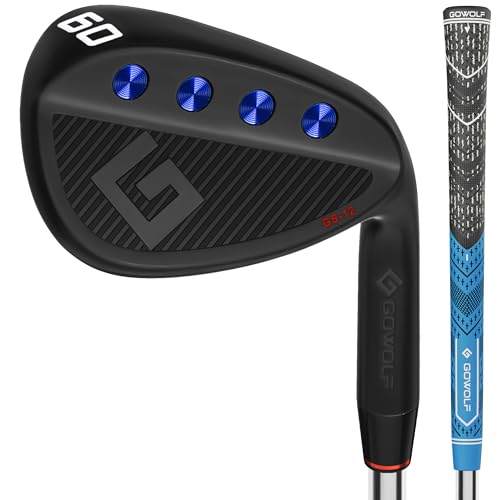
- 【Perfect Classic Golf Wedges】Classic blade shape, high performance and reliability for getting…
- 【Full Face Groove Wedge】Gowolf golf wedges have an innovative design for good backspin. With the…
- 【Superior Forgiveness】Gowolf Gap Wedge, Sand Wedge and Lob Wedge are designed with a leading…

- Key Takeaways
- 56° Wedge or 60° Wedge: Quick Specs Breakdown
- Loft and Distance Comparison
- Skill Level and Difficulty Differences
- Performance in Sand and Bunker Shots
- Chipping and Short-Range Shot Versatility
- Approach Shots and Spin Control
- Typical Wedge Set Compositions
- Usage Patterns and Wear Trends
- Frequently Asked Questions
- 56° Wedge or 60° Wedge? Take the Short-Game Challenge
Key Takeaways
- The 56° wedge offers longer carry (80-100 yards) and more roll, suitable for versatile approach shots and bunker play.
- The 60° wedge produces higher, softer shots with less roll, ideal for delicate chips and tight pin locations.
- The 56° wedge has higher bounce (8-12°), making it more forgiving in soft turf and sand conditions.
- The 60° wedge’s lower bounce (4-8°) requires precise contact, better suited for firm turf and tight lies.
- Beginners benefit from the 56° wedge’s consistency, while advanced players use the 60° wedge for specialized short-game control.
56° Wedge or 60° Wedge: Quick Specs Breakdown
| Feature | 56 Degree Wedge | 60 Degree Wedge |
|---|---|---|
| Typical Carry | 80-100 yards, more roll | 60-90 yards, minimal roll |
| Bounce Angle | Higher (8-12°), forgiving in sand | Lower (4-8°), precise on firm turf |
| Best For | Bunker shots, versatile approaches | Flop shots, tight pins |
| Skill Level | Beginners to intermediate | Advanced players |
| Launch & Spin | Lower trajectory, consistent spin | Steeper launch, max stopping power |
| Turf Interaction | Glides through soft conditions | Demands clean contact |
Loft and Distance Comparison
When comparing loft and distance, you’ll find the 56-degree wedge, classified as a sand wedge, offers a lower loft and longer carry than the 60-degree lob wedge. The 56-degree wedge also tends to have a softer feel due to its multi-layer construction, which can enhance control on approach shots.
The standard 56-degree wedge has a loft range of 54-58 degrees, producing carry distances of 80-100 yards with a full swing. In contrast, the 60-degree lob wedge, lofted between 58-62 degrees, carries the ball 60-90 yards.
This 4-degree loft differential leads to a noticeably higher ball flight and steeper launch angle for the 60-degree wedge, resulting in quicker elevation but reduced distance. You’ll also notice the 56-degree wedge delivers a balanced carry-to-roll ratio.
The 60-degree wedge emphasizes height and stopping power, sacrificing some carry for precision on shorter shots.
However, testing shows the 56-degree wedge provides more consistency and control in full shots, with a narrower distance spread compared to the 60-degree, which can have a wider and less predictable distance range due to its higher loft difficulty.
Skill Level and Difficulty Differences
If you’re just starting out in golf, you’ll likely find the 56 degree wedge to be a lot more forgiving. It tends to deliver consistent shot outcomes and interacts with the turf more easily, which is a real bonus for beginners.
Additionally, the 56-degree wedge is known as the sand wedge, excelling at bunker shots and providing high carry and versatility. One important aspect to consider is that using the right equipment and preparation can greatly improve your game, much like choosing the appropriate trail hitch and sway control when hauling a golf cart.
On the other hand, if you’re considering the 60 degree wedge, be prepared for a bit of a challenge. This club requires advanced skill because it has a narrower bounce and is much more sensitive to how you strike the ball. That can make it tough to achieve consistent shots.
Beginner vs Advanced
Although both 56-degree and 60-degree wedges serve specific roles, the 56-degree wedge offers greater accessibility for beginners due to its lower loft and higher versatility. This makes it easier to achieve consistent contact and distance control. You’ll find the 56-degree’s rounded sole and moderate bounce ideal for bunker shots and approach shots within 80-100 yards, simplifying shot execution.
In fact, the 56° wedge is primarily designed as a sand wedge, making it ideal for bunker shots with its moderate bounce. Proper equipment fit, such as using a cadet golf glove, can enhance grip stability and control when executing these shots. In contrast, the 60-degree lob wedge demands advanced technique; its higher loft creates a steeper launch and softer landing.
Beginners often struggle with fat or thin shots due to loft sensitivity. As an advanced player, you can exploit the 60-degree for delicate shots requiring precise spin and trajectory control around the green. Meanwhile, beginners benefit more from mastering the 56-degree wedge before integrating the specialized 60-degree wedge into their arsenal.
Shot Consistency Challenges
Mastering the 56-degree wedge lays a foundation. However, shot consistency becomes particularly challenging as you move to a 60-degree wedge due to its loft and design characteristics. The 60° wedge’s higher launch angle and increased spin loft amplify sensitivity to angle of attack.
This causes greater variability in shot distance and dispersion, especially for less skilled players. This is because turf interaction effects with tighter lies can drastically influence spin and launch, increasing shot variability.
In contrast, the 56° wedge offers more predictable launch and spin parameters. This facilitates tighter distance gapping. The interaction between wedge loft and swing speed also plays a critical role in optimizing spin and control.
| Wedge Loft | Launch Angle Range | Spin Loft Approx. | Skill Impact on Consistency |
|---|---|---|---|
| 56° | 20°-30° | ~55° | More forgiving, stable |
| 58° | 25°-35° | 57°-60° | Moderate difficulty |
| 60° | 30°-40°+ | 60°+ | Higher variability, skill-dependent |
You’ll need precise control over dynamic loft and attack angle to tame the 60°.
Bounce and Turf Interaction
When selecting between a 56-degree and a 60-degree wedge, understanding how bounce affects turf interaction is essential for controlling shot quality.
The 56-degree wedge typically features higher bounce (8-12 degrees), allowing it to glide through soft turf, sand, and heavy rough without digging. This makes it more forgiving for average golfers, reducing fat or thin shots.
In contrast, the 60-degree wedge often has lower bounce (4-8 degrees), demanding precise contact and suiting firmer turf conditions. Skilled players benefit from this lower bounce by executing delicate shots on tight lies and firm surfaces.
If you’re an average golfer, the higher bounce 56-degree wedge offers easier turf interaction and forgiveness, while a 60-degree wedge requires greater skill to manage its less forgiving bounce and narrower sole.
Performance in Sand and Bunker Shots
When you’re dealing with bunker shots, the 56-degree wedge is your best friend. It really shines in different sand conditions because of its higher bounce angle, which helps ensure you get consistent exits from the sand. This wedge is typically used with about 80% weight on the front foot to optimize control and clean contact.
On the other hand, if you’re faced with a deep or tightly framed bunker, that’s when the 60-degree wedge comes into play. Its increased loft is perfect for hitting those steep trajectories you need to clear the lip of the bunker.
Versatility in Bunker Exits
Although both wedges perform well in bunker play, the 56-degree wedge stands out for its efficiency in typical greenside sand shots. It offers longer carry and easier exits without demanding a harder swing. Its lower loft enables you to achieve faster, more effortless exits, particularly in hard-packed sand where bounce plays a lesser role.
Conversely, the 60-degree wedge excels in high-edge or pot bunker situations, delivering superior launch height and softer landings essential for tight pin placements. You’ll find the 60-degree especially useful when minimal green space exists between the bunker and pin. It allows for controlled trajectory and quick stopping action. This makes it ideal for golfers playing on small or postage stamp greens.
While the 56-degree handles standard bunker conditions with consistent distance, the 60-degree prioritizes precision over distance. This makes each wedge versatile depending on specific bunker challenges.
Loft Impact on Shots
Since loft directly affects launch angle and spin, understanding how a 56° wedge compares to a 60° wedge is essential for optimizing sand and bunker shots. The 60° wedge’s higher loft creates a steeper trajectory and more backspin, allowing the ball to stop quickly on firm greens and soft sand. This makes it ideal for high, soft bunker shots requiring precision and minimal rollout.
Loft, launch angle, and spin rate work together to determine ball trajectory and control, making these factors crucial when choosing between wedges. Additionally, players with slower swing speeds may benefit more from wedges that help maximize control through higher spin rates.
Conversely, the 56° wedge produces a lower launch with less spin, resulting in a flatter flight and more roll after landing. This suits deeper or softer bunkers where you need the ball to travel farther and release.
Additionally, the 60° wedge’s lower bounce favors tight lies, while the 56° offers more forgiveness. This makes loft choice critical depending on sand firmness and shot demands.
Chipping and Short-Range Shot Versatility
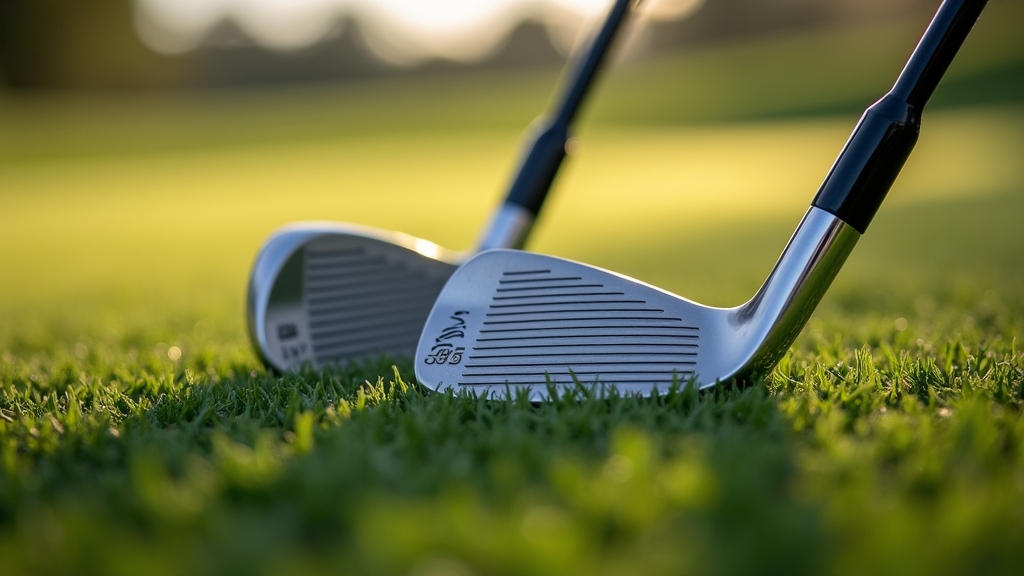
How do the 56-degree and 60-degree wedges differ in chipping and short-range shot versatility?
The 56-degree wedge offers more versatility, balancing carry and roll, which suits varied lies and distances. Its higher bounce helps it glide through sand and turf, reducing fat contact and improving control in diverse conditions.
Conversely, the 60-degree wedge delivers higher loft for steep, soft-landing chips, ideal for delicate shots requiring minimal roll near tight pins. However, it has lower bounce, making it less forgiving in heavy sand or thick grass and more challenging to control consistently.
The 60-degree wedge provides steep, soft-landing chips but is less forgiving in heavy sand or thick grass.
While the 56-degree wedge adapts well to chips, pitches, and bunker shots, the 60-degree wedge excels mainly in specialty flop shots demanding precision and softness rather than distance or roll.
To maintain optimal performance, it is important to keep your grips dry and clean using methods like using a towel to absorb moisture and ensure better control during these delicate shots.
Approach Shots and Spin Control
When you select between a 56-degree and 60-degree wedge for approach shots, understanding their differences in distance and spin control is essential. The 56-degree wedge typically carries 98–105 yards, offering more versatility and a mid-high trajectory with predictable landing and moderate roll.
It generates higher spin rates, around 7,000–9,000 rpm, due to lower loft and greater clubhead speed, enabling more aggressive attack angles and consistent yardage.
In contrast, the 60-degree wedge carries 80–90 yards, launching the ball higher with a steeper descent and minimal roll. It produces slightly less spin, 6,000–8,000 rpm, and demands precise contact for ideal results.
While the 56-degree wedge is more forgiving and consistent on approach shots, the 60-degree excels in short-range scenarios requiring soft landings and quick stops. For optimal performance during practice sessions with these wedges, wearing breathable, moisture-wicking fabrics can help maintain comfort and freedom of movement.
Typical Wedge Set Compositions
Although wedge selections vary widely, typical sets consist of pitching, gap, sand, and lob wedges, each designed to fill specific loft and shot-making roles. You’ll usually find pitching wedges at 44°–48°, gap wedges bridging 48°–54°, sand wedges around 54°–58°, and lob wedges between 58°–64°.
Maintaining 4°–6° loft gaps guarantees consistent distance control, which is important for optimizing swing weight and feel. Beginners often carry just a pitching wedge (~46°) and a sand wedge (~56°) for simplicity. Intermediate players add a gap wedge (~50°–52°) to smooth transitions.
Advanced players prefer three or four wedges for precise shot-shaping and turf interaction. Bounce angles and sole grinds vary accordingly: low bounce on pitching wedges for clean contact, medium to high bounce on sand and lob wedges for versatility in bunkers and tight lies.
This composition balances distance, trajectory, and turf engagement across short-game scenarios. Understanding the specific functions of wedges helps golfers select the right loft and bounce to improve their short-game effectiveness.
Usage Patterns and Wear Trends
After understanding typical wedge compositions, it’s important to contemplate how 56-degree and 60-degree wedges perform in real play and how their usage affects wear.
You’ll find that 56-degree wedges see heavier use, handling a broad spectrum of shots like bunker play, chips, and approach shots. This leads to pronounced wear on the leading edge and sole.
Conversely, 60-degree wedges are reserved for specialized, high-loft shots, showing less overall wear but focused on the leading edge. Choosing the right wedge also depends on factors such as hand size and strength, similar to how golfers decide between the interlock and overlap grip for better control and performance.
| Feature | 56-Degree Wedge | 60-Degree Wedge |
|---|---|---|
| Usage Frequency | Frequent, versatile shots | Infrequent, specialty shots |
| Wear Pattern | Heavy, sole and edge wear | Light, edge wear |
| Shot Types | Bunker, chip, approach shots | Flop, high soft shots |
| Player Skill | Suitable for all levels | Best for advanced players |
Frequently Asked Questions
How Does the Bounce Angle Affect 56 Vs 60-Degree Wedge Performance?
The bounce angle impacts your 56-degree wedge by offering higher bounce (10-12°), which helps prevent digging into turf or sand. This makes it more forgiving and consistent.
In contrast, your 60-degree wedge has lower bounce (4-8°), allowing precise turf interaction but requiring more skill to avoid mishits. This lower bounce increases shot variability.
While the 56-degree is versatile and reliable, the 60-degree demands better technique for specialty shots.
Can Beginners Effectively Use a 60-Degree Wedge?
You can use a 60-degree wedge as a beginner, but it demands precise contact and swing control due to its high loft and narrower sole.
While it excels in high, soft shots over obstacles, beginners might struggle with distance consistency and mishits like flubs or skulls.
Compared to lower lofted wedges, it’s less forgiving and versatile, so expect a steeper learning curve.
With practice, though, you’ll gain better control around tight pin placements and firm lies.
Which Wedge Is Better for Flop Shots Around the Green?
Oh sure, just grab your 56-degree wedge and expect to skyrocket the ball like a rocket. Except you won’t.
For flop shots around the green, you want the 60-degree wedge. It launches the ball higher and lands it softer with minimal roll, perfect for those delicate shots over hazards or tight pin placements.
Its lower bounce lets you pop the ball quickly from tight lies, making it the go-to for precision flop shots.
How Does Clubhead Design Differ Between 56 and 60-Degree Wedges?
You’ll notice the 56-degree wedge has a slightly larger clubhead, offering more forgiveness and stable turf interaction.
In contrast, the 60-degree wedge tends to have a more compact head, designed for precision and delicate touch.
Weight distribution in the 56-degree focuses on consistency.
Meanwhile, the 60-degree prioritizes feel and feedback.
Also, 60-degree wedges may be a bit heavier to enhance control during short game shots.
What Shaft Flex Works Best for These Wedges?
You’ll want to lean toward wedge flex shafts, which are subtly stiffer and a touch heavier than your irons, offering a firm yet responsive feel.
Matching the same flex as your irons guarantees consistency.
Though slightly heavier shafts—about 10 grams more—can enhance control.
Softer flexes may help with higher trajectory and spin on lob or sand wedges.
But generally, wedge flex shafts provide the balance needed for precise, repeatable short game shots.
56° Wedge or 60° Wedge? Take the Short-Game Challenge
Choosing between a 56 and 60 degree wedge hinges on your specific needs. Don’t assume the 60 degree is too challenging; it offers superior spin and control in bunkers and tight lies once you master it.
The 56 degree provides more versatility for chipping and approach shots, yet the 60 degree excels in steep, high-lofted shots. Consider your skill level and typical course conditions to optimize your wedge setup and performance.

- Wilson Harmonized Unisex Golf Wedge – Right Hand, 56
- Hand: Right
- Loft: 56
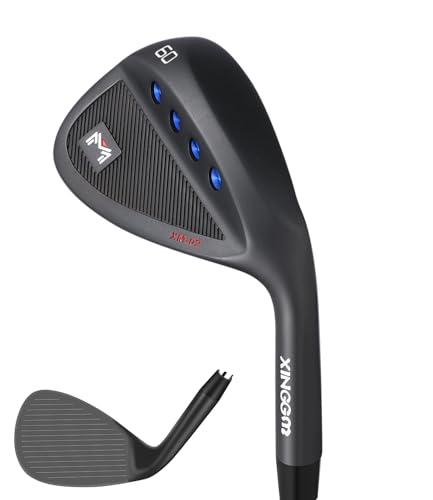
- MAX FORGIVENESS & NO-DIGGING SHOT:The leading edge of our golf wedge is designed to prevent…
- LONG-LASTING & QPQ APPEARANCE TECHNOLOGY:Forged craft & QPQ appearance technology increase the…
- OPTIMAL SPIN & MICRO CNC MILLED:Full face precision-machined groove and optimal surface roughness…
Last update on 2026-04-12 / Affiliate links / Images from Amazon Product Advertising API