
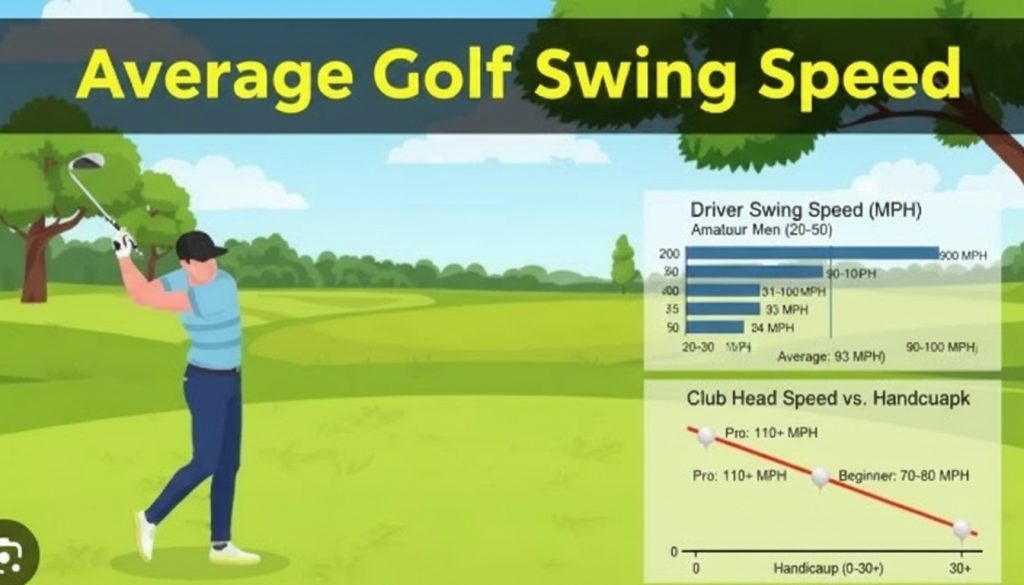
Your average golf swing speed depends on your skill, age, and club choice.
Beginners usually swing between 70–85 mph, while intermediate players range from 85–100 mph.
Advanced golfers often reach 100–110 mph, and pros exceed 110 mph.
Age affects speed too; younger players peak around 103 mph, while seniors hover near 99 mph.
Drivers produce the fastest swings, with irons and wedges trailing.
Understanding how speed ties to distance and technique can help you improve your game effectively.
- Key Takeaways
- What’s a Good Golf Swing Speed for Your Skill Level?
- How Does Your Handicap Affect Your Golf Swing Speed?
- How Age Changes Your Golf Swing Speed and Performance?
- Golf Swing Speeds for Different Clubs: Drivers to Wedges
- How Ball Speed and Smash Factor Affect Golf Swing Speed?
- How Golf Swing Speed Impacts Your Driving Distance?
- Frequently Asked Questions
- How Can I Accurately Measure My Golf Swing Speed at Home?
- What Equipment Upgrades Can Help Increase My Golf Swing Speed?
- Does Weather or Temperature Affect Golf Swing Speed and Ball Distance?
- How Important Is Flexibility Training for Improving Swing Speed?
- Can Swing Speed Differences Impact Golf Ball Flight Trajectory?
- Harness Your Swing Speed and Play Your Smartest Round Yet
Key Takeaways
- Average amateur driver swing speed ranges from about 85 to 100 mph depending on skill level.
- Beginners typically swing drivers at 70–85 mph to build fundamentals.
- Advanced and professional golfers often exceed 100 mph, with pros surpassing 110 mph.
- Clubhead speed generally decreases with age but can be maintained or improved with training.
- Swing speed varies by club, with drivers fastest and wedges slowest, affecting typical shot distances.
What’s a Good Golf Swing Speed for Your Skill Level?
When you’re working to improve your golf swing, knowing the right swing speed for your skill level can make all the difference.
As a beginner, you should aim for a driver swing speed between 70 and 85 mph to build solid fundamentals.
Beginners should target a driver swing speed of 70 to 85 mph to develop strong fundamentals.
Intermediate players can target 85 to 100 mph to gain more distance and control.
Advanced golfers typically reach 100 to 110 mph, which helps maximize power while maintaining accuracy.
If you’re endeavoring to play at a professional level, surpassing 110 mph is common.
Focus on gradual improvements rather than trying to match tour pros immediately.
Measure your swing speed regularly and adjust your training to fit your current level.
This ensures steady progress without risking injury or sacrificing technique.
Keep in mind that lower handicappers tend to drive farther and more accurately, which directly influences ideal swing speed targets.
How Does Your Handicap Affect Your Golf Swing Speed?
Understanding how your handicap influences your golf swing speed can provide valuable insight into your overall game performance. Generally, as your handicap decreases, your swing speed tends to increase, reflecting improved technique and power.
Lower handicaps allow you to generate faster clubhead speeds, translating into longer drives and better control. Here’s a quick reference to how your handicap relates to average driver swing speeds:
| Handicap | Average Driver Swing Speed (mph) |
|---|---|
| 0 | 108 |
| 10 | 96 |
| 20 | 92 |
Knowing your swing speed relative to your handicap helps you identify areas for improvement. Focus on building strength and refining mechanics to increase your speed and lower your handicap efficiently. Incorporating strength training into your routine can significantly enhance your swing speed and overall performance.
How Age Changes Your Golf Swing Speed and Performance?
As your handicap improves, your swing speed typically increases, but age also plays a significant role in how you perform on the course.
Younger players between 17-30 years often reach peak swing speeds around 103 mph. As you move into your 40s, your swing speed usually remains competitive with only slight decline.
However, once you hit 50 to 60 years old, you might notice your swing speed drop to an average near 99 mph. If you’re 65 or older, don’t be discouraged; there’s still room to improve beyond typical age expectations.
Understanding these age-related shifts helps you set realistic goals and focus on maintaining strength, flexibility, and technique to preserve or even enhance your swing speed and overall performance as you age. Using lightweight graphite shafts can help seniors boost clubhead speed and reduce fatigue, aiding performance despite natural declines.
Golf Swing Speeds for Different Clubs: Drivers to Wedges
When you swing your clubs, you might notice that your swing speed really changes depending on the type of club you’re using. For instance, drivers typically produce the fastest speeds, while wedges tend to be on the slower side. It’s pretty interesting, right?
Understanding these differences is super important because it can really help you optimize both distance and control with each shot. So, let’s dive a bit deeper into how your clubhead speed affects your performance, starting from those powerful drivers all the way down to your trusty wedges. Proper club weight and swing weight balance play a crucial role in maximizing swing speed and control.
Clubhead Speed Variations
Although your driver generates the fastest clubhead speed, the speed decreases as you move to other clubs.
For example, your 3-wood clubhead speed will be slightly slower, typically ranging 87-102 mph depending on your skill level.
As you shift to irons, expect speeds to drop progressively; a 7-iron averages between 73-86 mph, while a 9-iron falls to 69-81 mph.
Wedges produce the slowest speeds, with pitching wedges around 68-79 mph.
Understanding these variations helps you optimize your swing mechanics for each club and manage expectations during play.
Focus on maintaining consistent tempo and solid contact to maximize efficiency across your set, adjusting your swing speed intentionally as club length and loft change.
This approach guarantees better control and performance on the course.
Maintaining a smooth rhythm during your swing is crucial to achieving these consistent clubhead speeds.
Distance Impact By Club
Maximize your distance by understanding how swing speed and club type work together.
Drivers produce the highest clubhead speeds, typically between 92 and 108 mph, translating into drives over 250 yards for skilled players.
As you move to fairway woods and hybrids, speeds drop slightly, reducing distance yet improving control.
Irons see a further decrease: a 7-iron swings around 73-86 mph, yielding shots between 140 to 180 yards depending on your skill.
Wedges, with the slowest speeds near 68-79 mph, prioritize accuracy and spin over distance, usually covering 80-120 yards.
By matching your swing speed to the appropriate club, you optimize shot distance and consistency.
Focus on efficient mechanics to maximize your speed across all clubs, enhancing your overall performance on the course.
Data-driven club fitting using launch monitor data can help tailor club specifications to your unique swing speed and mechanics for optimal results.
How Ball Speed and Smash Factor Affect Golf Swing Speed?
When evaluating your golf swing, understanding ball speed and smash factor is essential because they directly reflect how efficiently you transfer energy from the club to the ball. Ball speed measures how fast the ball leaves the clubface, while smash factor is the ratio of ball speed to clubhead speed. A higher smash factor means you’re maximizing energy transfer, improving your swing efficiency without necessarily increasing swing speed.
| Metric | Typical Range |
|---|---|
| Ball Speed (mph) | 130 – 180 |
| Smash Factor | 1.3 – 1.5 |
| Efficient Swing | Smash factor > 1.4 |
| Average Amateur | Ball speed 130-150 |
| Pro Level | Ball speed 160-180 |
Focus on optimizing smash factor to make your swing more effective and consistent. Each 1 mph increase in ball speed can add approximately 2 yards to your drive distance, highlighting the importance of both ball speed and smash factor in maximizing your overall performance.
How Golf Swing Speed Impacts Your Driving Distance?
Understanding ball speed and smash factor gives you insight into how efficiently energy transfers from your swing to the ball, but your swing speed ultimately drives how far the ball travels.
The faster you swing, the greater your potential driving distance. For instance, a swing speed between 90-100 mph typically results in drives of 250-280 yards, while speeds over 110 mph can push your drives beyond 310 yards.
Improving your swing speed directly enhances distance, but only if you maintain solid contact and efficient energy transfer. Focus on proper technique and strength training to increase your clubhead speed. Matching your golf ball’s compression rating to your swing speed is essential to maximize energy transfer and optimize distance.
Frequently Asked Questions
How Can I Accurately Measure My Golf Swing Speed at Home?
You can accurately measure your golf swing speed at home by using a portable launch monitor or a swing speed radar device.
These tools track the clubhead speed in real-time. Set up in your practice area, swing naturally, and record your data.
Make sure your device is calibrated and positioned correctly for reliable results.
Using smartphone apps with swing analysis can supplement, but dedicated devices provide the most precise measurements.
What Equipment Upgrades Can Help Increase My Golf Swing Speed?
If you want to rocket your golf swing speed, upgrading your driver to a lighter shaft made of graphite can make a huge difference.
You should also consider clubs with larger sweet spots and better aerodynamics.
Custom fitting your clubs guarantees they match your swing perfectly.
Don’t overlook grips that improve your hold and comfort.
These equipment tweaks help optimize your swing mechanics, letting you swing faster without losing control or accuracy.
Does Weather or Temperature Affect Golf Swing Speed and Ball Distance?
Yes, weather and temperature do affect your golf swing speed and ball distance. Warmer temperatures help the ball travel farther because the air is less dense.
Your muscles perform better in the heat, allowing for faster swings. In colder weather, the ball won’t fly as far, and your swing speed may decrease due to tighter muscles.
Always adjust your club choice and swing effort based on conditions to maintain consistent performance.
How Important Is Flexibility Training for Improving Swing Speed?
Imagine a golfer struggling to add speed despite hours of practice.
Flexibility training is vital because it enhances your range of motion, allowing a fuller, more powerful swing.
By improving your hip and shoulder flexibility, you reduce tension and increase clubhead speed.
Incorporate dynamic stretches and mobility drills regularly to unleash your potential.
Without flexibility, you limit your swing speed, capping your distance and overall performance on the course.
Can Swing Speed Differences Impact Golf Ball Flight Trajectory?
Yes, swing speed differences definitely impact your golf ball flight trajectory.
When you swing faster, you generate higher ball speeds, which increase launch angle and carry distance.
Conversely, slower swings tend to produce lower trajectories and shorter distances.
Adjusting your swing speed changes spin rates too, affecting how the ball curves in the air.
To optimize trajectory, you need to match your swing speed with proper club selection and technique.
Harness Your Swing Speed and Play Your Smartest Round Yet
Understanding your golf swing speed is key to improving your game, whether you’re a novice or a seasoned player. Just like a knight wielding a sword in battle, your swing speed combines skill and power to achieve maximum distance and accuracy.
Keep in mind how your handicap, age, and club choice influence your swing. By mastering these factors, you’ll drive the ball farther and play smarter every time you step on the course.