
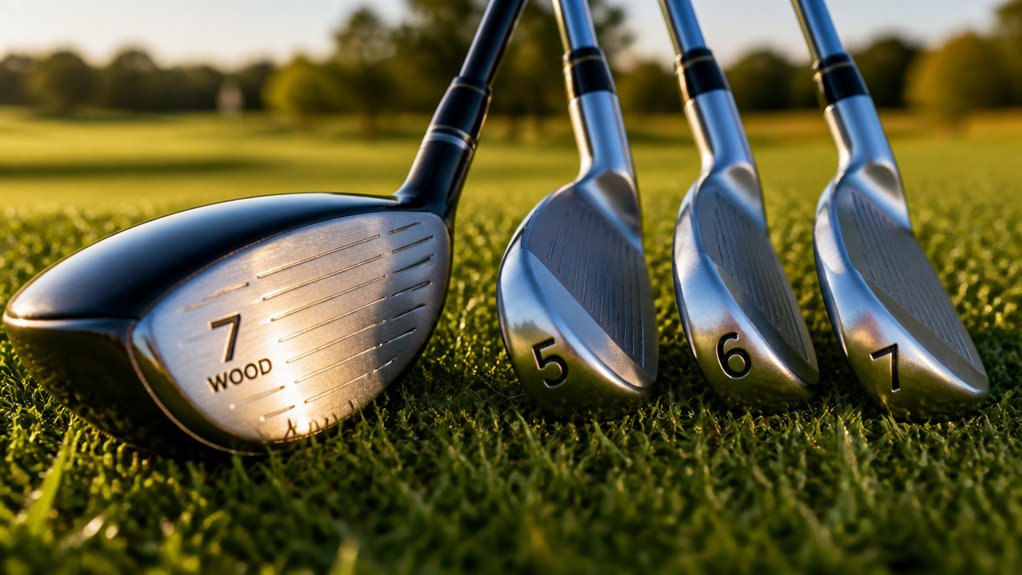
A 7 wood typically matches the loft and distance of a 4 or 5 iron, with lofts ranging from 20 to 23 degrees that align closely with older 3 or modern 4 irons.
You’ll get higher launch and more forgiveness due to its larger clubhead and longer shaft. This makes it easier to hit consistently compared to long irons.
It often replaces a 5 iron for average players but suits stronger swingers too. Understanding these nuances will clarify when a 7 wood best fits your game.
- Key Takeaways
- What Loft Does a 7 Wood Have Compared to Irons?
- How Far Does a 7 Wood Typically Hit Compared to Irons?
- Why Does a 7 Wood Launch Higher Than Long Irons?
- How Does a 7 Wood Compare to 3 and 4 Hybrids?
- How Player Strength and Swing Speed Affect 7 Wood Equivalency?
- How Loft and Shaft Differences Affect 7 Wood and Iron Performance?
- Why a 7 Wood Works Better Than Irons in Rough Conditions?
- Final Answer: What Is a 7 Wood Equivalent to in Irons?
Key Takeaways
- A typical 7 wood loft ranges from 20 to 23 degrees, closely matching a 3 or 4 iron’s loft.
- Older sets’ 3 irons usually have lofts around 20–21 degrees, similar to many 7 woods.
- Modern 4 irons with lofts of 22–23 degrees align well with the 7 wood’s loft range.
- Stronger lofts in contemporary irons shift the 7 wood equivalency toward a 4 or 5 iron.
- The 7 wood often replaces a 5 iron for average golfers, offering higher launch and more forgiveness.
What Loft Does a 7 Wood Have Compared to Irons?
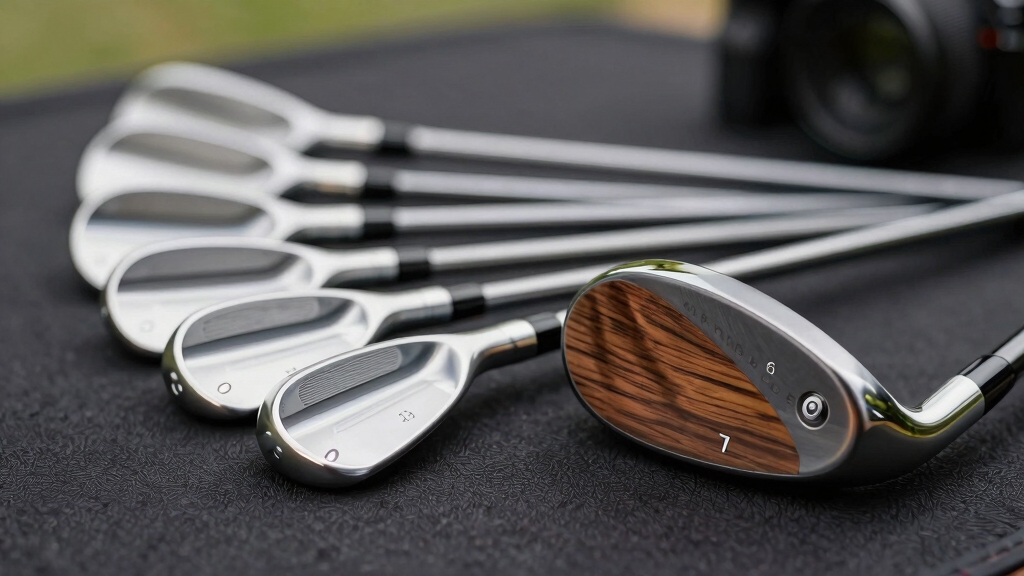
When comparing lofts, you’ll find that a 7 wood typically ranges between 20 and 23 degrees. This places it close to the loft of mid to long irons.
A 7 wood’s loft usually falls between 20 and 23 degrees, similar to mid to long irons.
A 7 wood with 20–21 degrees usually matches the loft of a 3 iron from older sets. In contrast, 22–23 degrees aligns more with a 4 iron in modern configurations.
Women’s 7 woods often feature lofts up to 27 degrees, reflecting the need for easier launch.
Due to stronger lofts in contemporary irons, the 7 wood’s equivalent loft has shifted, often sitting between a 4 iron and a 5 iron.
To determine exact equivalency, check the loft stamped on the club or consult manufacturer specs. Shaft length and design can influence performance despite similar loft numbers.
Additionally, shaft length and flex are critical factors that impact control and consistency, making it important to consider shaft fitting principles when comparing clubs.
How Far Does a 7 Wood Typically Hit Compared to Irons?
You can expect a 7 wood to cover distances similar to those of a 3 or 4 iron, typically carrying between 170 and 200 yards.
The exact distance depends on your swing speed and the club’s loft, which usually ranges from 20 to 23 degrees.
Stronger players often find their 7 wood matches or exceeds the distance of a 4 iron, sometimes reaching 210 yards.
Average golfers may see the 7 wood perform closer to a 5 iron with respect to distance.
Despite shafts and heads affecting performance, the 7 wood’s longer shaft length generally generates more swing speed.
This translates into greater carry, making the 7 wood a versatile option if you want consistent yardage comparable to mid to long irons.
Its longer shaft and higher trajectory make the 7 wood especially effective for long fairway shots and getting the ball airborne quickly.
Why Does a 7 Wood Launch Higher Than Long Irons?
Understanding why a 7 wood launches higher than long irons involves examining the club’s design and mechanics.
First, the 7 wood features a higher loft, typically between 20 to 23 degrees, compared to the stronger lofts on long irons. This increased loft angle generates a steeper launch trajectory.
The 7 wood’s loft of 20 to 23 degrees creates a noticeably steeper launch than long irons.
Second, the 7 wood’s larger clubhead and lower center of gravity promote easier ball contact and more efficient energy transfer, enhancing the upward launch.
Third, the longer shaft length on a 7 wood allows you to generate greater clubhead speed, contributing to higher ball flight.
Additionally, the club’s shallow face design reduces turf interaction, enabling cleaner strikes and consistent launch angles.
These design elements combined with the 7 wood’s higher loft contribute to its ability to produce higher launch and increased backspin compared to long irons.
Which Irons Does a 7 Wood Replace for Average Golfers?
You know, for most average golfers, a 7 wood usually takes the place of a 5 iron. It’s interesting because it can match or even exceed the distance of a 5 iron while giving you a higher launch angle.
With a loft range of about 20 to 23 degrees, a 7 wood makes it easier to get the ball up in the air. Plus, it tends to offer better consistency than those long irons. This combo really helps you gain more reliable distance control and perform better, no matter where you’re hitting from.
Choosing clubs with the right loft and shaft flex is essential to maximize performance and match your swing speed.
Distance Comparison to Irons
Although individual swing speed and technique vary, the 7 wood generally replaces irons in the mid-to-long range for average golfers. Typically, it matches or exceeds the carry distance of a 5 iron, offering more forgiveness and higher launch.
Here’s what to expect:
- A 7 wood usually carries between 170 and 200 yards, aligning with a 4 iron or a strong 5 iron.
- Some players reach distances of 210–215 yards with a 7 wood, comparable to a 3 iron.
- Because of its longer shaft and design, the 7 wood can generate more swing speed, helping you cover more ground than equivalent irons.
Understanding these distances helps you confidently replace harder-to-hit long irons with a 7 wood for better performance. The 7 wood’s longer shafts and lower lofts produce a penetrating flight with greater roll, making it ideal for maximum distance on clean fairway lies.
Loft and Launch Benefits
Since the 7 wood typically features lofts between 20 and 23 degrees, it effectively replaces mid-to-long irons like the 4 or 5 iron for most average golfers.
This loft range promotes a higher launch angle compared to similar irons, helping you achieve optimized ball flight and carry distance.
The 7 wood’s design encourages a sweeping swing path, minimizing turf interaction and enabling cleaner contact.
Its longer shaft length generates increased clubhead speed, further enhancing launch and distance.
You’ll notice the ball ascends more easily with a 7 wood, producing a steeper descent angle ideal for holding greens.
Additionally, the 7 wood offers better forgiveness due to its larger clubhead and design features that enhance stability on off-center hits.
Consistency for Average Golfers
The loft and launch advantages of a 7 wood directly enhance consistency for average golfers by replacing certain irons in their set. Typically, a 7 wood replaces a 5 iron due to its easier launch and greater forgiveness.
This substitution improves shot accuracy and height, reducing misses and enhancing distance control. When you swap your 5 iron for a 7 wood, expect:
- Higher ball flight with a more forgiving clubface, leading to better contact.
- Increased swing speed from a longer shaft, promoting consistent distance.
- Steeper descent angles, which improve green-holding ability on approach shots.
Additionally, selecting clubs that offer smooth-rolling wheels and ergonomic handle benefits can help maintain overall consistency by reducing fatigue during play.
How Does a 7 Wood Compare to 3 and 4 Hybrids?
When comparing a 7 wood to 3 and 4 hybrids, you’ll find that the 7 wood closely matches the loft of a 3 hybrid. The 4 hybrid aligns more with a 4 iron’s loft.
Typically, a 7 wood features loft between 20 and 23 degrees, similar to a 3 hybrid’s range. The 4 hybrid usually carries lofts from 21 to 23 degrees, paralleling a 4 iron.
Performance-wise, a 7 wood generally produces about 10 yards more carry than a 4 hybrid at moderate swing speeds. This is thanks to its longer shaft and larger clubhead.
Additionally, the 7 wood launches the ball higher with a softer trajectory, offering easier flight control compared to hybrids. This makes the 7 wood a preferred option for players seeking a higher launch and increased forgiveness relative to 3 and 4 hybrids.
Its forgiving design elements such as low center of gravity and wide sweet spots contribute significantly to the higher launch and improved accuracy.
When Should You Use a 7 Wood Instead of Long Irons?
You might want to reach for a 7 wood instead of long irons if you’re looking for easier launch and a bit more forgiveness. If you find yourself having trouble making consistent contact, the 7 wood can be a real game-changer. It’s perfect for those who benefit from a higher ball flight and need reliable distance, especially when you’re dealing with rough or uneven lies.
Plus, when the course conditions involve thick fairway grass or soft ground, the 7 wood really shines. It gives you the control and accuracy you need for those tricky shots. So, next time you’re on the course and facing those conditions, consider grabbing that 7 wood! Its forgiving clubhead geometry helps reduce impact inconsistencies, making it easier to achieve consistent ball speed.
Benefits Over Long Irons
Although long irons offer control and workability, opting for a 7 wood can markedly improve your consistency and launch, especially if your swing speed is moderate or you struggle with turf interaction.
The 7 wood’s design boosts your performance by providing:
1. Higher Launch and Forgiveness
Its larger clubhead and longer shaft help you generate more swing speed and a higher ball flight. This makes shots easier to execute and more consistent.
2. Improved Turf Interaction
The club’s shallow face reduces digging, allowing cleaner contact from tight lies or light rough.
3. Steeper Descent Angle
The 7 wood drops the ball more steeply onto greens, enhancing your accuracy and control compared to long irons.
Choosing a 7 wood over a long iron enhances playability without sacrificing distance. This is especially beneficial for average golfers seeking reliable performance. Additionally, the 7 wood often incorporates perimeter weighting to increase forgiveness and help maintain stability on off-center hits.
Ideal Player Profiles
Since players vary widely in swing speed, ball striking, and course conditions, choosing a 7 wood over long irons depends on specific performance needs and playing style.
You should consider a 7 wood if you struggle with consistent contact or generating clubhead speed. Its longer shaft and higher loft create easier launch and greater forgiveness compared to 3 or 4 irons.
Average golfers often replace a 5 iron with a 7 wood for improved distance and control. Stronger players who generate sufficient speed might prefer a 7 wood to substitute a 4 iron for added height and carry.
If your swing tends to dig steep divots, a hybrid may be better. For smoother sweeps or rough shots, the 7 wood excels, providing a higher trajectory and softer landing.
Course Conditions Advantage
When course conditions demand higher launch and softer landings, a 7 wood outperforms long irons by providing greater forgiveness and trajectory control.
You should consider using a 7 wood instead of long irons when:
- Tight fairways require precision. The higher launch and softer descent reduce roll, helping the ball stop quickly on the green.
- Rough or uneven lies dominate. The 7 wood’s wider sole and shallow face improve turf interaction, minimizing the risk of fat shots.
- Wind conditions fluctuate. Its higher trajectory and easier swing speed generation help you maintain control and distance.
In these scenarios, the 7 wood’s technical advantages make it a superior choice.
This ensures consistent performance where long irons might struggle.
How Player Strength and Swing Speed Affect 7 Wood Equivalency?
Understanding how your strength and swing speed influence the equivalency of a 7 wood to irons is crucial for optimizing your club selection. Stronger players with higher swing speeds typically find the 7 wood comparable to a 3 or 4 iron, benefiting from increased distance and control.
Conversely, moderate swing speeds often align the 7 wood closer to a 5 iron in distance. Your physical capability affects launch conditions and ball speed, which shifts equivalency.
| Player Strength | Swing Speed (mph) | 7 Wood Equivalent | Distance (yards) | Notes |
|---|---|---|---|---|
| Strong | 90+ | 3 or 4 Iron | 200+ | Maximizes distance potential |
| Moderate | 75-89 | 4 or 5 Iron | 170-200 | Balanced control and carry |
| Lower | <75 | 5 Iron | <170 | Emphasizes higher launch |
How Loft and Shaft Differences Affect 7 Wood and Iron Performance?
Although loft angles between a 7 wood and irons may appear similar, subtle differences markedly affect ball trajectory and distance.
Loft similarities between a 7 wood and irons can be deceptive, significantly influencing trajectory and distance.
The 7 wood typically has a longer shaft and slightly weaker loft compared to equivalent irons, influencing performance in key ways.
When you compare these clubs, consider:
- Loft Variance: A 7 wood’s loft (20–23°) often matches a 3 or 4 iron but launches the ball higher due to design differences.
- Shaft Length: The longer shaft on a 7 wood increases swing speed, translating to greater distance and a higher ball flight than irons.
- Clubhead Design: Woods feature larger, more forgiving clubheads, impacting launch angle and spin rates differently from irons.
Understanding these factors helps you optimize club selection for trajectory control and distance management.
Why a 7 Wood Works Better Than Irons in Rough Conditions?
The longer shaft and larger clubhead of a 7 wood give you a distinct advantage in rough conditions compared to irons.
The increased clubhead size creates a larger sweet spot, enhancing forgiveness when the ball sits deep in the rough.
Its higher loft, typically between 20 and 23 degrees, helps launch the ball cleanly, reducing turf interaction.
Unlike irons, which can dig into thick grass, the 7 wood’s shallow face and wider sole glide through rough more smoothly, minimizing resistance.
Additionally, the longer shaft generates greater swing speed, compensating for any loss of distance from slower, obstructed swings.
This combination makes the 7 wood easier to control and more consistent when hitting from challenging lies.
It outperforms equivalent irons like the 3, 4, or 5 iron in rough conditions.
Frequently Asked Questions
Can a 7 Wood Be Used Effectively off the Tee?
Yes, you can effectively use a 7 wood off the tee, especially on shorter par-4s or tight fairways where control is essential.
Its higher launch and forgiveness help you achieve a more accurate, controlled shot than a driver.
The longer shaft and larger clubhead provide good distance while reducing mishits.
If you struggle with consistency or need to keep the ball low under the wind, a 7 wood is a reliable, versatile tee option.
How Does the Weight of a 7 Wood Compare to Irons?
You’ll find a 7 wood generally weighs less than most irons, thanks to its larger head and longer shaft designed for higher swing speed.
While irons typically weigh between 260-310 grams, a 7 wood’s clubhead often ranges from 180-210 grams.
This weight difference helps you generate more clubhead speed and a higher launch.
The lighter overall feel makes it easier to swing smoothly compared to heavier irons.
Are 7 Woods Suitable for Beginner Golfers?
Yes, 7 woods suit beginner golfers well despite concerns about control.
You’ll find they’re easier to hit than long irons due to their larger clubhead and higher loft. This promotes better launch and forgiveness.
The longer shaft helps generate swing speed, while the club’s design reduces mishits.
For beginners struggling with consistency or distance, a 7 wood offers a reliable alternative.
It improves shot trajectory and confidence on the course.
What Are the Best Brands for 7 Woods?
You’ll find top 7 wood brands include Titleist, Callaway, TaylorMade, Ping, and Cobra.
These manufacturers excel in combining forgiveness, distance, and launch control.
Titleist’s TSi series offers precision engineering, while Callaway’s Rogue ST delivers high ball speed.
TaylorMade’s Stealth provides innovative carbon technology.
Ping focuses on consistency, and Cobra offers lightweight designs.
Choosing any of these guarantees you get a quality 7 wood tailored to your swing and needs.
How Does Weather Affect 7 Wood Performance Versus Irons?
Cold weather reduces ball speed and air density, lowering your 7 wood’s distance and launch compared to irons.
Wet conditions make turf softer, helping your 7 wood’s wider sole glide better than irons’ narrower blades.
Wind affects both clubs, but your 7 wood’s higher trajectory makes it more vulnerable to gusts than irons’ lower ball flights.
Final Answer: What Is a 7 Wood Equivalent to in Irons?
So, when you’re deciding between a 7 wood and irons, remember it typically replaces long irons like the 5 or 6 iron due to similar loft and distance.
Its higher launch and forgiving design can improve your consistency, especially in rough conditions.
Considering your swing speed and strength is key to choosing the right club.
After all, wouldn’t you want a club that blends distance, control, and ease of use seamlessly?