
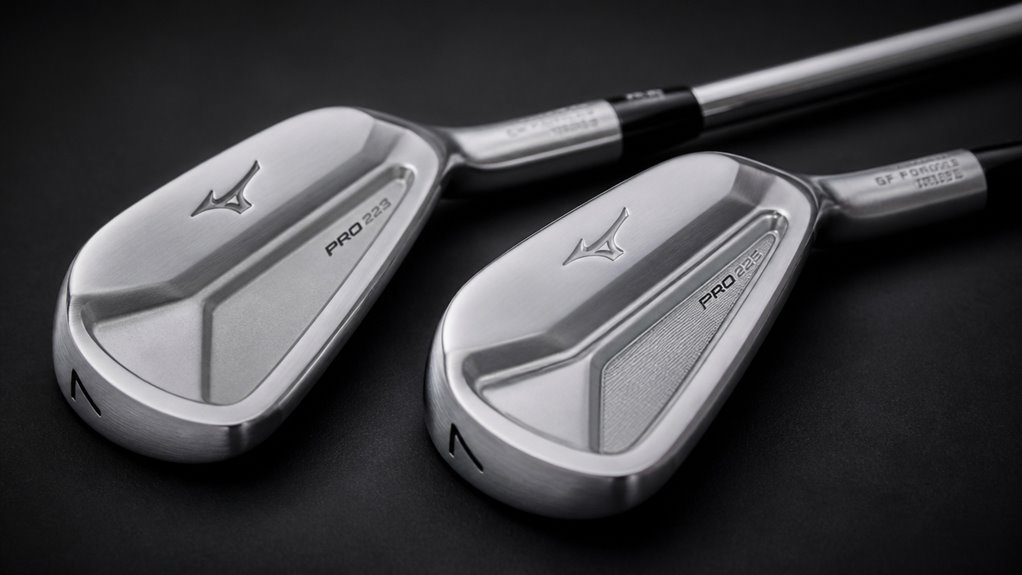
You’ll find the Mizuno Pro 223 offers a compact, tour-ready design with a thinner sole and Chromoly face focused on precision and shot-shaping.
In contrast, the 225 delivers more forgiveness with a larger hollow-body, tungsten weighting, and a multi-thickness face that boosts ball speed and distance by up to 10 yards.
Both use forged Chromoly but differ in lofts and trajectory, tailoring the 223 for control and the 225 for stability.
Explore further to see which best fits your game.

- Grain Flow Forged HD: One-piece Grain Flow Forged HD from 1025E Pure Select mild carbon steel at…
- Harmonic Impact Technology: Fine tuned head geometry delivers ideal impact feel and feedback
- 1025E Pure Select: Six time tighter tolerance than industry standard for greater purity.
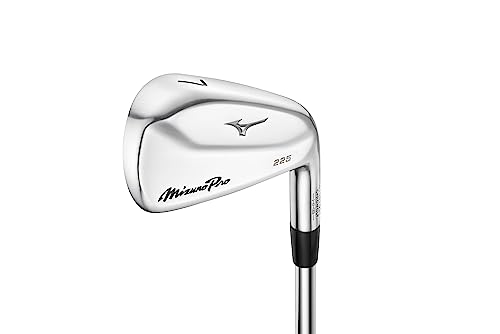
- Grain Flow Forged Chromoly: Our strongest Forged material with the solid, soft consistent feel of…
- Harmonic Impact Technology: Fine tuned head geometry delivers ideal impact feel and feedback
- Copper Underlay: Thin copper layer beneath a nickel chrome to provide a further enhanced impact feel
- Key Takeaways
- Mizuno Pro 223 vs 225 Comparison: Forgiveness, Distance, Feel, and Control
- Key Differences Between Mizuno Pro 223 and 225 Irons
- Head Design and Construction Differences Between 223 and 225
- Ball Speed and Distance Performance Comparison
- Loft Differences and Trajectory Impact
- Who Should Choose Mizuno Pro 223 or 225? Pricing and Market Positioning
- Choose the Iron That Matches Your Swing Style
Key Takeaways
- The Mizuno Pro 223 offers a smaller, compact head with thinner soles and toplines for enhanced precision and shot-shaping workability.
- The Mizuno Pro 225 features a hollow-body, dual-cavity design with tungsten weighting for increased forgiveness, stability, and higher launch.
- The 225’s multi-thickness forged Chromoly face and copper underlay boost ball speed by 2.4 to 3.5 mph, adding 4 to 10 yards of carry distance.
- The 223 uses weaker lofts for a traditional, controlled ball flight, while the 225 employs stronger lofts for greater distance without sacrificing trajectory.
- The 223 suits low handicappers prioritizing feel and control; the 225 fits mid to low handicappers seeking added forgiveness and players distance.
Mizuno Pro 223 vs 225 Comparison: Forgiveness, Distance, Feel, and Control
| Comparison Point | Mizuno Pro 223 | Mizuno Pro 225 | Best Choice |
|---|---|---|---|
| Main Design | Compact, tour-ready cavity design focused on precision | Larger hollow-body design built for speed and forgiveness | Depends on player goal |
| Player Type | Better for low handicappers and skilled shot-makers | Better for mid to low handicappers wanting help on mishits | 225 for more players |
| Forgiveness | Less forgiving due to smaller head and thinner profile | More forgiving with perimeter weighting and tungsten support | 225 for forgiveness |
| Control | Stronger option for shot-shaping and workability | Still controlled, but more focused on stability and distance | 223 for control |
| Head Shape | Smaller head, thinner sole, thinner topline | Slightly larger head with more hidden technology | 223 for classic look |
| Ball Speed | Solid speed with traditional forged feel | Higher speed from multi-thickness Chromoly face | 225 for ball speed |
| Distance | More traditional carry distance and flight | Adds roughly 4–10 yards depending on swing and strike | 225 for distance |
| Launch and Trajectory | Controlled flight with weaker, traditional lofts | Stronger lofts with tungsten helping maintain launch | 225 for easier launch |
| Feel | Classic Mizuno feel with strong feedback | Forged feel with added speed technology and copper underlay | 223 for pure feedback |
| Best Overall Use | Golfers who want precision, feel, and control | Golfers who want distance, forgiveness, and stability | Choose by swing needs |
Key Differences Between Mizuno Pro 223 and 225 Irons
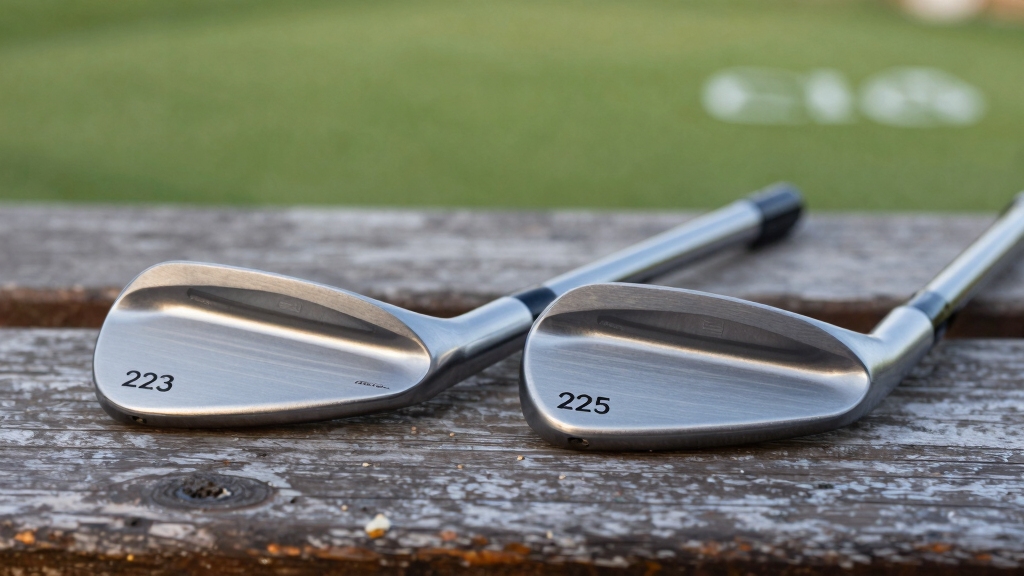
While both the Mizuno Pro 223 and 225 irons cater to skilled golfers, they differ markedly in design and performance.
The 223 features a smaller, compact head with thinner soles and top lines, prioritizing precision and workability.
In contrast, the 225 embraces a hollow-body, dual-cavity design with perimeter weighting, offering enhanced forgiveness and distance.
You’ll notice the 225 delivers about 2.4 mph more ball speed and 4 yards extra carry compared to the 223, despite similar spin and trajectory.
The 223 uses a Chromoly face for strength and control, while the 225’s multi-thickness Chromoly face and tungsten weighting boost ball speed and launch.
Additionally, the 225’s perimeter weighting and cavity back design provide a larger sweet spot for improved forgiveness and stability.
Head Design and Construction Differences Between 223 and 225
Understanding the differences in head design and construction between the Mizuno Pro 223 and 225 helps clarify how each iron achieves its unique performance characteristics.
You’ll notice the 223 features a smaller, compact head with thinner soles and toplines. This design caters to skilled players who value workability and control.
In contrast, the 225 adopts a slightly larger, hollow-body design with a dual-cavity construction. It integrates tungsten weights in the long to mid irons to enhance stability and promote a higher launch.
The 225 features a larger hollow-body and tungsten weights for improved stability and higher launch.
The 225’s multi-thickness forged Chromoly face and copper underlay improve ball speed and feel. Meanwhile, the 223 focuses on a traditional tour-ready profile with a Chromoly face for strength without sacrificing precision.
These structural choices distinctly align each iron with different player preferences. Similar to the Mizuno 225, irons like the Apex CF utilize tungsten inserts in longer irons to lower the center of gravity and enhance launch conditions.
Forgiveness and Control: Mizuno Pro 223 vs 225
You’ll notice that the Mizuno Pro 225 is more forgiving, thanks to its larger head and perimeter weighting. That means it’s a bit easier to hit consistently.
On the flip side, the 223 has a smaller, workability-driven design that really caters to those who prioritize precision. If you’re someone who loves to shape shots and values that pure feel, the 223 is definitely the way to go.
Now, if you’re looking for a balance, the 225 does a great job of combining control with added forgiveness. This makes it a solid choice for mid to low handicappers who want to hit the ball a bit further without losing playability.
Takomo irons offer a range of models tailored to different player needs, featuring perimeter weighting and forged construction that enhance forgiveness and control.
Forgiveness Differences Explained
When comparing the forgiveness of the Mizuno Pro 223 and 225, you’ll notice the 225 clearly takes the edge with its larger head and perimeter weighting. It offers more margin for error on off-center strikes.
Here’s how the forgiveness differences break down:
- The 225’s hollow-body, dual-cavity design distributes weight around the perimeter, enhancing stability.
- Tungsten weighting in the 225 lowers and deepens the center of gravity, promoting higher, more stable ball flights.
- The 223’s smaller, compact head focuses on workability, sacrificing some forgiveness for precision.
- Thinner soles and top lines on the 223 reduce forgiveness but increase shot-shaping ability.
If you prioritize forgiveness, the 225 provides a clear advantage without compromising Mizuno’s classic feel. Modern design tweaks like perimeter weighting and optimized center of gravity significantly improve forgiveness without sacrificing the forged feel.
Control and Precision Focus
While the Mizuno Pro 225 offers greater forgiveness through its larger head and perimeter weighting, the 223 holds a distinct advantage in control and precision.
Its compact, tour-ready profile and smaller head size deliver higher workability, letting you shape shots more effectively.
The thinner soles and top lines of the 223 provide a traditional feel favored by players who prioritize shot-making finesse over distance.
In contrast, the 225’s hollow-body construction and tungsten weighting promote consistent ball speed and stability but slightly reduce shot-shaping ability.
If you want to fine-tune trajectory and spin with each iron, the 223’s Chromoly face and tighter design respond better to skilled swings.
This balance between forgiveness and control is similar to how the ZipCore XL irons offer a progressive weighting system that optimizes launch and stability without sacrificing playability.
Player Suitability Comparison
Although both the Mizuno Pro 223 and 225 cater to skilled golfers, their forgiveness and control characteristics make them suited to different player profiles.
If you prioritize shot-shaping and feel, the 223’s smaller head and thinner soles provide precision and workability. Conversely, the 225’s larger head and perimeter weighting offer added forgiveness and distance without sacrificing control.
Consider these points to decide which fits you best:
- Choose the 223 if you want a tour-ready iron emphasizing control and a traditional feel.
- Opt for the 225 if you seek a players distance iron with enhanced forgiveness.
- The 223 suits low handicappers focused on precision.
- The 225 fits mid to low handicappers wanting more distance and stability.
Both models benefit from Mizuno’s Grain Flow Forged HD process, which ensures consistent feel and performance across the set.
Ball Speed and Distance Performance Comparison
Experience a noticeable boost in ball speed and distance when switching from the Mizuno Pro 223 to the 225.
The 225 increases ball speed by approximately 2.4 to 3.5 mph over the 223, translating to a carry distance gain of about 4 to 10 yards.
This improvement stems from the 225’s multi-thickness Chromoly face and hollow-body design that promote faster ball velocity across the face.
Despite these gains, spin rates, height, and descent angles remain nearly identical between the two models, ensuring a consistent flight profile.
While the 223 delivers solid speed with a compact, tour-ready head, the 225’s construction and tungsten weighting optimize energy transfer.
This makes it the preferred choice if you prioritize added distance without sacrificing control.
Additionally, selecting the proper shaft flex can further enhance ball speed and accuracy by matching the driver’s performance to your swing characteristics.
Loft Differences and Trajectory Impact
Building on the ball speed and distance advantages of the Mizuno Pro 225, loft differences play a significant role in shaping its trajectory and overall performance compared to the 223.
The 225 has stronger lofts, especially in the long and mid irons, which contribute to its higher ball speed and longer carry. You’ll notice these key impacts:
- The 225’s lofts are about two degrees stronger than the 223’s, promoting greater distance.
- Despite stronger lofts, the 225 maintains a higher trajectory thanks to wider soles and tungsten weighting.
- The 223’s weaker lofts align with a more traditional, controlled ball flight.
- Both models deliver similar spin and descent angles, so trajectory differences stem mainly from loft and design choices.
This loft setup makes the 225 ideal if you want more distance without sacrificing launch height. Proper club length and fitting, including consideration of swing weight adjustments, can further optimize performance with these irons.
Material Technology and Face Engineering in Mizuno Pro 223 and 225
You’ll notice that the Mizuno Pro 223 features a Chromoly face, which is known for its impressive strength-to-weight ratio. This design helps boost ball speed efficiently.
Now, let’s talk about the Pro 225. It takes things up a notch with a Multi-thickness Grain Flow Forged Chromoly face. What does that mean for you? Well, it allows for a thinner, stronger face that enhances speed across a larger area.
But there’s more! This forged Chromoly technology in the 225 also improves feel without sacrificing any performance. It really makes it stand out, doesn’t it?
Additionally, modern irons often incorporate laser milling and variable thickness face technology to improve spin control and maintain ball speed on mishits.
Face Material Differences
While both the Mizuno Pro 223 and 225 prioritize delivering high ball speeds, they achieve this through distinct face material technologies.
The 223 uses a Chromoly face, prized for its strength-to-weight ratio. This enables increased ball speed without sacrificing feel.
In contrast, the 225 employs a Multi-thickness Grain Flow Forged Chromoly face, which is thinner and stronger. This expands the high-speed impact zone.
- The 223’s single Chromoly face balances speed and traditional feedback.
- The 225’s multi-thickness face enhances speed across a larger area.
- Copper underlay in the 225 improves the precision forged sensation.
- The 225’s face technology supports its design for higher launch and distance.
These differences reflect Mizuno’s tailored approach to ball speed and player preference.
Their design philosophy aligns with the precision forged techniques found in top golf equipment, ensuring both performance and feel.
Forged Chromoly Advantages
The advanced face materials in the Mizuno Pro 223 and 225 owe much of their performance to the advantages of forged Chromoly.
In the 223, the Chromoly face offers an excellent strength-to-weight ratio that boosts ball speed without sacrificing feel.
The 225 takes this further with a Multi-thickness Grain Flow Forged Chromoly face, making its face thinner and stronger for increased speed across a larger area.
This design, combined with a copper underlay, enhances the forged precision feel.
You’ll notice the 225’s face material enables higher ball speeds consistently, contributing to its greater distance compared to the 223.
While both models benefit from forged Chromoly’s durability and responsiveness, the 225’s advanced face engineering clearly pushes performance boundaries for players seeking extra distance without losing the classic Mizuno feel.
Who Should Choose Mizuno Pro 223 or 225? Pricing and Market Positioning
Because both the Mizuno Pro 223 and 225 cater to discerning golfers, your choice depends largely on your priorities between shot-making precision and distance enhancement.
The 223 suits you if you value a compact, tour-ready iron with exceptional control and a traditional feel. The 225 appeals if you want added forgiveness and considerable distance gains without sacrificing a classic look.
Consider these factors:
- Opt for the 223 if you prioritize workability and a thinner sole for precise shot-shaping.
- Choose the 225 to capitalize on its hollow-body construction and tungsten weighting for higher ball speed and stability.
- Both share premium pricing around $187.50 per club, positioning them in Mizuno’s high-end player’s iron category.
- Your handicap and play style will determine which model better fits your game’s demands.
Frequently Asked Questions
Are Mizuno Pro 223 and 225 Irons Available in Left-Handed Versions?
You won’t find Mizuno Pro 223 or 225 irons in left-handed versions since both are typically offered only in right-hand configurations.
If you play left-handed, this limits your options with these models. However, you can explore custom orders or other Mizuno lines that cater to lefties.
Considering their design focus on precision and players distance, availability constraints might push you to seek alternatives that match your handedness and performance needs.
What Shaft Options Come Standard With the Mizuno Pro 223 and 225?
You’ll find the Mizuno Pro 223 typically comes with premium steel shaft options like the True Temper Dynamic Gold or Nippon Modus3, focusing on players who want precision and control.
The Pro 225 offers similar shaft choices but often includes a slightly lighter or more flexible steel option to complement its distance-oriented design.
Both cater to skilled golfers, but the 225’s shaft setups lean toward enhancing ball speed and forgiveness.
How Do the Grips on the 223 and 225 Compare in Feel and Durability?
Like choosing between a classic novel and a thrilling new release, the grips on the 223 and 225 offer distinct experiences.
The 223’s grips feel softer and more traditional, providing excellent tactile feedback with moderate durability.
Meanwhile, the 225 grips are slightly firmer, designed for enhanced longevity and consistent performance under stress.
If you want a plush feel, go for the 223, but for durability and a secure hold, the 225’s grips have the edge.
Are There Any Differences in Club Customization Options Between the 223 and 225?
You’ll find that both the 223 and 225 offer similar customization options, including shaft selections and lie angle adjustments tailored to your swing.
However, the 225’s stronger lofts and tungsten weighting might influence your choices toward shafts that complement its distance and forgiveness focus.
The 223, with its tour-ready profile, encourages setups favoring precision and control.
Which Mizuno Pro Iron Model Is Better Suited for Beginner Golfers?
If you’re starting out, the Mizuno Pro 225 suits you better. It’s like having a safety net with its larger head, perimeter weighting, and tungsten inserts, offering more forgiveness and boosting your distance.
The 223 favors precision and workability, which might challenge beginners. The 225’s stronger lofts and hollow-body design also help launch the ball higher and farther, making it easier to gain confidence and consistency in your game.
- Grain Flow Forged HD: One-piece Grain Flow Forged HD from 1025E Pure Select mild carbon steel at…
- Harmonic Impact Technology: Fine tuned head geometry delivers ideal impact feel and feedback
- 1025E Pure Select: Six time tighter tolerance than industry standard for greater purity.
- Grain Flow Forged Chromoly: Our strongest Forged material with the solid, soft consistent feel of…
- Harmonic Impact Technology: Fine tuned head geometry delivers ideal impact feel and feedback
- Copper Underlay: Thin copper layer beneath a nickel chrome to provide a further enhanced impact feel
Choose the Iron That Matches Your Swing Style
When choosing between the Mizuno Pro 223 and 225, think of it as picking the right tool for your game’s toolbox.
The 223 offers a classic feel with more control, ideal if you value precision over forgiveness.
The 225, meanwhile, delivers enhanced forgiveness and distance, perfect if you want a bit more help on off-center hits.
Understanding these subtle differences helps you swing smarter, not harder. Tailor your choice to your unique playstyle.
Last update on 2026-10-06 / Affiliate links / Images from Amazon Product Advertising API