
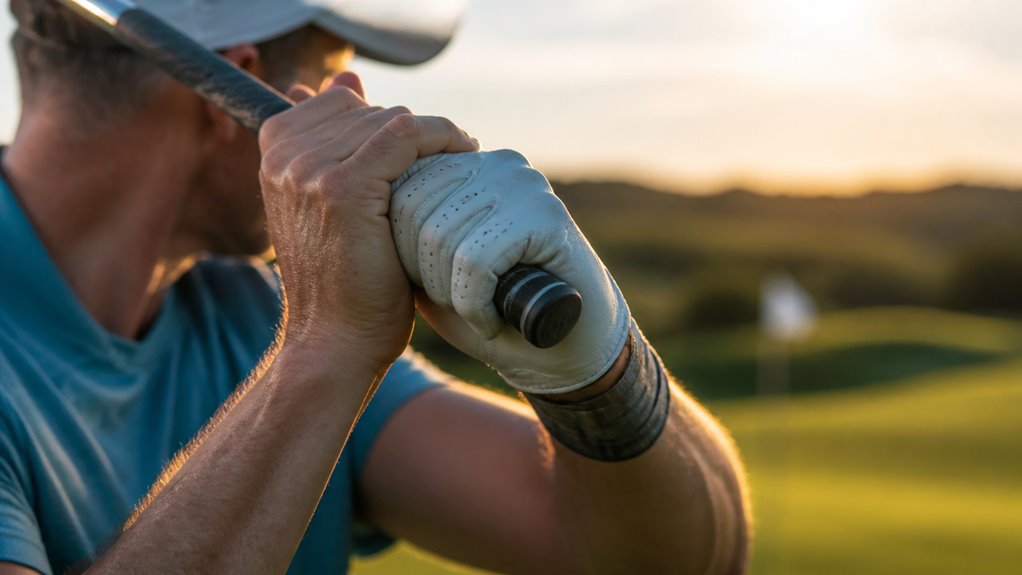
Hitting golf balls offers light to moderate exercise by engaging your core, back, and upper body muscles through repeated swings.
It raises your heart rate similarly to a brisk walk but doesn’t provide enough continuous movement or weight-bearing to build significant strength or cardiovascular fitness alone.
While it supports balance and coordination, you’ll get better health benefits by combining range practice with walking the course and other aerobic or strength activities.
Explore how golf fits into a thorough fitness plan for best results.
- Key Takeaways
- Is Hitting Golf Balls Good Exercise?
- How Does Hitting Golf Balls Affect Your Heart and Calories?
- Which Muscles Get a Workout When You Swing?
- How Golf Helps Your Balance and Coordination?
- Driving Range vs Walking a Golf Course: Which Burns More Calories?
- Why Hitting Golf Balls Alone Isn’t Enough for Fitness?
- Tips to Make Your Golf Practice a Better Workout
- Why Golf Works Best When Combined With Other Fitness Activities?
- How to Include Golf in Your Overall Fitness Routine?
- Frequently Asked Questions
- Can Hitting Golf Balls Help Improve Mental Focus and Concentration?
- How Does Weather Affect the Exercise Benefits of Practicing Golf?
- Are There Injury Risks Associated With Frequent Golf Swing Practice?
- What Equipment Helps Maximize Fitness Gains During Golf Practice?
- How Does Age Impact the Exercise Benefits of Hitting Golf Balls?
- Final Verdict: Is Hitting Golf Balls Good Exercise?
Key Takeaways
- Hitting golf balls provides light to moderate physical activity similar to a brisk walk but lacks vigorous exercise benefits.
- Range practice engages core and upper body muscles but does not significantly build muscle mass or strength alone.
- Calorie burn from hitting balls is moderate and lower than walking a full 18-hole course.
- Practice improves balance, coordination, and rotational movement but offers limited overall fitness without complementary exercises.
- Combining golf practice with strength training and aerobic activities creates a more effective, holistic fitness routine.
Is Hitting Golf Balls Good Exercise?
Hitting golf balls can count as exercise, but it typically provides light to moderate physical activity rather than intense training.
Hitting golf balls offers light to moderate physical activity, rather than vigorous exercise.
When you practice at the driving range, your body engages dynamically, somewhat like a brisk walk, activating multiple muscle groups including your core, shoulders, and back.
However, the overall exercise volume remains relatively low unless you sustain continuous swings with minimal rest and extend your session duration.
The physical demand increases when you combine hitting balls with walking the course or carrying clubs, which turns golf into a more total-body workout.
On its own, range practice offers limited strength gains and cardiovascular benefits.
It’s best viewed as a component of a broader fitness routine rather than a standalone exercise regimen.
In addition, golf provides moderate aerobic exercise that improves cardiovascular health and supports overall wellness.
How Does Hitting Golf Balls Affect Your Heart and Calories?
While practicing your golf swing at the range activates multiple muscle groups, its impact on your heart rate and calorie expenditure tends to be modest.
Typically, hitting balls elevates your heart rate to around 97–100 beats per minute, which is light exercise compared to sustained aerobic activities.
You can expect to burn calories roughly equivalent to a brisk walk, with a range session generally burning fewer calories than playing a full round.
However, longer sessions with continuous swings and minimal rest increase both heart rate and calorie burn.
For meaningful cardiovascular benefit and higher energy expenditure, combining range practice with walking the course or adding movement drills is essential.
Alone, hitting golf balls offers limited aerobic stimulus but supports moderate calorie burning as part of an active routine.
Incorporating a dynamic warm-up before hitting balls can enhance muscle activation and improve overall performance.
Which Muscles Get a Workout When You Swing?
When you swing a golf club, it’s not just your arms doing all the work. Your core and back muscles really step up to stabilize and power the movement.
As you swing, your rotational muscles, like your abs and obliques, kick in to help generate torque efficiently. It’s pretty interesting to see how much more is involved, right? Golf is definitely about more than just arm strength!
However, improper swing mechanics can increase stress on the wrist, leading to issues such as ECU tendonitis and other injuries.
Core And Back Engagement
Although swinging a golf club may seem simple, it actively engages several key muscle groups in your core and back. Your abdominal muscles stabilize your torso, while your lower back muscles support spinal alignment throughout the swing.
This engagement helps generate power and maintain balance. Regular practice strengthens these muscles, improving posture and reducing injury risk.
| Muscle Group | Role During Swing |
|---|---|
| Abdominals | Stabilize torso |
| Obliques | Assist in controlled bending |
| Lower Back (Erector Spinae) | Support spine and posture |
| Latissimus Dorsi | Aid in club acceleration |
This precise activation makes hitting balls a moderate workout for your core and back, contributing to overall muscular endurance. Incorporating thoracic spine mobility exercises can further enhance swing rotation and reduce strain on the lower back and hips.
Rotational Muscle Activation
Activating your rotational muscles during a golf swing engages several key groups responsible for generating power and control.
Primarily, your obliques and abdominal muscles work to twist your torso, while your lower back stabilizes this rotation. The latissimus dorsi and shoulders contribute to swinging the club through a coordinated movement.
This dynamic interplay of muscles not only produces the torque necessary for an effective strike but also enhances balance and posture control. Research shows that repeated swings activate these muscles in both concentric and eccentric contractions, promoting endurance and neuromuscular coordination.
While golf swings alone don’t build significant muscle mass, they effectively engage multiple muscle groups that support rotational strength and stability. This makes it a practical component of a broader fitness routine. Wearing moisture-wicking performance fabrics during play can help maintain comfort and focus while exercising.
How Golf Helps Your Balance and Coordination?
When you hit golf balls, you really get into the groove of managing your stance. It’s all about keeping your stability throughout that swing, right? As you practice, you find yourself shifting your weight and adjusting your posture. Over time, this not only helps you hit better shots but also improves your balance.
And let’s talk about the rotational movement involved. That’s where the magic happens! By practicing your swing, you’re training your body to move more efficiently and with precision. It’s like a workout for your coordination. So, every time you’re out on the course, you’re not just playing a game; you’re honing your balance and coordination skills, too!
Maintaining a smooth rhythm and proper weight transfer during the swing further enhances your overall balance and body control.
Improving Stance Control
Mastering your stance during a golf swing directly enhances your balance and coordination by demanding precise control over weight distribution and posture.
You must stabilize your feet evenly, engage your core, and maintain proper alignment, which challenges your proprioceptive skills.
Research shows repeated stance control during swings improves neuromuscular coordination, critical for balance maintenance.
This controlled positioning activates stabilizing muscles in the lower body and core, reinforcing postural adjustments.
Although range sessions provide less balance training than walking varied terrain, consistent practice sharpens your ability to shift weight smoothly without losing stability.
By refining stance mechanics, you develop better postural awareness, reducing fall risk and enhancing overall motor control.
Consequently, improving stance control through golf offers measurable gains in balance and coordination, particularly valuable for aging adults or those seeking functional fitness.
Additionally, following proper golf etiquette during practice and play helps maintain focus and consistency in stance control, further benefiting balance and coordination.
Enhancing Rotational Movement
Because golf swings demand controlled rotational movement, you engage your core, obliques, and lower back muscles in ways that enhance your balance and coordination.
This repeated rotational action requires precise weight shifts and posture adjustments, which strengthens your neuromuscular control.
Research shows that these movements improve proprioception, especially important for maintaining stability on varied terrain.
While short driving-range sessions provide moderate stimulation, combining swings with walking on the course amplifies these benefits by challenging your lower-body stability further.
Over time, this dynamic interplay between rotation and stance control refines your motor patterns, reducing fall risk and improving overall mobility.
However, hitting balls alone offers limited balance training compared to full rounds.
Integrating walking and weight-bearing activities maximizes golf’s potential as a coordination-enhancing exercise.
Proper maintenance of your equipment, including regular cleaning and groove care, supports consistent performance and contributes to the overall effectiveness of your golf practice through improved shot control and feedback from the clubface during swings, emphasizing the importance of groove maintenance in your routine.
Driving Range vs Walking a Golf Course: Which Burns More Calories?
Comparing calorie burn between hitting balls at the driving range and walking a golf course reveals clear differences in energy expenditure.
While range sessions provide light to moderate exercise, walking a full 18-hole course markedly increases your calorie burn.
Research shows:
Hitting balls alone burns fewer calories, roughly comparable to a brisk walk.
Walking 18 holes can expend between 1,200 to 1,600 calories, depending on pace and terrain.
Using a golf cart reduces energy expenditure, averaging around 500 calories per round.
Longer range sessions with minimal rest enhance calorie burn but rarely match the sustained effort of course walking.
If your goal is maximizing calorie burn, walking a golf course clearly offers a more effective workout than stationary practice at the range.
Walking 18 holes typically results in 10,000 to 13,000 steps, contributing to its higher calorie burn and physical benefits.
Why Hitting Golf Balls Alone Isn’t Enough for Fitness?
Although hitting golf balls engages multiple muscle groups and raises your heart rate to some extent, it generally provides only light to moderate exercise. This falls short of all-encompassing fitness benefits.
When you practice solely at the driving range, your cardiovascular workload stays relatively low, often near 97–100 beats per minute. This is insufficient for meeting aerobic exercise guidelines.
Additionally, range sessions lack the continuous movement and weight-bearing activities that promote significant calorie burn, muscle strengthening, and balance improvements.
The repetitive swings target core and upper-body muscles but don’t generate enough resistance or volume to induce major strength gains or body-shape changes.
Without incorporating walking, carrying clubs, or extended duration, hitting balls alone remains a limited form of physical activity. It’s best supplemented with other fitness components to achieve thorough health benefits.
In contrast, playing a full round of golf involves moderate-intensity exercise that can burn significant calories and improve cardiovascular health.
Tips to Make Your Golf Practice a Better Workout
Enhancing your golf practice to serve as effective exercise involves increasing intensity, duration, and movement variety.
Merely hitting balls at the range offers light exercise, so you should structure sessions to boost cardiovascular and muscular engagement.
To make your practice a better workout, try these evidence-based tips:
Alternate between continuous swings and brief movement drills to keep your heart rate elevated.
Extend practice sessions to increase total calorie burn and muscle activation.
Incorporate dynamic stretches and rotational mobility exercises to improve balance and flexibility.
Minimize rest periods to sustain moderate aerobic effort comparable to a brisk walk.
Why Golf Works Best When Combined With Other Fitness Activities?
Because hitting golf balls alone provides primarily light to moderate exercise, combining golf with other fitness activities markedly boosts your overall workout effectiveness.
Golf’s dynamic, multi-muscle engagement offers benefits, but its cardiovascular impact is limited without added aerobic effort.
By integrating strength training or aerobic exercises, you enhance muscle development and calorie burn beyond what golf alone achieves.
Walking the course or carrying clubs elevates heart rate and energy expenditure, complementing the sport’s balance and coordination benefits.
Additionally, combining golf with targeted fitness routines addresses golf’s insufficiency in muscle-building and intense cardiovascular conditioning.
This holistic approach guarantees you meet recommended weekly exercise guidelines while improving performance, mobility, and overall health more effectively than relying on golf practice alone.
How to Include Golf in Your Overall Fitness Routine?
Incorporating golf into your overall fitness routine requires balancing its light to moderate exercise benefits with complementary activities that target cardiovascular health, strength, and flexibility.
Since hitting balls alone provides limited aerobic stimulus and modest muscle engagement, you should blend golf practice with other forms of exercise to maximize fitness gains.
Consider these strategies:
Walk the course instead of using a cart to increase calorie burn and cardiovascular load.
Combine range sessions with strength training to develop core and upper-body muscles involved in the swing.
Include dynamic stretching and mobility drills to enhance flexibility and reduce injury risk.
Structure practice with continuous swings and minimal rest to elevate heart rate closer to aerobic zones.
This evidence-based approach guarantees golf contributes effectively to your broader fitness goals.
Frequently Asked Questions
Can Hitting Golf Balls Help Improve Mental Focus and Concentration?
Yes, hitting golf balls can help improve your mental focus and concentration.
The sport requires you to maintain attention on swing mechanics, ball placement, and timing, which sharpens your cognitive control.
Repeated practice cultivates mindfulness and reduces distractions.
Additionally, golf’s rhythm and precision enhance your ability to sustain mental engagement over time.
This benefits your overall concentration skills in both sport and daily tasks.
How Does Weather Affect the Exercise Benefits of Practicing Golf?
Weather impacts your golf practice by influencing intensity and duration.
Warm, dry conditions let you practice longer with less fatigue, boosting calorie burn and cardiovascular benefits.
Cold or wet weather may shorten sessions and reduce muscle warmth, lowering exercise quality.
Wind can increase physical effort for stability and control, enhancing balance work.
To maximize benefits, adapt your practice to weather. Dress appropriately, warm up well, and adjust intensity based on conditions.
Are There Injury Risks Associated With Frequent Golf Swing Practice?
Imagine you’re a knight repeatedly swinging his sword.
Overdoing golf swings can cause injury risks like muscle strains, tendonitis, or lower back pain.
Frequent practice stresses your core, shoulders, and wrists, especially without proper warm-up or technique.
To minimize harm, mix in rest, stretch well, and vary your routine.
Evidence shows that overuse injuries arise from repetition without recovery.
Balance practice with conditioning and listen to your body to stay safe.
What Equipment Helps Maximize Fitness Gains During Golf Practice?
To maximize fitness gains during golf practice, you should use weighted clubs or swing trainers to increase resistance and engage muscles more intensely.
Incorporate wearable fitness trackers to monitor heart rate and activity levels.
Use a golf bag designed for carrying to build endurance and strength.
Adding resistance bands and balance boards can improve stability and coordination, turning your practice into a more all-encompassing workout that targets strength, cardiovascular health, and mobility.
How Does Age Impact the Exercise Benefits of Hitting Golf Balls?
Like a well-oiled clock, your body’s response to hitting golf balls shifts with age.
As you grow older, the balance and coordination benefits become more pronounced, helping maintain stability and proprioception.
However, your cardiovascular response might lessen, requiring longer or more active sessions to achieve aerobic gains.
Emphasizing controlled, continuous swings and integrating walking can maximize exercise benefits.
This makes golf practice a valuable, age-adaptive component of your fitness routine.
Final Verdict: Is Hitting Golf Balls Good Exercise?
Hitting golf balls alone burns about 150 calories per hour, which is modest compared to other activities.
While swinging engages key muscles and improves coordination, it won’t replace a full workout.
To maximize fitness, combine your practice with walking the course or strength training.
By integrating golf into a broader routine, you’ll enjoy better heart health, balance, and calorie burn.
This turns a leisurely activity into a more effective exercise habit.