
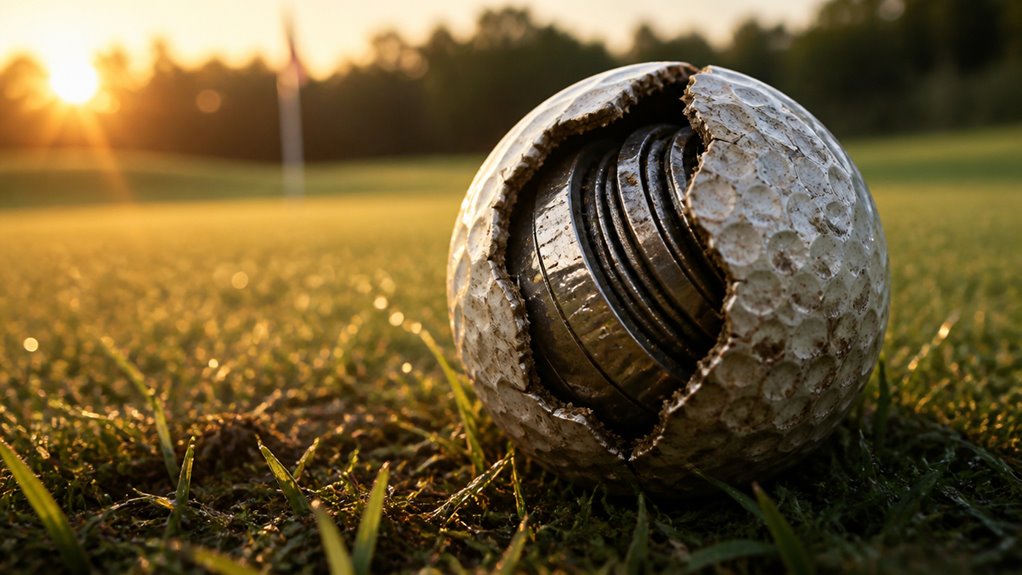
You use illegal distance golf balls when you want to exploit designs that surpass limits on size, weight, velocity, and sphericity to gain measurable advantages.
These balls often have larger cores, asymmetrical dimples, or altered compression to increase ball speed and reduce spin for straighter, longer shots.
Tournament bans exist because such balls compromise fairness by enhancing distance and accuracy beyond regulations.
Understanding their unique features sheds light on how technology pushes performance boundaries.
- Key Takeaways
- Factors That Make a Golf Ball Illegal for Distance Play
- Why Illegal Distance Golf Balls Are Banned in Tournaments?
- How Illegal Golf Balls Increase Distance and Improve Accuracy?
- How Self-Correcting Tech Helps Illegal Balls Fly Straighter?
- Top Illegal Distance Golf Balls and What Makes Them Special
- Frequently Asked Questions
- Final Thoughts on Illegal Distance Golf Balls
Key Takeaways
- Illegal distance golf balls exceed USGA/R&A standards for size, weight, velocity, or sphericity, giving unfair performance advantages.
- These balls use larger cores or special covers to increase speed, resulting in longer carry distances beyond legal limits.
- Asymmetrical dimple patterns and altered construction improve flight stability and accuracy but violate equipment rules.
- Tournament bans target such balls to maintain fairness, with penalties including disqualification for use.
- Popular examples like Polara XD and MG Senior claim 10-20 yards extra distance by reducing spin and optimizing launch conditions.
Factors That Make a Golf Ball Illegal for Distance Play
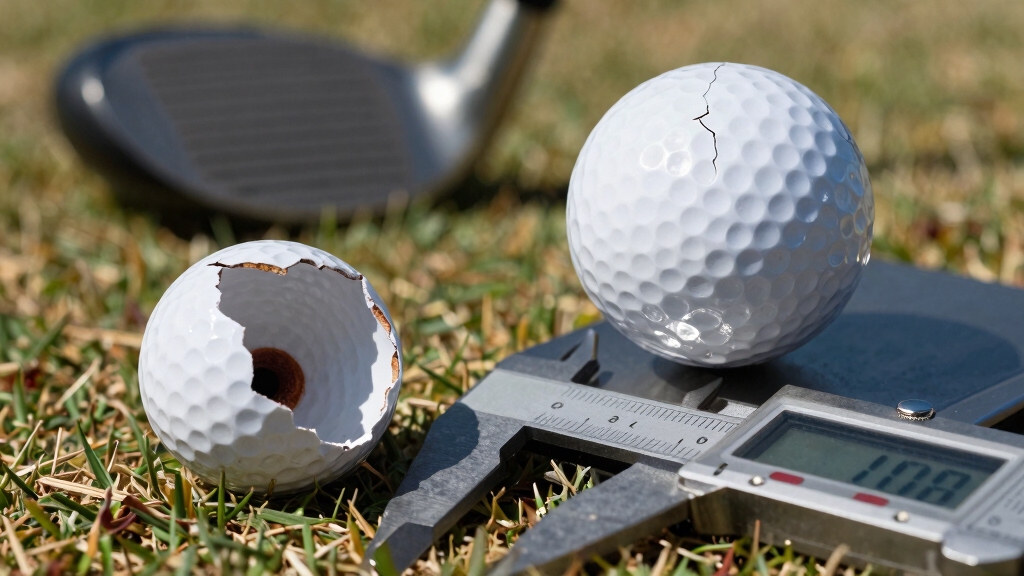
Although many golf balls look similar, certain design factors can make a ball illegal for distance play under USGA and R&A rules. You need to guarantee the ball conforms to strict limits on size, weight, initial velocity, overall distance, and sphericity.
If a ball falls outside these parameters, such as having a smaller diameter, heavier construction, or a core that increases speed beyond accepted thresholds, it’s deemed non-conforming. Additionally, asymmetrical dimple patterns that alter flight characteristics violate sphericity rules.
Lower spin rates and self-correcting designs, like those reducing hooks and slices, also breach regulations by providing unfair advantages. Always check if the ball is on the USGA conforming list; if not, it won’t be legal for tournament play as it compromises the standardized equipment criteria established for fair competition. The choice between urethane and Surlyn covers can also influence conformity, as their material properties affect spin and distance characteristics regulated by the rules.
Why Illegal Distance Golf Balls Are Banned in Tournaments?
Because illegal distance golf balls provide measurable performance advantages, tournament officials ban them to maintain fairness and integrity in competition.
Illegal distance golf balls are banned to preserve fairness and integrity in competitive play.
You must understand that these balls violate USGA and R&A equipment standards, particularly limits on initial velocity, overall distance, and sphericity.
Using such balls artificially enhances shot distance or accuracy, disrupting the level playing field that tournaments demand.
When you use a non-conforming ball, you gain an unfair equipment advantage, undermining competitive balance and the validity of scoring comparisons.
Consequently, officials enforce strict penalties, including disqualification, to deter their use.
These standards often relate to core technology and compression, which directly impact the ball’s speed and distance, as seen in high-speed Reactiv core designs.
How Illegal Golf Balls Increase Distance and Improve Accuracy?
Illegal golf balls boost distance and improve accuracy by manipulating key physical and aerodynamic properties beyond USGA limits. They achieve higher initial velocity through larger cores and heavier construction. Reduced spin minimizes side curvature. Smaller size or asymmetrical dimple patterns alter flight stability, enhancing carry distance and fairway hit percentage. However, these performance gains come at the cost of violating compression standards, which are designed to optimize energy transfer and shot consistency.
| Property | Effect on Performance |
|---|---|
| Larger Core | Increases ball speed, distance |
| Lower Spin Rate | Reduces hooks and slices, improves accuracy |
| Asymmetrical Dimples | Alters aerodynamic drag, extends carry |
How Self-Correcting Tech Helps Illegal Balls Fly Straighter?
Self-correcting technology in golf balls actively reduces hooks and slices by manipulating aerodynamic forces during flight.
Self-correcting golf balls use aerodynamic forces to minimize hooks and slices mid-flight.
You benefit from asymmetrical dimple patterns that create differential drag, generating stabilizing moments to counteract side spin.
This aerodynamic intervention reduces the ball’s lateral deviation by up to 75%, effectively straightening your shots.
The ball’s internal design shifts the center of pressure, promoting a self-aligning trajectory when you orient the ball’s marker toward your target.
While this improves accuracy, it violates USGA symmetry rules, rendering these balls illegal for official play.
By reducing side spin, you achieve a more stable, controlled flight path, decreasing hooks and slices substantially.
However, this self-correcting mechanism may slightly reduce your overall distance, trading raw carry for enhanced directional consistency.
Modern golf ball tracking systems utilize aerodynamic modeling to simulate and analyze these flight path modifications in real time.
Top Illegal Distance Golf Balls and What Makes Them Special
While self-correcting technology enhances shot accuracy by reducing hooks and slices, certain golf balls also push the boundaries of distance performance through design innovations that exceed USGA regulations.
Balls like the Polara XD leverage asymmetrical dimple patterns, improving flight stability but violating sphericity rules.
Models such as the MG Senior exceed initial velocity limits by employing larger cores and heavier constructions, maximizing ball speed.
Bandit balls focus on maximizing carry distance, often surpassing USGA velocity and overall distance thresholds.
These designs frequently reduce spin to minimize side curvature while increasing ball speed for longer drives.
If you prioritize raw distance over conformity, these balls deliver noticeable yardage gains—often 10 to 20 yards more—but at the cost of tournament legality due to their non-conforming physical and performance characteristics.
Many of these balls achieve their performance through low driver spin and advanced core technology, optimizing launch and carry distance beyond typical legal limits.
Frequently Asked Questions
Can I Use Illegal Distance Golf Balls for Casual Rounds?
Yes, you can use illegal distance golf balls for casual rounds since no official rules prohibit them outside tournament play.
However, keep in mind that these balls often increase distance or reduce hooks and slices by altering spin and flight characteristics.
While they provide an advantage in casual settings, using them in tournaments or for handicap purposes is prohibited due to fairness and equipment conformity standards set by governing bodies.
How Do Illegal Golf Balls Affect My Handicap Posting?
Using illegal golf balls during rounds can invalidate your score for handicap posting.
Since these balls provide an equipment advantage by increasing distance or reducing spin, scores achieved with them aren’t recognized by the USGA or World Handicap System.
To maintain accurate and compliant handicap records, you should only post scores made with conforming balls listed on the USGA’s approved list.
Otherwise, your handicap won’t accurately reflect your true skill level.
Are There Legal Alternatives for Players Seeking More Distance?
Yes, you can find legal alternatives to increase distance without violating rules.
Opt for lower-compression golf balls that conform to USGA standards, which help maximize energy transfer and ball speed.
Choose models with optimized dimple patterns and construction designed for distance within regulations.
Prioritize balls on the USGA conforming list to avoid penalties.
This approach guarantees you gain distance while maintaining compliance for tournament play and accurate handicap posting.
What Penalties Apply if Caught Using Illegal Balls in Tournaments?
If you get caught using illegal balls in a tournament, you face disqualification.
Tournament rules strictly enforce the use of conforming equipment. Non-conforming balls provide an unfair advantage.
Officials will assess your ball against USGA and R&A standards. If it’s non-conforming, your scorecards can be invalidated.
This penalty is designed to maintain fairness and integrity. You must make certain your balls meet all regulations before play.
How Can I Verify if a Golf Ball Is USGA Conforming?
To verify if your golf ball is USGA conforming, you’ll want to consult the official USGA conforming ball list. Think of it as the rulebook’s gatekeeper.
Check the ball’s model and manufacturer against this list on the USGA website. Additionally, make certain the ball adheres to size, weight, velocity, and sphericity standards.
If your ball isn’t on the list or fails these technical specs, it’s considered non-conforming and prohibited in official play.
Final Thoughts on Illegal Distance Golf Balls
You understand why illegal distance golf balls push boundaries and why tournaments ban them.
You see how advanced tech boosts distance and accuracy.
Self-correcting features enhance flight stability, and you recognize what sets top illegal balls apart.
By grasping these factors, you understand the delicate balance between innovation and regulation, performance and fairness.
In mastering this balance, you refine your game and respect the integrity of golf’s competitive spirit.