
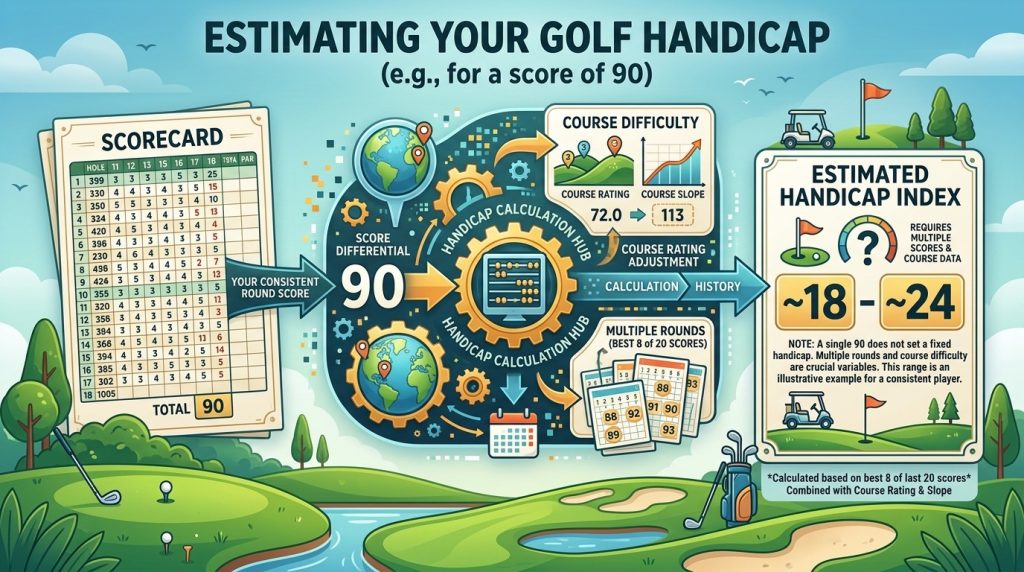
If you shoot a 90 regularly on a par-72 course, your handicap will likely hover around 18, since that score is about 18 strokes over par.
Keep in mind, course rating and slope adjust this number, meaning your actual handicap might shift depending on where and how you play.
You’ll need at least 54 holes tracked to get an official Handicap Index, which averages your best score differentials.
Understanding these factors helps you fine-tune your game and grasp how your 90 influences your overall handicap.
- Key Takeaways
- What Shooting a 90 Really Means for Your Handicap?
- Why Course Rating and Slope Matter for Your Handicap When Shooting 90?
- How to Estimate Handicap From a 90 Score on Par-72 Courses?
- Calculating Course Handicap From a 90 Score
- How Many Scores to Establish a Handicap Index?
- How Do Score Differentials Refine Your Handicap?
- How Playing Conditions and Adjustments Affect Your Handicap After Shooting 90?
- Top Tools to Calculate Your Handicap From a 90 Score
- How Your Handicap Index Changes When You Shoot 90 Regularly?
- Frequently Asked Questions
- From 90 to Next Level: Your Golf Journey Starts Here
Key Takeaways
- Shooting a consistent score of 90 on a par-72 course typically indicates a handicap around 18.
- Handicap index calculation requires adjusting your score for course rating and slope ratings.
- Course Handicap = Handicap Index × (Slope ÷ 113) + (Course Rating − Par), refining your strokes given course difficulty.
- A single 90 score provides a baseline but your official handicap needs at least 54 holes for accuracy.
- Playing conditions and course difficulty affect how a 90 translates into your actual Handicap Index.
What Shooting a 90 Really Means for Your Handicap?
Consistently shooting a 90 usually indicates a handicap around 18 on a standard par-72 course.
This means you typically score 18 strokes over par, reflecting your current playing ability.
Your handicap index represents this skill level, allowing you to compete fairly against golfers of varying abilities.
To estimate your handicap from shooting 90 regularly, subtract the par (72) from your average gross score (90), giving you 18.
This rough calculation aligns with the simple handicap method, which averages your best scores and adjusts for course difficulty.
Keep in mind, your actual handicap index can vary with different courses and ratings.
However, shooting 90 consistently gives you a solid baseline.
Stay encouraged; tracking scores accurately helps you improve and refine your handicap over time.
Understanding how the handicap system works ensures you make the most accurate adjustments to your playing level.
Why Course Rating and Slope Matter for Your Handicap When Shooting 90?
Understanding your handicap from shooting a 90 involves more than just subtracting par from your score.
You need to factor in the course rating and slope, which reflect the course’s difficulty.
The course rating measures how tough the course plays for a scratch golfer, while the slope rating adjusts for challenges faced by a bogey golfer.
These numbers directly impact your course handicap, which translates your Handicap Index into strokes allowed on that specific course.
For example, shooting 90 on a course with a high slope means your handicap might be lower than if you shot 90 on an easier course.
Factoring in these ratings guarantees your handicap accurately represents your skill.
This lets you compete fairly and track improvement effectively.
Additionally, understanding the stroke index helps you see which holes will most affect your handicap strokes during play.
How to Estimate Handicap From a 90 Score on Par-72 Courses?
When you shoot a 90 on a par-72 course, estimating your Handicap Index is pretty straightforward. Just subtract 72 from your score, and you’ll find a rough estimate of around 18. That’s your handicap if you keep playing consistently at that level.
But there’s more to it! Your Course Handicap comes into play, which adjusts that number based on the specific course’s Slope and Rating. This adjustment gives you a much clearer picture of your actual playing ability. Understanding the difference between gross and net scores helps clarify why these adjustments matter for fair competition.
Calculating Handicap Index
To estimate your Handicap Index from a score of 90 on a par-72 course, start by recognizing that a 90 typically reflects a handicap around 18 if your performance is steady.
To calculate it more precisely, you’ll need at least 54 holes of scores. The Handicap Index averages the lowest 40% of your recent score differentials, which adjust your gross scores for course difficulty using the Course Rating and Slope Rating.
For a quick estimate, subtract 72 from your average lowest scores. If you consistently shoot 90, your differential hovers near 18.
Keep entering your scores, and the system will refine your Handicap Index over time. Stay consistent, and you’ll see an accurate reflection of your playing ability emerge.
Taking professional golf instruction can help improve your skills and lower your handicap more effectively.
Course Handicap Impact
Since your Handicap Index reflects your potential ability, converting it into a Course Handicap helps you see how many strokes you’ll receive on a specific par-72 course.
To estimate your Course Handicap from a 90 score, start by recognizing that a consistent 90 roughly equates to an 18 Handicap Index.
Use the formula: Handicap Index × (Slope Rating ÷ 113) + (Course Rating − Par).
For example, with a Slope of 127 and Course Rating of 72, your Course Handicap would be close to 18.
This means you receive 18 strokes, making your net score near par.
Understanding this impact clarifies how your raw score translates into a competitive level on that course.
It encourages you to track scores and adjust expectations effectively.
Maintaining good pace of play during your rounds can also help improve your overall golfing experience and performance.
Calculating Course Handicap From a 90 Score
To figure out your Course Handicap from a score of 90, the first step is to estimate your Handicap Index. This should be based on your consistent scoring over time.
It’s like getting a feel for where you stand as a golfer.
Once you have a good idea of your Handicap Index, you can dive into the Course Handicap formula. You’ll need the course’s Slope Rating and Course Rating for this part.
These ratings help tailor your score to the specific challenges of different courses.
So, by using this method, you can see how your 90 translates into strokes you might be allowed on various courses.
It’s a handy way to gauge your game across different playing fields!
Understanding factors like dynamic loft and swing mechanics can also improve your overall game performance.
Estimating Handicap Index
How can you estimate your Handicap Index from a single score of 90? While official indexes require multiple rounds, you can get a solid estimate by understanding key factors.
Typically, shooting 90 on a par-72 course suggests a Handicap Index near 18, assuming consistent play. This rough estimate helps you gauge your skill level before posting enough scores for an official index.
Consider these points to estimate your Handicap Index effectively:
A 90 score minus par 72 equals 18 strokes over par. Handicap Index averages your best performances, so one 90 is a starting point.
Course rating and slope adjust difficulty but aren’t needed for rough estimates. Minimum 54 holes are needed for a true official Handicap Index.
Using metrics like strokes gained can provide deeper insight into your performance beyond just the score.
Use your 90 score as motivation to track and improve!
Applying Course Handicap Formula
When you want to translate your estimated Handicap Index from a 90 score into a Course Handicap for a specific course, you’ll need to apply the Course Handicap formula.
Start by multiplying your Handicap Index by the course’s Slope Rating divided by 113. Then, add the difference between the Course Rating and the Par.
This calculation adjusts your index for course difficulty, giving you a Course Handicap that reflects the strokes you get on that course.
For example, if your estimated Handicap Index is 18 and the course has a Slope of 127, Course Rating of 72.5, and Par 72, your Course Handicap = 18 × (127/113) + (72.5 – 72) ≈ 20.
This means you get 20 strokes, helping you compete fairly and enjoy your round more.
To ensure optimal performance, also consider proper club length based on your height and swing style when evaluating your handicap and game improvement.
How Many Scores to Establish a Handicap Index?
Typically, you need to post at least 54 holes of golf before you can establish a valid Handicap Index. This usually means playing either three 18-hole rounds or six 9-hole rounds.
The more scores you post, up to 20, the more accurate your Handicap Index will be. Here’s what you should keep in mind:
Minimum of 54 holes required for initial Handicap Index. You can use a combination of 9- and 18-hole rounds.
The system uses your best 8 score differentials from your most recent 20 rounds. Posting fewer than 20 scores still allows a Handicap Index but with less precision.
Regularly updating your scores refines and improves your Handicap Index over time.
Understanding how different golf ball covers affect play can help tailor your game as your handicap changes, especially factors like spin rates and control.
How Do Score Differentials Refine Your Handicap?
Because your raw scores don’t tell the whole story, score differentials adjust each round to reflect course difficulty and playing conditions. This gives you a more accurate measure of your true ability.
Each score differential factors in the course rating and slope rating. So a 90 on a tough course might translate into a lower differential than the same score on an easier course.
By calculating differentials for up to 20 recent rounds and averaging your best eight, you refine your Handicap Index. This reflects consistent performance rather than just individual score fluctuations.
This method helps you track real improvement and compete fairly, no matter where or when you play. Embrace score differentials; they’re key to understanding and improving your handicap beyond just your raw scores.
Advanced technologies like the GCQuad’s four-camera system enable precise measurement of ball and club data, helping players better understand the factors influencing their score differentials.
How Playing Conditions and Adjustments Affect Your Handicap After Shooting 90?
Although shooting a 90 gives you a solid baseline, your handicap can shift based on playing conditions and adjustments applied to that round.
These factors guarantee your handicap reflects your true ability, not just one score. When entering your 90, consider how the round’s context affects your Score Differential and ultimately your Handicap Index.
Keep these in mind:
- Course rating and slope adjust for course difficulty.
- Weather or course conditions might trigger Playing Conditions Adjustments (+1 to +3 strokes).
- Exceptional scores or unusually bad days can activate caps or reductions.
- 9-hole rounds use half the 18-hole handicap, adjusting calculations accordingly.
- Your recent scoring trend influences how much one 90 impacts your overall handicap.
Top Tools to Calculate Your Handicap From a 90 Score
Understanding how your 90 score fits into your overall handicap is easier when you use the right tools.
Start with the USGA Course Handicap Calculator. It uses your Handicap Index, Course Rating, and Slope Rating to give an accurate Course Handicap.
Begin with the USGA Course Handicap Calculator for an accurate Course Handicap using your Index, Course Rating, and Slope Rating.
If you don’t have an Index yet, tools like 18Birdies let you enter a single 90 score along with course details to estimate your handicap quickly.
You can also use ready reckoner tables or the NCGA’s calculator for straightforward comparisons.
For more precision, post multiple scores through GHIN or similar systems, which consider your best rounds and adjust for course difficulty.
These tools empower you to track progress and understand how that 90 translates into your playing ability confidently.
How Your Handicap Index Changes When You Shoot 90 Regularly?
Regularly shooting a 90 will steadily shape your Handicap Index to reflect that level of play, especially on a par-72 course. As you post consistent scores, your Handicap Index adjusts by averaging your best differentials, showing your true ability over time. Expect your index to approach 18 if 90 is your typical score.
Here’s what happens when you shoot 90 regularly:
Your score differentials stabilize near 18 strokes above par. The Handicap Index averages the lowest 8 of your most recent 20 rounds. Course rating and slope factors fine-tune your Course Handicap. A minimum of 54 holes posted is required for an official index. Occasional better or worse rounds can slightly raise or lower your index.
Stay consistent, and your index will accurately mirror your skill level.
Frequently Asked Questions
Can a Single 9-Hole Score of 45 Estimate My Handicap?
Yes, you can estimate your handicap from a single 9-hole score of 45, but it’s only a rough starting point.
You’d use half of your 18-hole Handicap Index to calculate it, considering the 9-hole par and ratings.
Keep posting more scores to get an accurate Handicap Index since one score isn’t enough.
Stay consistent, and your handicap will become more precise as you log more rounds!
How Do Caps Limit Handicap Increases After Shooting 90?
Caps limit how much your handicap can rise within a year, preventing sudden jumps after rounds like shooting 90.
Even if you post higher scores, the system restricts increases to keep your handicap stable and fair.
This helps you avoid inflated handicaps due to a few off days, encouraging steady improvement.
What Is the Impact of Exceptional Scores on My Handicap?
Imagine a medieval squire suddenly winning a joust. Exceptional scores in golf work like that, signaling your skill has leapfrogged expectations.
When you post an exceptional score, your Handicap Index drops more than usual, reflecting improved ability. This encourages you to keep pushing while ensuring fair play.
The system adjusts carefully, preventing drastic swings but rewarding your progress.
How Does Stroke Index Affect Hole-By-Hole Handicap Allocation?
Stroke index determines which holes you receive handicap strokes on, starting with the hardest hole (stroke index 1) and moving up. If your Course Handicap is 18, you get one stroke on each hole.
If it’s higher, you get additional strokes on holes with lower stroke indexes. This system guarantees your handicap strokes are fairly distributed, helping you compete better hole-by-hole.
Use it to plan your strategy and maximize scoring opportunities confidently.
Are Handicap Allowances Different in Team Formats Like Fourball?
You might think handicap allowances stay the same across all formats, but in team games like fourball, they actually differ to keep competition fair.
You’ll find that 90% of your course handicap is often used instead of 100%. This balances individual skill with team dynamics.
This adjustment encourages teamwork and strategic play, so embrace it. It helps level the field and makes matches more enjoyable and competitive for everyone involved.
From 90 to Next Level: Your Golf Journey Starts Here
Shooting a 90 is like planting a seed in your golfing journey. It’s a solid starting point that helps you grow your handicap index.
By understanding course rating, slope, and score differentials, you can accurately estimate and track your progress. Keep recording your scores, use reliable tools, and adjust for conditions to sharpen your game.
With consistent effort, that 90 will become a stepping stone toward lower scores and greater confidence on the course. Keep swinging!