
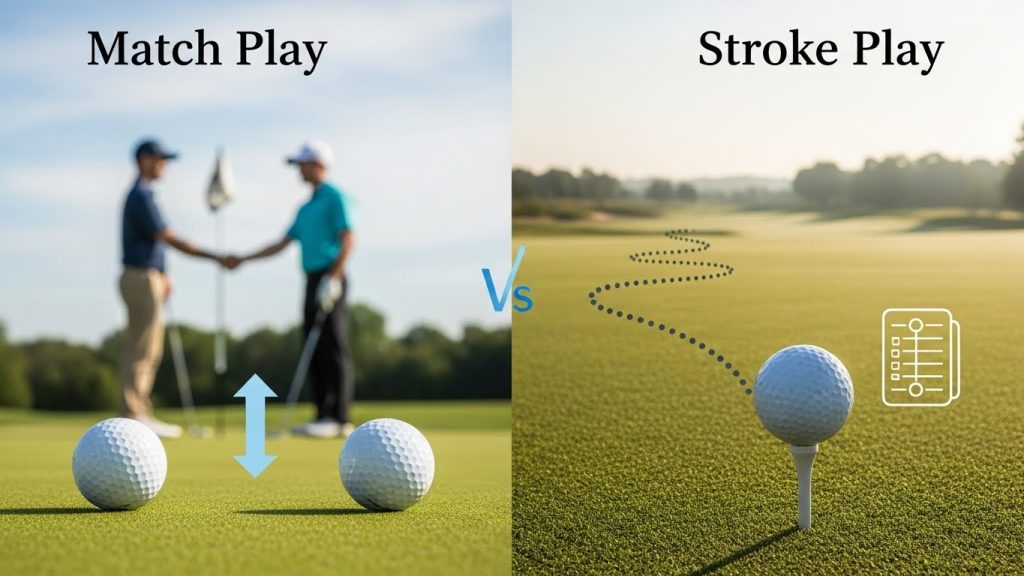
When playing golf, match play pits you directly against an opponent hole-by-hole, rewarding bold, tactical risks as each hole resets the competition. Stroke play challenges you to maintain steady, consistent scoring across all holes, where every stroke counts toward your total.
Match play lets you recover quickly from mistakes, while stroke play demands sustained focus. Choosing the right approach sharpens your strategy and mindset for different competitive situations. Explore how these formats shape your game and psychology.
- Key Takeaways
- Fundamental Format Differences Between Match Play and Stroke Play
- Distinct Scoring Systems Explained
- Penalties and Rules Specific to Each Format
- Strategic Approaches in Match Play Versus Stroke Play
- Popularity and Usage in Professional and Amateur Golf
- Tracking Scores and Record Keeping Methods
- How Format Choice Impacts Player Psychology and Gameplay?
- Frequently Asked Questions
- Pick Your Edge: Match Play or Stroke Play?
Key Takeaways
- Match play scores by holes won head-to-head; stroke play counts total strokes for the entire round.
- Match play ends early if a player leads by more holes than remain; stroke play always completes all holes.
- Penalties in match play often result in loss of hole; in stroke play, penalties add strokes to the total score.
- Stroke play emphasizes consistent, risk-managed performance; match play encourages bold, opponent-focused tactics and momentum shifts.
- Professional tournaments mainly use stroke play; match play is popular in team events and smaller, intense competitions.
Fundamental Format Differences Between Match Play and Stroke Play
When you step onto the course, understanding the fundamental format differences between match play and stroke play can shape your strategy and mindset.
Knowing the key differences between match play and stroke play guides your game strategy and mindset on the course.
In match play, you’re locked in a head-to-head battle, focusing on winning individual holes rather than counting every stroke. You gain an advantage by winning a hole, and tied holes simply halve. Match play also allows conceded putts, which can speed up the pace of play.
The match can end early if you’re ahead by more holes than remain, letting you capitalize on momentum.
Stroke play demands consistency, as every stroke counts toward your cumulative score across all holes. You compete against the entire field, not just one opponent, so patience and steady play are key.
Each format requires a unique approach. Match play rewards boldness and tactical reaction, while stroke play emphasizes steady, error-free performance. Adjust your mindset accordingly!
Distinct Scoring Systems Explained
How do the scoring systems in match play and stroke play differ fundamentally? In match play, each hole is a mini-contest where you win by taking fewer strokes than your opponent, regardless of the margin. This format emphasizes winning individual holes rather than accumulating the lowest total score.
Stroke play adds every stroke you take across the entire round, and the lowest total wins. This difference shapes your strategy and mindset. Because stroke play uses the gross score, every stroke counts toward your final result.
In match play, focus on winning individual holes; a bad hole hurts less. Match play formats often use 1-on-1 matches or Ryder Cup style team matches with fixed teams for a season.
Stroke play demands consistent, risk-averse play since every stroke counts. Match play ends early if you lead by more holes than remain, while stroke play completes all holes.
Penalties and Rules Specific to Each Format
It’s important to recognize how penalties vary between match play and stroke play, as this can really influence your strategy and mindset on the course. In match play, if you incur a penalty, it usually means you lose the hole right then and there. That can be a pretty big blow!
For example, playing a wrong ball in match play results in loss of hole under the rules. The stroke index also plays a role in match play by dictating where handicap strokes are applied, which can affect the outcome of close holes.
On the flip side, stroke play works a bit differently. Here, penalties add strokes to your score, but you still have to finish the hole. So, while you may not lose the hole outright, those extra strokes can definitely impact your overall game.
Understanding these differences in how rules are enforced and how penalties affect your score can really give you an edge in competition. It’s all about playing smart and knowing how to navigate the rules to your advantage!
Penalty Impact Differences
Although both match play and stroke play enforce penalties to maintain fairness, the way those penalties impact your score differs markedly between the two formats.
In match play, a rules breach often costs you the hole, directly affecting that single contest. Stroke play, however, tacks on penalty strokes to your total score, influencing your round cumulatively.
Additionally, the general penalty in match play is typically a loss of hole, whereas in stroke play it is commonly a two-stroke penalty. Understanding how penalties factor into the gross score is essential for accurate play and scoring.
Understanding these distinctions helps you manage risks and strategize effectively. Consider these key penalty impact differences:
- In match play, playing from outside the teeing ground might just require a replay, while stroke play adds two penalty strokes.
- Hitting a wrong ball results in loss of hole in match play but a two-stroke penalty plus correction in stroke play.
- Conceded strokes or holes in match play are final, eliminating later penalty adjustments.
Rule Enforcement Variations
When playing match play, your opponent often holds the power to enforce or waive penalties. This gives the format a strategic layer absent in stroke play, where penalties must be applied once a breach is identified. Being aware of pace of play expectations can also influence how leniency is applied in match play.
In match play, breaches can lead to loss of hole or match adjustments, but your opponent can choose leniency, influencing momentum. Stroke play demands strict penalty strokes recorded on your scorecard, like two strokes for general breaches or up to four for too many clubs.
Order of play violations differ too: match play requires waiting for your opponent, while stroke play allows ready golf without penalty. Additionally, the order-of-play rules differ significantly between formats and affect the timing of shots.
Understanding these rule enforcement nuances sharpens your strategy, ensuring you play smart, respect protocols, and leverage format-specific opportunities to outmaneuver your competition.
Strategic Approaches in Match Play Versus Stroke Play
Since match play and stroke play demand distinct mindsets, mastering their strategic differences can elevate your game markedly.
In stroke play, you focus on consistency, minimizing risks, and avoiding big mistakes, since every stroke adds to your total. The emphasis on course neutralization through pre-planned strategies helps minimize external variables like wind and pin placement.
Practicing in varied weather and course conditions enhances adaptability and supports better course management in this format. Match play lets you be bolder, adapting shot selection based on your opponent’s position and momentum swings.
You can reset mentally each hole, seizing chances to pressure your rival or concede tactically. Emphasize conservative, high-percentage shots in stroke play; lean into aggressive shot-making in match play.
Manage psychological momentum by staying steady in stroke play and exploiting confidence shifts in match play. Tailor your course management to cumulative scoring in stroke play versus opponent-centric tactics in match play.
Popularity and Usage in Professional and Amateur Golf
You’ll notice that professional tournaments tend to favor stroke play. Why? Well, it’s great for managing large fields and really highlights consistent performance. On the flip side, amateurs often embrace match play. It’s all about that direct competition and fun team formats.
Additionally, managing pace and group size is crucial to keep rounds within the typical 4 to 5 hours and ensure an enjoyable experience for all players.
Professional Tournament Preferences
Although match play offers thrilling head-to-head competition, stroke play dominates professional golf due to its clear scoring and broad comparability across large fields. Proper maintenance of equipment, including regular cleaning and groove sharpening, supports players’ consistent performance in stroke play.
When you follow professional tournaments, you’ll notice stroke play is the standard in all four majors and flagship events like the 2025 Tour Championship. Its straightforward scoring makes it easier to track performance over four rounds and adapt strategies on risk and reward.
To succeed and appreciate the sport’s structure, keep in mind:
Stroke play involves large fields and cuts, emphasizing consistent play. The upcoming changes to the Tour Championship consider a combination of playing formats including stroke play, match play, and byes to enhance competition.
Match play thrives in smaller, intense events like the WGC-Dell Technologies Match Play and team competitions. These formats often highlight the importance of club maintenance to ensure reliable shot control under pressure. Innovations blend formats, aiming to boost fan engagement and competitive drama.
Amateur Event Formats
When you dig into amateur golf events, stroke play clearly takes the lead in popularity due to its straightforward scoring and ease of managing large fields.
You’ll find stroke play suits all skill levels, emphasizing consistency and risk management, which appeals to steady, analytical players. It aligns with professional tours, reinforcing its status among amateurs. Many clubs use a Stableford indexing system based on hole difficulty relative to par to allocate handicap strokes in stroke play, aiming to reward net scoring on the hardest holes.
Additionally, stroke play encourages players to develop a strong mental game, which can be enhanced through professional coaching to improve focus and confidence.
However, match play holds a strong niche in smaller, competitive settings like club championships, offering a player-vs-player dynamic that tests strategy and psychological resilience. If you enjoy head-to-head contests and thrive under pressure, match play might excite you more.
Handicap systems and stroke indexes further balance both formats, ensuring fair competition. Understanding these nuances helps you choose the right format, boosting your performance and enjoyment in amateur golf events.
Team Versus Individual Play
Plunge into the world of golf, and you’ll notice clear differences in how team and individual play shape the game at both professional and amateur levels.
At the pro level, individual stroke play dominates tours like the PGA, emphasizing consistency and scoring. Team events like the Ryder Cup add excitement through match play but remain rare. The stroke play format is the older and more well-known scoring system used in most professional tournaments.
Many pros also customize their equipment, including choosing special grips to enhance performance during different match conditions. As an amateur, you’ll find team formats foster camaraderie and skill development, often using modified formats to keep play inclusive and fun.
Consider these points:
Professional team events spark fan enthusiasm with intense rivalries but are special occasions, not regular play. Amateur golf embraces team formats for social engagement and competitive growth alongside individual stroke play.
Understanding these dynamics helps you choose formats that best fit your goals and enjoyment.
Tracking Scores and Record Keeping Methods
Since accurate score tracking forms the backbone of any golf competition, mastering the methods and tools for record keeping is essential to your success.
In stroke play, you record every stroke per hole, aiming for the lowest total. In match play, focus on holes won, lost, or halved. Organizing your golf bag with club dividers can help you quickly switch clubs during play, improving your pace and focus.
Use traditional scorecards or modern digital apps for precise, real-time updates. Remember, accuracy prevents disputes and guarantees fair competition. A good practice is to write down your score immediately after each hole to avoid confusion and errors.
| Aspect | Stroke Play | Match Play |
|---|---|---|
| Score recorded | Total strokes per hole and round | Holes won, lost, or halved |
| Winning determination | Lowest total strokes over round | Player with most holes won |
| Scorecard detail | Detailed strokes per hole | Hole-by-hole win/loss results |
| Record keeping focus | Cumulative stroke count | Hole results only |
| Handicap adjustments | Common for net scoring | Rarely used |
Stay precise, confident, and motivated to keep your game and records sharp!
How Format Choice Impacts Player Psychology and Gameplay?
Although both match play and stroke play demand skill and focus, they shape your mindset and strategy in fundamentally different ways.
In stroke play, you maintain steady concentration over many holes, managing risk carefully to avoid costly mistakes. Advances in AI analytics now allow players to leverage data-driven insights for optimizing their stroke play strategies.
Steady focus and careful risk management are essential in stroke play to prevent costly errors.
Match play, however, turns golf into a psychological battle where momentum swings and opponent tactics directly affect your mental game.
You’ll find yourself adapting quickly, managing emotions hole by hole, and exploiting psychological cues.
Key psychological and gameplay impacts include:
Match play encourages aggressive, high-risk shots to pressure opponents, while stroke play rewards consistent, conservative play.
Momentum in match play can boost confidence rapidly, but stroke play demands emotional endurance akin to a marathon.
You must read and respond to your opponent’s mental state in match play, a dynamic absent in stroke play’s self-focused strategy.
Frequently Asked Questions
Can Match Play Be Used in Team Golf Competitions?
Yes, you can use match play in team golf competitions. It lets your team compete hole-by-hole, awarding points for each hole won or tied.
This format encourages strategic play and direct competition, boosting team engagement. As a captain or player, you’ll decide pairings and order while following strict rules on conduct and scoring.
Match play adds excitement and flexibility, making your team events more dynamic and fun.
How Does Weather Affect Match Play Versus Stroke Play?
Weather impacts match play and stroke play differently, like a gust of wind shaking a delicate mobile.
In stroke play, bad weather magnifies errors since every stroke counts toward your total score, demanding consistent focus.
In match play, you can recover from a single poor hole without it ruining your whole game, letting you take more risks.
Are There Specific Golf Courses Better Suited for Match Play?
Yes, you’ll find that courses with risk-reward holes, varied difficulty, and narrow fairways suit match play best.
These features let you strategize aggressively and adapt to your opponent’s moves. Look for layouts that encourage bold shots and psychological battles, with multiple tee options and shorter yardage.
Choosing such a course empowers you to exploit momentum shifts, reset between holes, and maximize your match play advantage effectively.
How Do Handicaps Influence Match Play Matches?
Think of handicaps as your secret weapon in match play. They level the battlefield by giving strokes to the player with the higher handicap on the toughest holes.
You’ll compete hole-by-hole, with net scores deciding winners, not total strokes. This means every hole is a fresh chance to outsmart your opponent.
Embrace this system; it pushes you to strategize smarter and stay motivated. This makes competition fair and fiercely exciting.
Can a Player Concede a Hole in Stroke Play?
No, you can’t concede a hole in stroke play. Every stroke counts toward your total score, so you must hole out on each hole.
If you pick up your ball or fail to complete the hole, you’ll have to record an adjusted score, like a net double bogey, which could hurt your results.
Stay focused, play every shot, and complete every hole to maintain integrity and maximize your chances of success.
Pick Your Edge: Match Play or Stroke Play?
You’ll find that match play’s head-to-head intensity contrasts sharply with stroke play’s relentless focus on every single shot. While match play lets you reset each hole, stroke play demands consistent precision throughout the round.
Understanding these differences helps you adapt your strategy and mindset, turning challenges into opportunities. Embrace both formats to sharpen your skills, boost your mental game, and become a more versatile golfer ready to take on any course or competitor.