
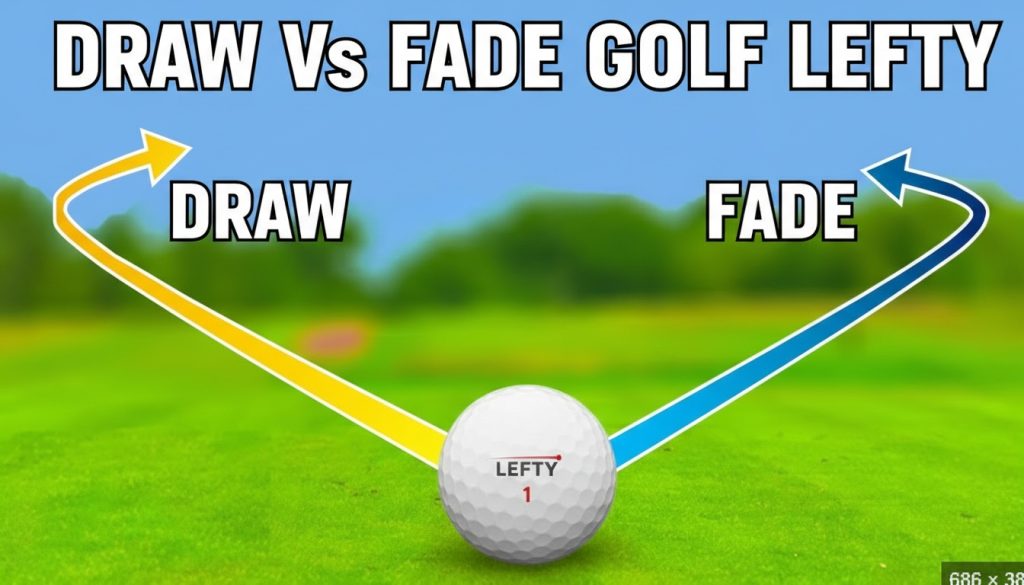
For a lefty golfer, a draw starts right of your target and curves left with a lower, longer flight. This shot is ideal for added distance and roll. A fade begins left and curves right, flying higher with more backspin for better stopping power and precision.
You control these by adjusting your body alignment, grip, ball position, and swing path. Understanding when to use each shot boosts your course strategy. You can refine these techniques further to improve consistency and control.
- Key Takeaways
- What Makes a Left-Handed Draw Different From a Fade?
- How to Set Up Your Body and Clubface for Draw and Fade Shots?
- How to Adjust Your Grip to Control Lefty Draw and Fade Shots?
- How Ball Position Influences Draw and Fade for Left-Handed Golfers?
- How Swing Path Creates Draw and Fade Curves for Left-Handers?
- When to Use a Left-Handed Draw or Fade on the Course?
- Practice Drills to Master Left-Handed Draw and Fade Shots
- Frequently Asked Questions
- How Do Weather Conditions Affect Left-Handed Draw and Fade Shots?
- What Common Equipment Tweaks Help Optimize Draw or Fade for Lefties?
- How Do Ball Types or Brands Influence Draw Versus Fade Performance?
- Can Left-Handed Golfers Switch Between Draw and Fade Mid-Round Effectively?
- What Mental Strategies Improve Confidence When Choosing Draw or Fade Shots?
- Master Course Strategy With Draw vs Fade Golf Lefty
Key Takeaways
- A left-handed draw curves the ball from right to left, flying lower with more roll and typically adds about 6 yards of carry.
- A left-handed fade curves left to right, launches higher with more backspin, and stops quicker for softer, more controlled landings.
- Draw shots suit longer distance needs, dogleg-right holes, or softer greens, while fades excel on dogleg-left holes and firm greens requiring accuracy.
- Draw setup aligns feet and body slightly right with a closed clubface, while fade setup aligns left with an open clubface and forward ball position.
- Swing path for a draw is inside-to-outside with a closed face relative to path; fade uses outside-to-in path with an open face relative to path.
What Makes a Left-Handed Draw Different From a Fade?
Understanding what makes a left-handed draw different from a fade is essential for mastering shot shaping and course strategy.
A left-handed draw starts right of your target and curves gently left, flying lower with less backspin. This helps it travel farther, typically about 6 yards more carry than a fade. This shot is particularly useful for navigating right-bending fairways or when trying to add extra distance due to its topspin advantage. Its execution requires a stronger grip and an inside-to-outside swing path to achieve the desired ball flight.
A left-handed draw begins right, curves left, flies lower, and carries about 6 yards farther than a fade.
Conversely, a fade begins left and curves softly right, launching higher with increased backspin, stopping more quickly. The fade is generally easier to control and more forgiving for most golfers due to its outside-in swing path.
Draws excel against left-to-right winds by counteracting them with a lower trajectory. This lower, penetrating flight also produces more roll after landing, adding valuable yards. Fades suit right-to-left winds and offer more consistent control. They are often preferred when accuracy and precision are more critical than distance.
However, draws demand precise wrist flexing and clubface control, making them harder to execute without risking hooks. Mastering the draw involves intentional adjustments in grip, body alignment, and swing mechanics.
Fades, easier for most amateurs, provide better accuracy and control, especially when precision outweighs distance on the course.
How to Set Up Your Body and Clubface for Draw and Fade Shots?
When you set up for a draw or fade shot, your body alignment and clubface position play pivotal roles in shaping the ball’s flight. For a draw, align your feet, hips, and shoulders slightly right of the target, with a closed clubface relative to your swing path.
For a fade, aim your body slightly left, keeping the clubface open. Maintain this alignment throughout your swing to guarantee a consistent path and spin. Ball position slightly forward for fade and slightly back for draw can help refine the ball flight and spin.
Draw: body aims right, clubface closed, promotes in-to-out swing. Fade: body aims left, clubface open, encourages out-to-in swing. Clubface angle at address influences spin and curvature. Proper alignment stabilizes swing path and reduces errors. Ball position adjustments support shot shape execution.
How to Adjust Your Grip to Control Lefty Draw and Fade Shots?
Although body alignment and clubface position set the foundation for your shot shape, adjusting your grip is essential for controlling draw and fade tendencies as a left-handed golfer.
Body alignment and clubface set the foundation, but grip adjustments are key for shaping shots left-handed.
To promote a draw, strengthen your lead-hand grip by showing more knuckles and positioning the grip in your fingers to increase wrist hinge and forearm rotation. Using a proper left hand placement ensures better control and consistency in your draw shots.
Match this with a stronger trail-hand grip, placing it more under the handle to encourage early face closure.
For a fade, weaken your lead-hand grip with fewer visible knuckles and place the grip slightly more in the palm to limit rotation. Align your trail hand on top of the handle to hold the face open longer.
Maintain consistent, moderate grip pressure in both hands to guarantee repeatable release and precise curvature control.
Because the ball is in contact with the clubface for only about 4/10,000 of a second, shaping the shot depends largely on pre-impact setup and swing path rather than last-moment hand adjustments.
How Ball Position Influences Draw and Fade for Left-Handed Golfers?
Since ball position directly affects the clubface angle and swing path at impact, adjusting it’s essential for shaping your shots as a left-handed golfer.
For a draw, position the ball at or slightly back of center, encouraging a closed clubface and a natural rightward swing path.
For a fade, move the ball forward, just ahead of center, to maintain an open clubface and promote a left-to-right spin.
Draw: ball back of center for closed clubface and rightward path.
Fade: ball forward of center to keep clubface open.
Forward ball position raises fade trajectory and softens landing.
Back ball position maximizes draw distance.
Consistent placement guarantees repeatable shot shapes.
Master this to control shot shape precisely.
An open stance with feet aimed left of the target complements the forward ball position for a fade, helping to guide the ball along the intended body plane.
How Swing Path Creates Draw and Fade Curves for Left-Handers?
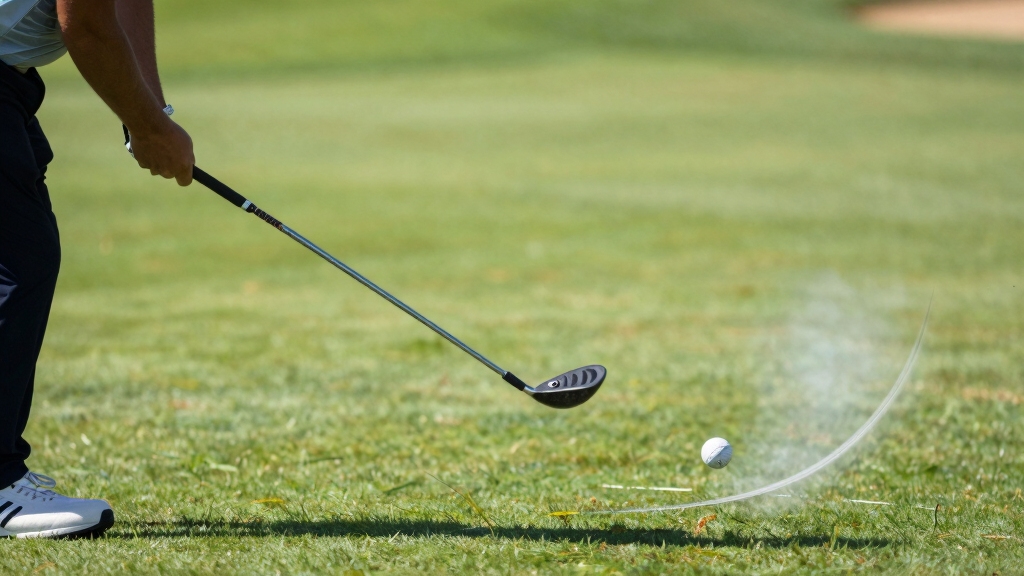
To shape your draw or fade as a left-handed golfer, it’s really important to grasp how your swing path works with the clubface angle at impact.
You see, the ball’s starting direction is largely influenced by your swing path in relation to the target line, so maintaining proper hip and shoulder alignment at address is crucial.
Now, when it comes to the ball’s curvature, that’s determined by the difference between your clubface angle and your swing path.
This relationship between face and path at impact is what ultimately defines whether your shot will curve left or right, so controlling it is essential for shaping your shots precisely face-to-path relationship.
Understanding this relationship is key! Once you get the hang of it, you’ll be able to control your shot shape with confidence and steer clear of those pesky hooks or slices.
Swing Path Basics
When you control your swing path as a left-hander, you directly influence whether your ball will draw or fade. Your swing path relative to the target line dictates curvature: a path left of the target promotes a draw, while a path right encourages a fade.
Maintaining face angle slightly less closed or open than the path guarantees the ball curves back toward the target. To master this, focus on:
- Aligning your body left for draws, right for fades.
- Swinging along your body line to match clubhead travel.
- Adjusting ball position back for draws, forward for fades.
- Avoiding excessive path deviation to prevent pulls or pushes.
- Keeping a consistent path for repeatable shot shapes.
One key to diagnosing your shot shape is to observe where the ball starts, as this start direction reveals the face-to-path relationship impacting curvature. Developing a smooth rhythm and proper swing sequencing helps maintain a consistent path and face angle throughout your swing.
Understanding these basics empowers you to shape shots precisely as a lefty golfer.
Clubface Angle Effects
Understanding how clubface angle influences ball flight is crucial for shaping draws and fades as a left-handed golfer. The clubface angle at impact determines your ball’s starting direction, with the ball launching mostly where the face points. This makes the face angle the most important factor in controlling your shot’s initial direction.
For a left-handed draw, you’ll want the face slightly right of the target, starting the ball right but curving it left by having your swing path more right. Conversely, a left-handed fade requires a face slightly left of the target, with the path left of the target line, allowing the ball to start left and curve right.
The key lies in how the face relates to the swing path: closed face to path for draws, open face to path for fades. Each affects spin, loft, and shot shape distinctly. Choosing the proper grip style can also influence your ability to control these curves effectively.
When to Use a Left-Handed Draw or Fade on the Course?
Mastering the decision between a left-handed draw or fade on the course hinges on evaluating hole design, wind conditions, and hazard placement.
You’ll choose a draw when the hole doglegs right, trouble lies left, or a left-to-right wind demands a lower flight with roll-out. It is also important to note that the draw is favored for distance, making it a strategic choice when extra yardage is beneficial. Adjusting your swing to maintain smooth acceleration can help control the ball flight in windy conditions.
Conversely, a fade suits dogleg-left holes, right-side hazards, and right-to-left winds, where control and stopping power matter more.
Consider these guidelines:
- Use a draw off the tee on dogleg-right holes or when left-side hazards dictate.
- Opt for a fade on dogleg-left holes or when right-side trouble is present.
- Employ a fade for tighter landing zones requiring accuracy.
- Approach firm greens with a fade for higher spin and quick stops.
Attack softer greens with a draw to utilize roll and distance.
Practice Drills to Master Left-Handed Draw and Fade Shots
Developing reliable left-handed draw and fade shots requires targeted practice drills that focus on stance, grip, clubface control, and swing path. Matching your shaft flex to your swing speed can significantly improve consistency and reduce slicing tendencies, which is crucial for controlling shot shape.
Mastering left-handed draw and fade shots hinges on precise stance, grip, clubface, and swing path adjustments.
For a draw, position your right shoulder left of the target line and drop your right foot back about an inch to establish a closed stance. Remember, the draw for lefties starts left of the target and curves back to the center line.
Strengthen your grip by placing both hands away from the target, thumbs down the left side of the shaft, and practice closing the clubface at address. Using the correct grip size ensures proper hand release and better clubface control during the swing.
Emphasize an in-to-out swing path, starting the ball left to allow it to curve back.
For a fade, open your stance by aligning your right shoulder right of the target and move the ball slightly forward. Aim the clubface left of your body and develop a controlled out-to-in swing path to produce a consistent fade trajectory. Adjusting your shaft torque can help stabilize the clubhead through impact, reducing unwanted sidespin for a more predictable fade.
Frequently Asked Questions
How Do Weather Conditions Affect Left-Handed Draw and Fade Shots?
Weather impacts your left-handed draw and fade by altering spin, ball flight, and distance.
Headwinds increase spin, making fades balloon and lose distance, while draws stay more stable.
Tailwinds boost draw rollout but can make fades stop quicker.
Crosswinds exaggerate curvature, so you’ll want to aim into the wind and shape shots accordingly.
Cold, dense air reduces distance more for fades.
Adjust your club and shot shape to maintain control and optimize performance.
What Common Equipment Tweaks Help Optimize Draw or Fade for Lefties?
Think of your clubface as a painter’s brush. Small tweaks create big strokes.
To optimize your draw, you’ll want a slightly closed clubface at impact with a stronger grip and ball positioned back in your stance.
For a fade, keep the clubface a bit open, use a neutral grip, and place the ball forward.
Also, adjust your shaft position and stance width accordingly to fine-tune swing path and wrist action for consistent shot shape.
How Do Ball Types or Brands Influence Draw Versus Fade Performance?
Ball types greatly influence your draw or fade performance.
High-spin urethane balls boost curvature, enhancing both draws and fades if your swing speed supports it.
Low-spin distance balls reduce side spin, softening shot shape differences.
Aerodynamically stable balls help keep your intended flight path, especially in wind.
Multi-layer urethane balls give you better workability with irons, while firmer covers lower spin.
This makes your shot shape more dependent on clubface alignment than ball interaction.
Can Left-Handed Golfers Switch Between Draw and Fade Mid-Round Effectively?
Yes, you can switch between draw and fade mid-round effectively by adjusting your alignment, clubface angle, and swing path intentionally.
Reposition your feet, hips, and shoulders right of target for draws and left for fades.
Modify ball position and grip accordingly, ensuring your clubface and swing path align with the desired shot shape.
Practice these shifts regularly to build consistency.
Maintain focus on face-to-path relationship during your pre-shot routine for reliable execution.
What Mental Strategies Improve Confidence When Choosing Draw or Fade Shots?
To boost your confidence choosing draw or fade shots, develop a clear pre-shot routine that includes a commitment cue and mental rehearsal of successful shots.
Use data to identify which shape produces tighter dispersion for you, then embrace that as your default.
Practice breath control to stay calm, replace judgmental self-talk with neutral statements, and focus on your process, not outcome.
This mindset sharpens focus and builds trust in your shot decisions.
Master Course Strategy With Draw vs Fade Golf Lefty
Mastering the left-handed draw and fade can lower your scores markedly. Did you know that 70% of skilled golfers use a controlled draw to gain distance and accuracy? By adjusting your grip, stance, and swing path, you can shape shots precisely to fit any course challenge.
Keep practicing the drills we covered to build confidence and consistency. With focused effort, you’ll turn these shot shapes into reliable tools that elevate your game every round.