
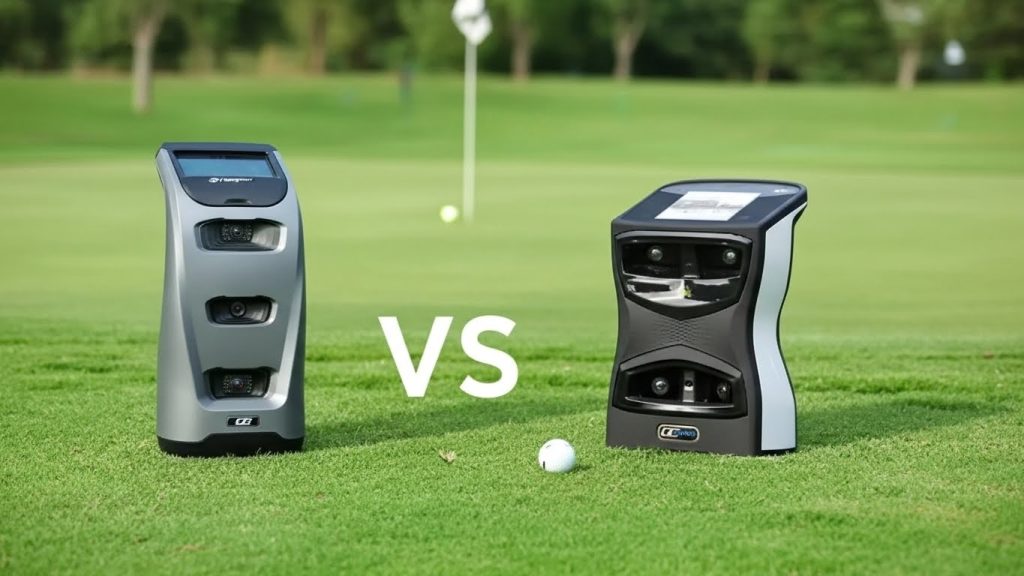
If you want portability and a budget-friendly option, the GC3 is compact with a built-in battery and solid ball data. It is ideal for serious amateurs or smaller facilities. The GCQuad, with its four-camera system, removable battery, and advanced club tracking including loft, lie, and closure rate, offers superior accuracy and detailed metrics for pros and fitters.
It excels in spin consistency and shot-shape analysis. Understanding their distinct strengths helps tailor your decision to your needs.

- HEAVY-DUTY PROTECTION – Built from Q235 carbon steel with a durable powder-coated finish to shield…
- PRECISION-FIT DESIGN – Custom dimensions engineered for Foresight GCQuad and Bushnell Launch Pro…
- CLEAR ACRYLIC SHIELD – Transparent front panel protects sensors without blocking visibility or…

- Precision Fit for Foresight GC Quad – Custom-designed to perfectly house and protect your GC Quad…
- Premium Metal Protection – Built from heavy-duty metal to shield your device from drops, knocks…
- Integrated Carry Handle – Strong, ergonomic handle makes transporting your GC Quad effortless for…
- Key Takeaways
- GC3 or GCQuad: Side-by-Side Comparison for Golfers
- Portability and Physical Dimensions Comparison
- Differences in Data Capture and Analysis
- Accuracy and Performance Metrics Evaluation
- Simulator Software Compatibility and Integration
- Display and User Interface Features
- Pricing and Target User Groups
- Use Cases for Casual Vs Professional Players
- Advanced Club Data Capabilities
- Spin and Shot Shape Measurement Differences
- Frequently Asked Questions
- Making the Smart Investment: GC3 or GCQuad
Key Takeaways
- GCQuad offers higher accuracy with a four-camera system, improving spin consistency, shot shape, and detailed club metrics compared to GC3’s three-camera setup.
- GC3 is more compact and portable with a built-in battery, making it ideal for smaller spaces and serious amateurs on a budget.
- GCQuad tracks club and ball independently using four fiducial stickers, enabling advanced clubface data like loft, lie, and closure rate, which GC3 lacks.
- GCQuad provides richer real-time feedback and on-device shot analysis with a larger screen and AI-driven analytics, while GC3 requires external devices for full data review.
- GC3 suits mid-tier analysis and smaller teaching facilities, whereas GCQuad targets professionals, fitters, and academies valuing precision and comprehensive club data.
GC3 or GCQuad: Side-by-Side Comparison for Golfers
| Feature | GC3 | GCQuad |
|---|---|---|
| Camera System | 3-camera photometric system | 4-camera photometric system |
| Data Accuracy | Highly accurate ball data | Tour-level accuracy with tighter consistency |
| Club Data Depth | Basic club metrics | Advanced club data (loft, lie, face, closure) |
| Portability | Lighter and more compact | Larger and heavier |
| Battery Design | Built-in battery | Removable battery |
| On-Device Display | Smaller screen, basic feedback | Larger screen with detailed visuals |
| Best For | Serious amateurs, home use | Professionals, fitters, academies |
| Overall Value | Strong performance at lower cost | Premium price for maximum data depth |
Portability and Physical Dimensions Comparison
When evaluating portability and physical dimensions, the GC3 clearly stands out due to its lighter weight and more compact size compared to the GCQuad.
The GC3 excels in portability with its lighter weight and more compact design than the GCQuad.
Weighing 5 lbs versus the GCQuad’s 7.5 lbs, the GC3 offers enhanced transport ease, fitting comfortably in smaller travel bags.
Its dimensions—6″ wide, 12″ high, and 5″ deep—translate into a smaller footprint, requiring less adjacent space during setup. This compactness supports easier integration into various practice environments, maintaining measurement accuracy despite its size.
The GCQuad is wider (7″) and taller (12.5″) but less deep (4″), reflecting its more complex four-camera system.
The GC3’s built-in lithium-ion battery increases depth slightly but eliminates external components, improving compactness.
Conversely, the GCQuad’s removable battery supports extended use but demands a marginally larger setup.
These differences affect portability and space optimization, making the GC3 preferable for tighter environments.
Additionally, the GC3’s sleek, compact design includes a user-friendly touchscreen interface, enhancing ease of use in portable settings user-friendly touchscreen.
Differences in Data Capture and Analysis
Although both the GC3 and GCQuad capture essential ball data with high accuracy using photometric technology, the GCQuad’s four-camera system delivers more detailed ball tracking and superior club data analysis. You’ll get 200 images per shot from multiple angles, enhancing precision in challenging lighting. The GC3’s three-camera setup still provides accurate ball metrics but lacks the GCQuad’s depth in club data, omitting loft, lie, and closure rate.
The GCQuad requires four fiducial stickers for full clubface tracking, enabling advanced swing metrics like angle of attack and closure rate, critical for pros and fitters. Its highly regarded putting data also supports short-game improvements, which the GC3 does not provide. This precision is supported by its ability to maintain 1-3% shot data accuracy, crucial for detailed swing analysis.
Additionally, the GCQuad’s enhanced processing power and AI-driven analytics offer faster, richer real-time feedback and simulation integration. In contrast, the GC3 provides solid ball data with less sophisticated software support, suitable for mid-tier analysis. Its affordable price point and portability make it budget-friendly for serious amateurs and smaller teaching facilities.
Accuracy and Performance Metrics Evaluation
You’ll really appreciate how GCQuad delivers superior spin rate consistency. It has noticeably lower standard deviations, which really enhances shot predictability. Plus, the clubhead speed measurements are incredibly precise, minimizing any variability that could impact your performance analysis. The GCQuad’s ability to provide precise clubhead delivery data is crucial for understanding the causes behind observed launch conditions. Its advanced data capture technology ensures reliable performance even in varying environments.
And when it comes to shot shape accuracy, GCQuad truly shines. Its advanced data capture offers a clearer and more stable profile compared to GC3. So, if you’re looking for reliable metrics to improve your game, GCQuad is definitely worth considering!
Spin Rate Consistency
Since spin rate consistency critically influences shot analysis and equipment fitting, understanding the precision differences between GC3 and GCQuad is essential.
GCQuad’s four-camera system captures 200 images per shot, achieving a spin rate standard deviation of ~82 RPM on center strikes, markedly tighter than GC3’s less precise three-camera data. This direct measurement approach ensures that true spin data is recorded at the moment the ball leaves the clubface, providing unmatched accuracy. Its multi-perspective tracking is similar in concept to advanced launch monitors like the Bushnell Launch Pro.
This precision extends to off-center strikes, where GCQuad independently measures club and ball data, reducing variability. GC3 remains reliable for amateurs but lacks GCQuad’s advanced multi-perspective accuracy.
| Feature | GC3 | GCQuad |
|---|---|---|
| Spin Rate Std. Dev. | Higher variability | ~82 RPM (tightest) |
| Off-Center Accuracy | Moderate consistency | Superior consistency |
| Spin Axis Variation | Less precise (~>6.6°) | Tighter (~6.6°) |
Clubhead Speed Precision
Examining clubhead speed precision reveals how GC3 and GCQuad leverage their camera systems to deliver accurate, repeatable measurements critical for performance analysis.
GC3 employs a triscopic setup, while GCQuad’s quadrascopic design adds a fourth camera, enhancing spatial resolution and vantage points.
Both rely on high-speed cameras, avoiding radar, to track clubhead speed with tight standard deviations, especially on center strikes. The GCQuad’s use of fiducials for club face tracking contributes to its ultra-high accuracy, distinguishing it from radar-based monitors.
GCQuad shows marginally superior precision on off-center hits due to its larger hitting zone and enhanced resolution. This precision aids golfers in understanding the impact of swing weight variations on their clubhead speed and consistency.
For most users, GC3’s precision suffices; however, professionals aiming for tour-grade analysis benefit from GCQuad’s advanced accuracy and broader impact coverage.
Shot Shape Accuracy
Although both GC3 and GCQuad deliver reliable shot shape accuracy, their differing camera configurations influence performance metrics such as spin rate consistency, launch angle precision, and mis-hit detection.
You’ll find:
- GCQuad’s four-camera system achieves superior spin rate consistency (82 SD, 226 range) and 3D impact point precision, enhancing shot shape reliability on off-center strikes.
- GC3’s three-camera setup provides near-equivalent launch angle accuracy and dependable off-center strike data, with lower standard deviation on clubhead speed mis-hits (0.4 MPH). For all practical purposes identical ball data and simulation results make GC3 a great option if extra club data is not needed.
- Both maintain consistent ball flight simulations within their hitting zones, though GCQuad’s larger capture area benefits variable outdoor conditions.
Simulator Software Compatibility and Integration
When integrating golf launch monitors into simulation setups, both the GC3 and GCQuad guarantee compatibility with Foresight Sports’ FSX software suite, including FSX 2020 and FSX Play. This provides native support for their proprietary environment. Their advanced spin and groove technology ensures highly accurate ball flight and spin data for simulation fidelity.
You’ll also find third-party compatibility with E6 Connect and GSPro, expanding your simulation platform options. The GCQuad excels with advanced club and putting data integration, leveraging its four-camera system for superior calibration and realism.
In contrast, the GC3 offers essential ball data and simpler club metrics, focused on straightforward setup and home use. Additionally, the GCQuad is positioned toward high-level competitive players and teaching professionals due to its enhanced hardware and data capabilities.
| Feature | GC3 | GCQuad |
|---|---|---|
| Camera System | 3 cameras, easy calibration | 4 cameras, precise calibration |
| Club Data Integration | Basic metrics | Detailed, including putting |
| Software Packages | Bundled, essential play | Premium, advanced courses |
Display and User Interface Features
How do the display and user interface features of the GC3 and GCQuad impact your data analysis and usability?
The GCQuad’s larger screen offers rich graphical feedback, including impact location maps and club data metrics, directly on the device. This real-time data access helps golfers make immediate adjustments to optimize ball speed and spin rate during practice.
GC3 provides essential ball metrics on a compact display but lacks integrated club data visualization and detailed shot tracking on the unit itself. Both devices include simulation bundled in the price, providing valuable practice without additional subscription fees subscription-free simulation.
Consider these points:
- GCQuad supports real-time, on-screen shot feedback with advanced software integration, enhancing immediate analysis.
- GC3 requires external devices and software for comprehensive data review, limiting standalone usability. This reliance can affect the ability to track key parameters such as launch angle and ball speed conveniently.
- GCQuad’s interface facilitates deeper insight with graphical spin axis and clubface impact visualizations, which GC3 doesn’t offer.
Pricing and Target User Groups
Understanding the display and interface differences between the GC3 and GCQuad naturally leads to evaluating their pricing structures and intended users.
The GC3, priced between $6,999 and $7,999, targets serious amateurs seeking thorough data without subscription fees. It offers a user-friendly interface that balances advanced metrics with ease of use.
In contrast, the GCQuad’s approximate $17,999 price reflects its premium positioning for professionals requiring advanced metrics and versatility. Its four-camera setup provides every useful metric for players, teaching pros, clubfitters, and simulator users.
Subscription models differentiate lower-cost GC3 variants, while GCQuad bundles often include costly add-ons.
| Feature | GC3 |
|---|---|
| Price Range | $3,800 – $7,999 |
| Target User | Serious amateurs, coaches |
| Data Depth | Essential ball and club metrics |
| Feature | GCQuad |
| Subscription | None, add-ons possible |
| Target User | Professionals, fitters, academies |
| Data Depth | Advanced club & putting analysis |
Use Cases for Casual Vs Professional Players
Choosing between the GC3 and GCQuad hinges on your skill level and the depth of data you require. If you’re a casual player, you’ll value GC3’s simplified interface, essential shot metrics, and portability, enhancing social play and steady improvement without data overload.
Many casual players appreciate setups and shot guidance that avoid hazards like bunkers and rough, focusing on safe and consistent shots bunker and rough tactics. Conversely, professionals benefit from GCQuad’s advanced ball tracking, real-time 3D ball flight, and integration with pro coaching tools, supporting precise performance diagnostics.
Consider these use cases:
- Casual players use GC3 for straightforward feedback, quick practice, and accessible on-the-go sessions.
- Professional players rely on GCQuad for detailed spin, launch angle, and biomechanical data to refine swings.
- GCQuad’s complexity suits tournament preparation, while GC3 optimizes low-pressure, social rounds.
Advanced Club Data Capabilities
Explore into the advanced club data capabilities, and you’ll find the GCQuad considerably outperforms the GC3 in precision and detail.
Delving into club data, the GCQuad delivers far greater precision and detail than the GC3.
The GCQuad’s four-camera 3D system tracks four fiducials on the club face, enabling comprehensive metrics like face angle, closure rate, loft, lie, and impact location. Its ability to deliver consistent data is enhanced further when paired with high-quality simulator golf mats that offer realistic feedback during swings.
This exceeds the GC3’s limited basic data. Its larger hitting zone and enhanced sensors guarantee consistent, repeatable measurements even under variable lighting or outdoor conditions.
The GC3’s three-camera setup and fewer markers provide adequate but less granular club data, lacking advanced metrics unless add-ons are purchased. It is important to note that different launch monitors, including these, may report club path using different measurement definitions, leading to variations in data when switching systems.
Additionally, GCQuad supports putting analysis and integrates AI-driven analytics for refined swing insights. In contrast, GC3 focuses on core ball and club data without advanced analytics. Thus, GCQuad suits professional fitting and coaching, whereas GC3 fits serious amateurs and smaller facilities.
Spin and Shot Shape Measurement Differences
While both the GC3 and GCQuad measure spin and shot shape, the GCQuad’s advanced multi-camera system and thorough club data tracking deliver markedly higher precision and consistency.
You’ll notice superior spin rate accuracy with GCQuad’s standard deviation around 82 RPM versus GC3’s ~114 RPM. Its tighter spin axis variation (~6.6°) enhances shot curvature analysis, critical for fitting and trajectory prediction. Because the GCQuad uses a high-speed photometric camera system, it directly measures impact parameters rather than relying on ball flight modeling, which improves data reliability.
This direct measurement approach is key to its accuracy and consistency. Additionally, the GCQuad’s technology minimizes data dispersion similar to how VeloCore+ technology in golf shafts enhances shot stability and feedback.
Additionally, GCQuad’s detailed club data—face angle, path, attack angle—directly refines spin and shot shape calculations, whereas GC3 relies more on ball data alone.
Key differences include:
- GCQuad’s four cameras capture spin from multiple angles for improved accuracy.
- Spin axis and tilt measurements are more consistent on GCQuad.
- Shot shape data integrates extensive club metrics, boosting reliability.
Frequently Asked Questions
How Long Does the Battery Last on GC3 and GCQUAD During Use?
You can expect the GC3 battery to last about 5 to 7 hours during typical use, while the GCQuad offers slightly longer endurance, around 6 to 8 hours. The GC3 uses a fixed lithium-ion battery, so you need to recharge it after each session.
In contrast, the GCQuad features an interchangeable battery, allowing you to swap batteries and extend your usage without interruption. This makes it better suited for longer or more intensive sessions.
Are There Any Differences in Setup Time Between GC3 and GCQUAD?
You’ll notice a slight difference in setup time between the two.
GC3’s smaller hitting zone and single clubface sticker mean you can set up faster with less precision needed.
GCQuad’s larger hitting area speeds ball placement but requires four clubface stickers, adding complexity.
Also, GCQuad’s bigger footprint might demand more space.
Can GC3 or GCQUAD Be Used Effectively in Low-Light Conditions?
You might think low light undermines ball-tracking accuracy, but both devices perform well indoors where lighting’s controlled.
Still, the GCQuad excels in dim conditions due to its four-camera system, larger hitting zone, and enhanced processing power. This ensures tighter data consistency and reliable spin measurements.
The GC3 works, but its three-camera setup and smaller hitting zone may reduce precision and complicate alignment when visibility drops. This makes GCQuad a smarter choice for low-light use.
Do GC3 and GCQUAD Require Regular Calibration or Maintenance?
You don’t need to perform regular calibration on either device for measurement accuracy, as both are designed for plug-and-play use. The GC3 requires battery calibration only if you disconnect or replace its battery, or after long storage.
The GCQuad doesn’t need manual recalibration but does require monthly full battery discharge and recharge to maintain peak battery health. Routine maintenance focuses primarily on battery care and ensuring proper device handling.
Making the Smart Investment: GC3 or GCQuad
Choosing between the GC3 and GCQuad is like selecting the right lens for a precision instrument. The GC3 offers portability and solid fundamentals, akin to a reliable magnifying glass—compact yet effective.
The GCQuad, however, acts as a multifaceted prism, delivering advanced data clarity and superior accuracy for professionals demanding granular insights. Your choice hinges on whether you prioritize convenience or all-encompassing analysis, ensuring your game’s vision is as sharp and precise as your swing.

- CIRCLE B EDITION LAUNCH PRO FITMENT NOTICE: For Circle B edition Bushnell Launch Pro units, the…
- HEAVY DUTY METAL CASE WITH BUILT IN CARRY HANDLE: Built from solid metal for long term protection…
- REAR LOCKING BAR FOR SECURE FIT AND STABILITY: A reinforced rear lock bar keeps your launch monitor…
- Precision Fit for Foresight GC Quad – Custom-designed to perfectly house and protect your GC Quad…
- Premium Metal Protection – Built from heavy-duty metal to shield your device from drops, knocks…
- Integrated Carry Handle – Strong, ergonomic handle makes transporting your GC Quad effortless for…
Last update on 2026-04-08 / Affiliate links / Images from Amazon Product Advertising API