
Yes, golf clubs come in different lengths tailored to your gender, club type, height, and wrist-to-floor measurement.
Men’s drivers, for example, average around 45 inches, while women’s are about 44 inches. Adjustments range from -1 inch to +1 inch based on your physical attributes.
This optimizes your posture and swing mechanics. Proper length helps control swing weight, shot consistency, and power.
Understanding how these factors influence fit can markedly improve your performance and club feel.
- Key Takeaways
- Standard Golf Club Lengths by Club Type and Gender
- Standard Length Ranges for Irons and Woods
- How Height Influences Golf Club Length?
- How Wrist-to-Floor Measurement Customizes Club Length?
- Regulatory Limits on Golf Club Lengths
- Adjusting Golf Club Length for Better Swing and Performance
- Choosing the Right Golf Club Length for Your Playing Style
- Frequently Asked Questions
- Unlock Better Performance with the Right Club Length
Key Takeaways
- Golf clubs come in standard lengths that vary by club type and gender, with drivers typically 44–45 inches long.
- Club lengths are customized based on a golfer’s height and wrist-to-floor measurement to improve swing mechanics and comfort.
- Length adjustments usually range from -1 inch to +1 inch, influencing swing weight, control, and shot consistency.
- Longer clubs increase swing weight and can alter stance, while shorter clubs promote a more compact posture and tighter dispersion.
- Regulations limit woods and irons to a maximum length of 48 inches, with putters having no maximum but a minimum length of 18 inches.
Standard Golf Club Lengths by Club Type and Gender
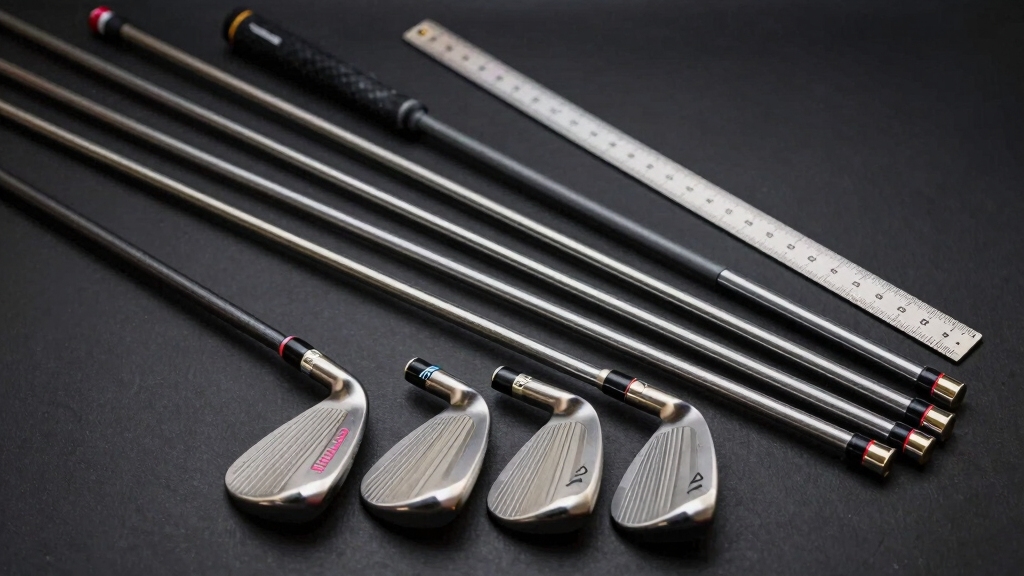
When selecting golf clubs, understanding the standard lengths for different club types and genders is essential for peak performance.
Men’s drivers typically measure 45 inches, with 3-woods at 43 inches and 5-woods at 42 inches. Irons follow a descending scale: a 3-iron is 39 inches, and a 5-iron is 38 inches.
For women, these lengths reduce by approximately one inch across the board: drivers measure 44 inches, 3-woods 42 inches, and 5-woods 41 inches. Women’s 3-irons are 38 inches, and 5-irons 37 inches.
These length standards promote proper swing mechanics and contact consistency. Deviations from these norms usually require professional fitting to match individual height and wrist-to-floor measurements, optimizing control and power delivery.
Understanding these standards forms the foundation for selecting the right clubs. Proper club length is best confirmed by measuring from the heel of the clubhead sole to the top of the grip, ensuring accurate sizing and fit through heel placement consistency.
Standard Length Ranges for Irons and Woods
You’ll notice that iron lengths usually range from about 39.5 inches for a 3-iron down to 35 inches for a pitching wedge. There are precise increments between each club, too.
Now, when it comes to woods, they start out longer. For instance, drivers are typically around 45 inches. Then, as you move to 3-woods and 5-woods, they get shorter progressively.
Getting familiar with these measurements can really help you choose clubs that fit your height and swing. That way, you can achieve peak performance on the course! Proper club length adjustments based on arm length and wrist-to-floor measurements are essential for optimizing your posture and swing mechanics.
Iron Length Variations
Although golf club lengths vary across different types, irons and woods follow specific standard ranges that affect your swing mechanics and shot accuracy. Irons progressively shorten from the 3-iron to the pitching wedge to optimize control and trajectory.
Adjusting length based on your height or wrist-to-floor measurement enhances consistency and comfort.
| Club Type | Standard Length Range (inches) |
|---|---|
| 3-Iron | 39.0 – 39.5 |
| 5-Iron | 37.5 – 38.0 |
| 7-Iron | 36.0 – 37.0 |
| Pitching Wedge | 35.0 |
This progression guarantees you maintain proper posture and swing plane, essential for accuracy. Custom fitting can further refine these lengths, tailoring clubs to your physical dimensions. Selecting the right grip size to match your hand and club measurements also plays a crucial role in optimizing comfort and control.
Wood Club Measurements
Since wood clubs cover longer distances and require different swing dynamics than irons, their length plays a critical role in optimizing power and control.
Standard men’s drivers measure 45 inches, with 3-woods at 43 inches and 5-woods at 42 inches. For women, these lengths are generally one inch shorter—drivers at 44 inches, 3-woods at 42 inches, and 5-woods at 41 inches.
These measurements align with your height and wrist-to-floor length, ensuring an efficient swing plane. Adjustments typically range from -1 inch for shorter players to +1 inch for taller golfers, maintaining leverage without sacrificing accuracy.
Keep in mind, the USGA caps wood club length at 48 inches, balancing maximum distance with regulatory compliance. Proper length selection directly influences your consistency and shot trajectory.
Additionally, most modern drivers feature lightweight graphite shafts to help increase swing speed and reduce vibration, enhancing overall performance.
How Height Influences Golf Club Length?
When selecting golf club lengths, your height directly impacts the ideal measurements to guarantee proper swing mechanics and comfort.
Your height plays a crucial role in determining the perfect golf club length for comfort and effective swings.
Taller players require longer clubs to maintain posture and swing plane. Shorter players benefit from shorter clubs for control and accuracy. Adjustments typically range from -1 inch to +1 inch from standard lengths depending on your height.
Consider these height-based length modifications:
- If you stand between 6’4” and 6’8”, add 1 inch to standard club lengths.
- Heights from 6’1” to 6’4” call for a 0.5-inch increase.
- If you’re 5’4” to 5’7”, shorten clubs by 0.5 inch.
- Heights from 5’0” to 5’3” require a 1-inch reduction.
These precise adjustments guarantee optimized swing mechanics and consistent ball striking. Measuring your wrist to floor height is essential to ensure the club length matches your body proportions for better performance.
How Wrist-to-Floor Measurement Customizes Club Length?
Measuring your wrist-to-floor distance is a great way to customize your club length. Instead of just relying on your height, this measurement helps you make those fine-tuned adjustments.
Typically, you’ll find that the length changes range from -1 inch to +1 inch, and this really helps with your swing mechanics.
Accurate measurement is essential for optimizing grip size and club length to enhance control and comfort during your swing, especially considering factors like hand size and swing mechanics for fine-tuning accurate measurement.
Measuring Wrist-To-Floor
Measuring your wrist-to-floor length accurately helps customize your golf club length to fit your body mechanics and optimize your swing.
To measure, stand straight with your arms relaxed at your sides.
Have someone measure the distance from the crease of your wrist (where your hand meets your arm) straight down to the floor, wearing golf shoes if possible for accuracy.
Use this measurement to determine necessary club length adjustments:
- Wrist-to-floor 40–41 inches suggests adding +1 inch to standard club length.
- Wrist-to-floor 37–40 inches indicates a +0.5 inch increase.
- Wrist-to-floor 34–37 inches aligns with standard club lengths.
This precise measurement guarantees your clubs correspond to your height and posture, improving control and performance. Properly fitted clubs also complement using equipment like the PARADAX A1-1 integrated cart, which supports optimal play by ensuring your gear matches your needs.
Length Adjustments Guide
Accurately capturing your wrist-to-floor measurement provides the foundation for customizing golf club lengths to your unique physique.
This measurement directly informs how much length adjustment your clubs require. For example, a wrist-to-floor measurement between 40 and 41 inches signals a +1 inch increment, while 37 to 40 inches calls for a +0.5 inch increase.
Measurements from 34 to 37 inches use standard club length. Those from 29 to 34 inches require a -0.5 inch reduction, and 27 to 29 inches necessitate a -1 inch decrease.
These adjustments guarantee your posture and swing mechanics remain optimal, preventing compensatory movements. By aligning club length with wrist-to-floor data, you enhance control, accuracy, and comfort during play, maximizing your overall performance on the course.
Adjusting club length also impacts swing weight, typically adding approximately 3 points for every half-inch increase, which influences club balance and feel.
Regulatory Limits on Golf Club Lengths
Although golf club lengths can vary to suit individual players, regulatory bodies set strict limits to guarantee fairness in competition.
Golf club lengths vary by player but must follow strict rules to ensure fair play.
The USGA and R&A govern these rules under Rule 4.3c, ensuring clubs meet defined measurements. You must adhere to these when selecting or customizing clubs for official play.
Key regulatory limits include:
- Woods and irons can’t exceed 48 inches in length.
- Putters have no maximum length but must be at least 18 inches long.
- Local competitions may impose stricter length limits, often capping woods and irons at 46 inches.
Proper maintenance and regular inspection of equipment, similar to how battery health is monitored in golf carts, can help ensure consistent performance and safety during play.
Adjusting Golf Club Length for Better Swing and Performance
Optimizing your golf club length directly influences your swing mechanics and shot consistency. When you adjust club length, you modify your posture, swing arc, and angle of attack, all critical to performance.
For example, if your clubs are too long, you may stand too upright, causing an inconsistent strike and loss of control. Conversely, clubs that are too short force you into a cramped stance, limiting power and accuracy.
To fine-tune, measure your wrist-to-floor distance and correlate it with recommended length adjustments. Add or subtract increments of 0.5 to 1 inch based on your height. Additionally, adjusting length impacts the club’s swing weight, which affects feel and control during your swing.
Choosing the Right Golf Club Length for Your Playing Style
When selecting the right golf club length for your playing style, you need to take into account how your swing mechanics and physical attributes interact with club dimensions. The correct length optimizes swing path, control, and power.
Choosing the ideal golf club length enhances your swing mechanics, control, and overall power.
Consider these factors:
- Height and Wrist-to-Floor Measurement: Taller players or those with longer arms generally require longer clubs. Shorter players do better with shorter clubs to maintain consistency and control.
- Swing Tempo and Arc: Faster swing speeds often benefit from standard or slightly longer clubs for maximum distance. Slower tempos might gain better accuracy with shorter clubs.
- Shot Shape and Trajectory Preferences: If you favor a higher ball flight, a slightly longer club can help. For a lower trajectory and tighter dispersion, shorter clubs improve precision.
Aligning club length with these parameters guarantees your equipment complements your unique style and physicality.
Frequently Asked Questions
Can Golf Club Length Affect Shot Accuracy?
You can improve shot accuracy by adjusting your golf club length.
For example, players between 5’4” and 5’7” often benefit from clubs shortened by 0.5 inches, enhancing control and consistency.
Using a standard-length club when you should use a shorter or longer one can throw off your swing plane and timing.
Properly fitted clubs align your swing mechanics, reducing mishits and improving precision on every shot.
How Does Shaft Flexibility Relate to Club Length?
Shaft flexibility directly influences how you control clubs of varying lengths.
Longer clubs typically need more flexible shafts to compensate for increased swing speed and torque. This helps you maintain accuracy and distance.
Conversely, shorter clubs benefit from stiffer shafts, offering better control and precision.
Matching shaft flexibility to club length guarantees peak energy transfer and shot consistency. You’ll want to weigh both factors carefully when selecting or adjusting your equipment.
Are Junior Golf Clubs Shorter Than Adult Clubs?
Yes, junior golf clubs are shorter than adult clubs to suit their smaller stature and swing mechanics.
For example, while a standard men’s driver measures 45 inches, junior drivers can be markedly shorter, often ranging from 36 to 40 inches.
This adjustment helps juniors maintain control and develop proper technique.
Club length correlates closely with height and wrist-to-floor measurements, ensuring juniors use clubs that optimize performance and comfort.
Do Different Brands Vary in Standard Club Lengths?
Yes, different brands do vary in their standard club lengths. While most manufacturers follow industry norms, like a 45-inch driver for men, specific measurements can differ by up to an inch.
These subtle variations arise from design philosophies and targeted player types. When you choose clubs, it’s important to compare lengths across brands.
Consider your height and wrist-to-floor measurement to find the best fit for your swing and comfort.
How Often Should I Adjust My Club Length?
You should adjust your club length whenever your height or posture changes markedly, like growth spurts or injury recovery.
Also, if you notice inconsistent ball striking or discomfort, consider a check.
Regular fittings every couple of years or after major swing changes help maintain peak performance.
Use wrist-to-floor measurements and consult fitting charts to guarantee correct length, adhering to USGA regulations for legal play.
Proper length maximizes control and distance.
Unlock Better Performance with the Right Club Length
You’ll find golf clubs come in various lengths, designed to fit your height, wrist-to-floor measurement, and playing style.
You’ll adjust clubs for comfort, optimize clubs for control, and select clubs for performance.
You’ll follow regulatory limits, respect standard ranges, and customize lengths to enhance your swing.
Ultimately, choosing the right club length means balancing precision, power, and consistency.
This ensures every shot benefits from a perfectly tailored fit.