
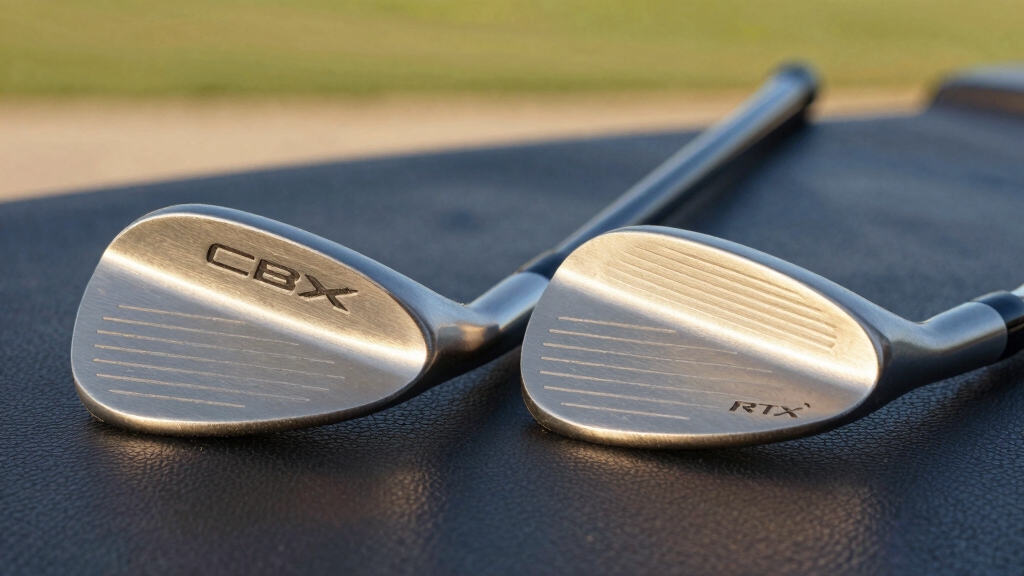
If you’re after forgiveness and consistent turf interaction, the CBX wedge’s cavity back and wider sole help minimize mishits. It has higher bounce suitable for softer conditions.
Meanwhile, the RTX offers sharper edges and a thinner sole for precise shot-shaping and better control on firmer turf.
Both use advanced Rotex faces for similar full-shot spin, but their grind and design differences impact spin and playability around the greens.
Explore their specs to see which suits your game.
- Key Takeaways
- Cmparison Table for CBX & RTX Wedges
- Design and Shape Differences Between CBX and RTX Wedges
- Key Technologies in CBX and RTX Wedges
- Spin Performance Comparison: CBX vs RTX
- Forgiveness and Shot Consistency Compared
- Bounce, Sole Shape, and Turf Interaction Differences
- Which Wedge Fits Your Playing Conditions Best?
- Shaft and Grip Options for CBX and RTX Wedges
- Loft Choices, Pricing, and Availability Overview
- How to Choose the Right CBX or RTX Wedge for Your Game?
- Frequently Asked Questions
- From Rough to Refined: Making the Smart Wedge Choice
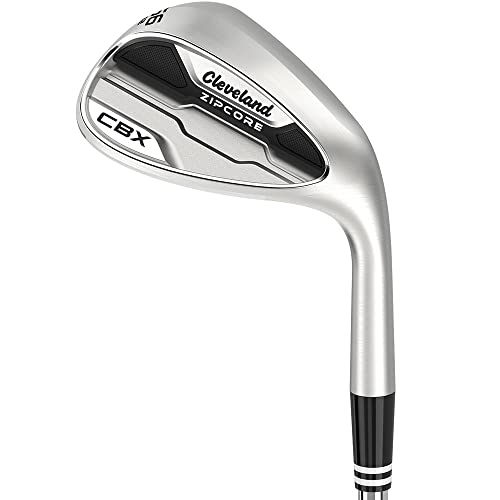
- ZipCore – A lightweight, low-density core sits at the heart of the club. While reducing vibrations…
- Hollow Cavity Design – Weight in the toe with a hollow chamber near the heel makes a better, more…
- UltiZip Grooves – Sharper, deeper, and closer together, UltiZip Grooves are more efficient at…
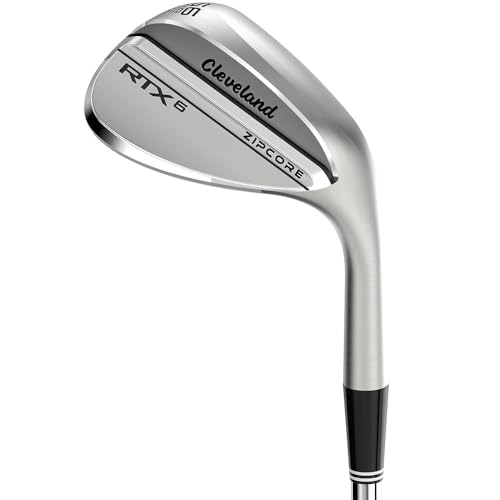
- HydraZip A new, dynamic blast and laser-milled line system creates roughness to enhance…
- ZipCore Our proprietary, low-density core technology has exponentially evolved for RTX 6 ZipCore…
- UltiZip UltiZip features grooves that are sharper, deeper, and more tightly spaced. They slice…

Key Takeaways
- CBX wedges feature a cavity back design with wider soles for enhanced forgiveness and turf interaction, ideal for softer conditions and consistent shots.
- RTX wedges offer a traditional blade profile with sharper edges and narrower soles, prioritizing precision, shot-shaping, and control on firm turf.
- Both wedges have similar full-shot spin rates (~9,400 RPM) but RTX produces higher spin on short shots, aiding better control around the greens.
- CBX uses a lighter Dynamic Gold 115 shaft for increased swing speed, while RTX focuses on traditional shafts for classic feel and feedback.
- CBX is more affordable with game-improvement features, whereas RTX commands a premium price for tour-inspired design and advanced shot-making capabilities.
Cmparison Table for CBX & RTX Wedges
| Feature | Cleveland Golf CBX ZipCore Wedge | Cleveland Golf RTX 6 ZipCore Wedge |
|---|---|---|
| Design Type | Cavity back with perimeter weighting | Traditional blade profile |
| Forgiveness | High forgiveness on mishits | Lower forgiveness, precision-focused |
| Sole Width | Wider sole with modified V-Sole | Narrower sole with sharper camber |
| Bounce Options | Higher bounce; better in soft turf | Mid-bounce (~10°); ideal for firm turf |
| Turf Interaction | Smooth glide, prevents digging | Cleaner contact on tight lies |
| Spin (Full Shots) | ~9,412 RPM | ~9,400 RPM (very similar) |
| Spin (60-Yard Shots) | ~6,800 RPM | ~8,000 RPM (higher greenside spin) |
| Half Shot Spin | Slightly higher consistency | Comparable, slightly lower |
| Technology | ZipCore, UltiZip Grooves, Rotex Face, Feel Balancing | ZipCore, HydraZip, UltiZip Grooves, Rotex Face |
| Shaft (Stock) | Dynamic Gold 115 (lighter, faster swing) | Traditional steel shafts (classic feel) |
| Grip | Lamkin BlueCap | Tour-style grip options |
| Best For | Mid-to-high handicappers seeking forgiveness | Low handicappers seeking shot-shaping control |
| Price Point | More affordable (game-improvement focused) | Premium pricing (tour-inspired design) |
| Playing Conditions | Soft turf, sand, inconsistent lies | Firm turf, tight lies, precision greenside play |
Design and Shape Differences Between CBX and RTX Wedges
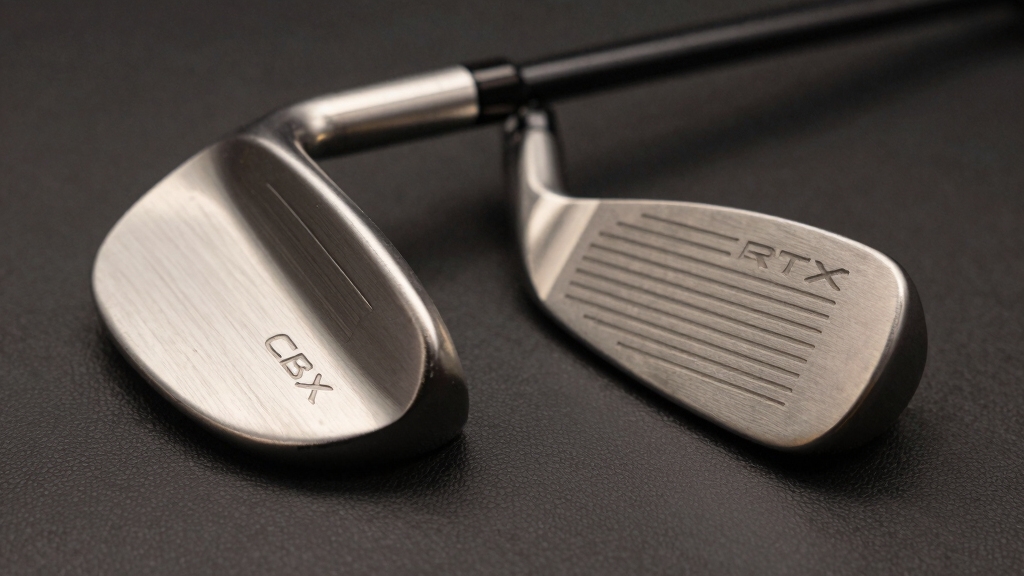
While both the CBX and RTX wedges serve specific player needs, their design and shape diverge markedly.
You’ll notice the CBX features a cavity back design with perimeter weighting, enhancing forgiveness and promoting consistent ball speeds across the face.
Its wider sole is engineered with a modified V-Sole, delivering game improvement benefits without looking overly “shovel-like.”
In contrast, the RTX wedges maintain a traditional blade-like profile, boasting a thinner top line and a narrower sole, which appeals to players seeking precision and shot-shaping ability.
The RTX’s sharper edges and more compact design provide versatility around the greens.
Both wedges benefit from precision-forged construction that enhances feel and accuracy, comparable to major-brand models.
Key Technologies in CBX and RTX Wedges
Explore the advanced technologies that both CBX and RTX wedges share, which elevate their performance and feel.
Both incorporate Rotex faces enhanced by Zip Grooves, Micro Milling, and Laser Milling, optimizing spin and control.
Feel Balancing Technology centers the weight closer to the face, improving stability and shot consistency.
Each features a V-Sole grind, though CBX modifies it for game improvement and versatility, comparable to RTX’s ZipCore sole.
The Dynamic Gold 115 shaft in CBX is lighter, enhancing swing speed without sacrificing feel.
While RTX wedges maintain a traditional blade profile with thinner soles, CBX’s cavity back and perimeter weighting focus on forgiveness.
These shared technologies blend precision with forgiveness, allowing you to select a wedge that balances advanced spin control with playability tailored to your skill level.
Additionally, the emphasis on spin control and shot shaping in these wedges aligns with design principles found in advanced golf balls like the Vice Pro Plus, enhancing overall short game performance.
Spin Performance Comparison: CBX vs RTX
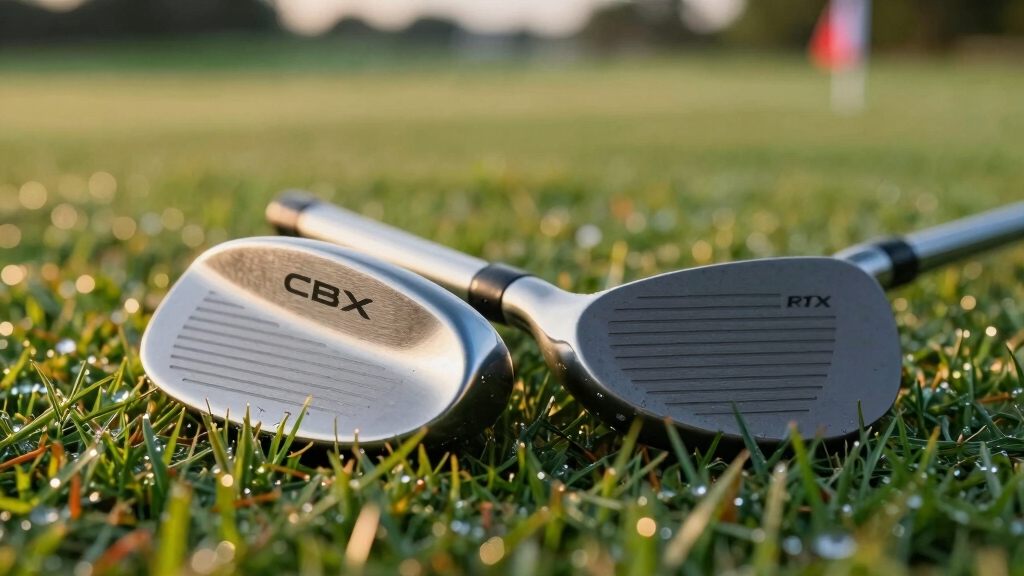
When you compare the CBX and RTX wedges, you’ll notice that they both deliver nearly identical spin rates on full shots. The CBX averages around 9,412 RPM, and the RTX is right in the same ballpark at typical distances.
Now, let’s talk about short game control. This is where the RTX really shines! For 60-yard shots, it generates about 8,000 RPM of spin, while the CBX comes in a bit lower at 6,800 RPM. That extra spin from the RTX gives you a little more stopping power around the greens, which can be a game-changer.
But here’s the thing: when it comes to half shots, the spin rates of both wedges are pretty comparable. So ultimately, your choice will depend on what you value more—consistency in your full swings or that extra spin for your short game. What do you think fits your style better?
Keep in mind that groove design plays a critical role in enhancing spin and control on short shots, so wedges with well-milled grooves like the RTX can provide an edge around the greens.
Full Shot Spin Rates
Typically, when comparing full shot spin rates between the CBX and RTX wedges, you’ll find that the CBX generates approximately 9,412 RPM, closely matching the RTX’s performance at similar distances.
This parity stems from their shared Rotex face technology, Zip Grooves, and micro milling, which optimize friction and backspin on full swings.
Despite the CBX’s cavity back and wider sole designed for forgiveness, it doesn’t sacrifice spin, maintaining consistency with the RTX’s traditional blade profile.
You’ll notice minimal variance in spin rates, with both delivering tight dispersion and comparable carry distances—CBX at 51 yards and RTX at 52 yards on full shots.
Fundamentally, when it comes to full shot spin, both wedges perform at a near-identical level, giving you reliable control without compromise.
This consistent spin performance is enhanced by the CNC-milled faces, which ensure precise control and consistent spin across various shot types.
Short Game Spin Control
While full shot spin rates between the CBX and RTX wedges are nearly identical, their performance diverges when focusing on short game spin control.
You’ll notice the RTX consistently produces higher spin on partial shots, around 8000 RPM on 60-yard shots compared to the CBX’s 6800 RPM. This edge stems from RTX’s thinner sole and sharper leading edges, which engage turf more aggressively, enhancing friction.
Meanwhile, the CBX generates slightly more spin on half shots, 6960 RPM versus RTX’s 6699 RPM, likely due to its cavity-back design promoting more consistent contact.
Additionally, RTX’s ZipCore technology maintains steadier spin levels across varying lie conditions, giving you reliable control around the green.
Ultimately, if you prioritize aggressive spin and versatility on short shots, RTX edges ahead. If forgiveness and consistency in spin matter more, CBX serves you well.
This difference in spin control mirrors how urethane covers provide higher spin and better greenside control compared to Surlyn, emphasizing the importance of design and material choice in wedge performance.
Forgiveness and Shot Consistency Compared
Although both the CBX and RTX wedges deliver strong performance, the CBX clearly excels in forgiveness and shot consistency due to its cavity back design and perimeter weighting. These features help maintain consistent ball speeds across the heel-to-toe axis.
You’ll notice tighter dispersion patterns with the CBX, as its nearly centered center of gravity minimizes off-center shot penalties. The RTX, with its blade-like profile, offers less perimeter weighting, resulting in more variability when striking away from the sweet spot.
While full shot carry distances are nearly identical—51 yards for the CBX and 52 for the RTX—the CBX’s design reduces offline deviation on half shots. It may be slightly less accurate than the RTX by about a yard. This difference aligns with the forgiveness and sweet spot characteristics seen in cavity back versus blade irons, where cavity backs provide greater consistency on mishits.
Bounce, Sole Shape, and Turf Interaction Differences
Have you ever noticed how different wedges can really affect your game? Take the CBX wedge, for instance. It has a higher bounce angle and a wider sole compared to the RTX. The RTX, on the other hand, features a sharper sole camber and a mid-level bounce around 10 degrees.
This design difference really plays a role in how each wedge interacts with the turf. The CBX excels in softer conditions thanks to its rounded front edge and back relief. It’s fascinating how these variations can help you choose the right wedge based on the turf conditions and the kind of shots you want to make.
Understanding this can definitely enhance your game! The higher bounce of the CBX wedge improves turf interaction by helping prevent digging in soft turf and sand.
Bounce Angle Comparisons
Since bounce angle critically affects turf interaction and shot versatility, understanding how the CBX and RTX wedges differ is essential for optimizing performance.
The CBX wedges feature a higher bounce angle and a wider sole with more back relief, which helps you handle soft turf and tight lies with less digging. In contrast, the RTX wedges have a mid-bounce around 10 degrees, paired with a sharper sole camber that suits tighter lies and firmer turf.
| Feature | CBX Wedges | RTX Wedges |
|---|---|---|
| Bounce Angle | Higher, enhanced back relief | Mid-bounce (~10°), sharper |
| Sole Shape | Wider sole, rounded front edge | Narrower sole, more camber |
| Turf Interaction | Better in soft, forgiving turf | Better in tight, firm turf |
Choosing the right wedge also involves considering the lie angle to ensure consistent turf interaction and shot accuracy.
Sole Width Variations
When examining sole width variations between the CBX and RTX wedges, you’ll notice the CBX’s wider sole offers increased turf interaction benefits, particularly in softer conditions.
The CBX features a larger sole with more back relief and a rounded front edge, helping it glide smoothly through turf and sand.
In contrast, the RTX has a narrower sole with sharper camber, designed for precise shot-making and tighter lies.
The CBX’s higher bounce and broader sole reduce digging, making it more forgiving on softer turf.
The RTX’s mid-bounce and thinner sole provide versatility around the greens by allowing cleaner contact.
Although both utilize the V-Sole grind, their sole shapes cater to different turf interaction preferences.
CBX favors forgiveness and smoothness, while RTX emphasizes control and precision.
Using launch monitors during practice can help golfers understand how these sole variations impact turf interaction and shot performance.
Turf Interaction Effects
In analyzing turf interaction effects, the CBX wedge‘s higher bounce and wider sole shape enhance its performance on softer turf by reducing digging and providing smoother turf engagement.
You’ll notice the CBX’s larger sole with more back relief lets it glide through grass and sand, minimizing resistance. In contrast, the RTX features a mid-level 10-degree bounce and a narrower sole with sharper camber, giving you more precision on tight lies but demanding cleaner contact.
The CBX’s rounded leading edge and backside kick from its high bounce improve turf forgiveness, especially in softer conditions. Meanwhile, the RTX’s thinner sole excels on firmer turf and allows versatility around the greens.
Ultimately, the CBX caters better to players seeking consistent turf interaction in softer conditions, while the RTX suits those prioritizing shot-making control. For golfers aiming to improve consistency and forgiveness, irons with optimized center of gravity and cavity-back design can offer beneficial performance characteristics.
Which Wedge Fits Your Playing Conditions Best?
Although both CBX and RTX wedges share advanced technology, your choice hinges on the course conditions and shot preferences.
The CBX’s wider sole and higher bounce excel in soft turf and sand, offering forgiveness and preventing digging.
Conversely, the RTX’s sharper sole and mid-bounce suit firmer turf and tight lies, enabling precise shot shaping and versatility around the greens.
| Condition | CBX Wedge | RTX Wedge |
|---|---|---|
| Turf Softness | Wide sole, high bounce, great for soft/sandy conditions | Narrow sole, sharper edges, better on firm turf |
| Shot Type | Forgiving full/half shots, consistent spin | Versatile shots, sharper control on tight lies |
| Course Preference | Players favoring forgiveness and turf interaction | Skilled players seeking shot-making precision |
Shaft and Grip Options for CBX and RTX Wedges
Choosing between the CBX and RTX wedges means also considering the shaft and grip options that impact feel and performance.
The CBX wedges come standard with the Dynamic Gold 115 shaft, which is lighter than traditional steel shafts. This offers enhanced swing speed and control, ideal for players seeking a game-improvement profile.
In contrast, RTX wedges typically feature more traditional shaft options that cater to players preferring a classic blade feel and precise feedback.
Regarding grips, the CBX models sport the Lamkin BlueCap grip, designed for secure traction and comfort during aggressive shots.
RTX wedges may offer alternative grip textures focused on fine touch around the greens. Your choice here directly influences your wedge’s responsiveness and stability during varying shot types.
Loft Choices, Pricing, and Availability Overview
While both CBX and RTX wedges offer a range of lofts to suit various shot requirements, the CBX series provides increments from 46 to 60 degrees in two-degree steps. This gives you fine control over trajectory and spin.
CBX models come in men’s and women’s versions, with steel or graphite shafts, and feature Lamkin BlueCap grips as standard.
RTX wedges, designed for versatility around greens, also cover a similar loft spectrum but tend to focus more on precision shotmaking.
Pricing for both lines is competitive, with CBX positioned slightly lower due to its game-improvement design. RTX commands a premium for its tour-inspired blade profile.
Availability is robust across major retailers, ensuring you can readily find the right loft and shaft combination for your game within each series.
How to Choose the Right CBX or RTX Wedge for Your Game?
How do you determine whether the forgiving cavity back design of the CBX or the precision-focused blade profile of the RTX suits your game better?
Choosing between the forgiving CBX cavity back and precise RTX blade depends on your game style and course conditions
If you prioritize forgiveness, consistent ball speeds heel-to-toe, and higher bounce benefiting soft turf or tight lies, the CBX with its wider sole and larger back relief excels.
Conversely, if you demand sharper edges, a thinner top line, and a narrower sole offering more versatility around the greens, the RTX’s blade-style profile fits better.
Consider your shot preferences: CBX’s cavity and centered CG aid tighter dispersion and ease of use, while RTX’s ZipCore technology delivers consistent spin and precise control.
Assess your typical conditions and shot types to select the wedge that complements your technique and turf interaction most effectively.
Frequently Asked Questions
How Do CBX and RTX Wedges Differ in Durability Over Time?
You’ll find both CBX and RTX wedges hold up well over time, thanks to their high-quality construction and advanced milling technologies.
However, RTX’s traditional blade-like profile with sharper edges may show wear more quickly on the leading edge compared to CBX’s cavity back and wider sole, which distribute impact stresses better.
Are CBX or RTX Wedges Better Suited for Beginners?
You’ll find CBX wedges better suited for beginners due to their cavity back design and perimeter weighting. This delivers more forgiveness and consistent ball speeds across the face.
Their wider sole and higher bounce help in soft conditions and tight lies, making mishits less punishing.
RTX wedges, with a blade-like profile and sharper edges, cater more to skilled players needing shot versatility and precision around greens.
What Are the Recommended Practice Drills for Each Wedge Type?
While CBX wedges demand you focus on groove engagement drills to maximize their forgiving cavity back design, RTX wedges require precision contact practice to exploit their blade-like sharp edges.
For CBX, work on consistent full shots and half shots to harness spin and forgiveness.
For RTX, emphasize tight, controlled chips and pitches, honing your sole interaction with varied lies.
Both benefit from short game distance control drills to master spin and trajectory nuances.
How Do Weather Conditions Affect CBX Vs RTX Wedge Performance?
You’ll find CBX wedges handle softer, wetter conditions better thanks to their higher bounce and wider sole, which prevent digging in.
RTX wedges, with their sharper sole and mid-bounce, excel on firmer turf and tight lies, offering cleaner contact.
In rainy or damp weather, CBX offers more forgiveness and stability.
RTX demands precise technique but rewards you with versatile shot-making around the greens in dry conditions.
Can CBX and RTX Wedges Be Customized With Aftermarket Grips?
You’re free to personalize your wedges with aftermarket grips to suit your feel and style.
Both CBX and RTX models come with standard grips—Lamkin BlueCap for CBX—but swapping them out won’t compromise performance.
Just make sure the replacement grips match shaft specifications and installation is precise to maintain balance.
This subtle customization lets you enhance comfort and control without altering the wedge’s engineered characteristics or playability.
From Rough to Refined: Making the Smart Wedge Choice
Choosing between CBX and RTX wedges is like picking the right tool from a precision toolbox. CBX wedges offer forgiveness and consistency, perfect for smoothing out rough shots, while RTX wedges deliver sharp spin control and turf interaction for pinpoint accuracy.
Understanding their design, bounce, and technology helps you match the wedge to your playing conditions. Equip yourself wisely, and watch your short game transform from a scattershot gamble into a finely tuned performance.
- ZipCore – A lightweight, low-density core sits at the heart of the club. While reducing vibrations…
- Hollow Cavity Design – Weight in the toe with a hollow chamber near the heel makes a better, more…
- UltiZip Grooves – Sharper, deeper, and closer together, UltiZip Grooves are more efficient at…
- HydraZip A new, dynamic blast and laser-milled line system creates roughness to enhance…
- ZipCore Our proprietary, low-density core technology has exponentially evolved for RTX 6 ZipCore…
- UltiZip UltiZip features grooves that are sharper, deeper, and more tightly spaced. They slice…
Last update on 2026-04-12 / Affiliate links / Images from Amazon Product Advertising API