
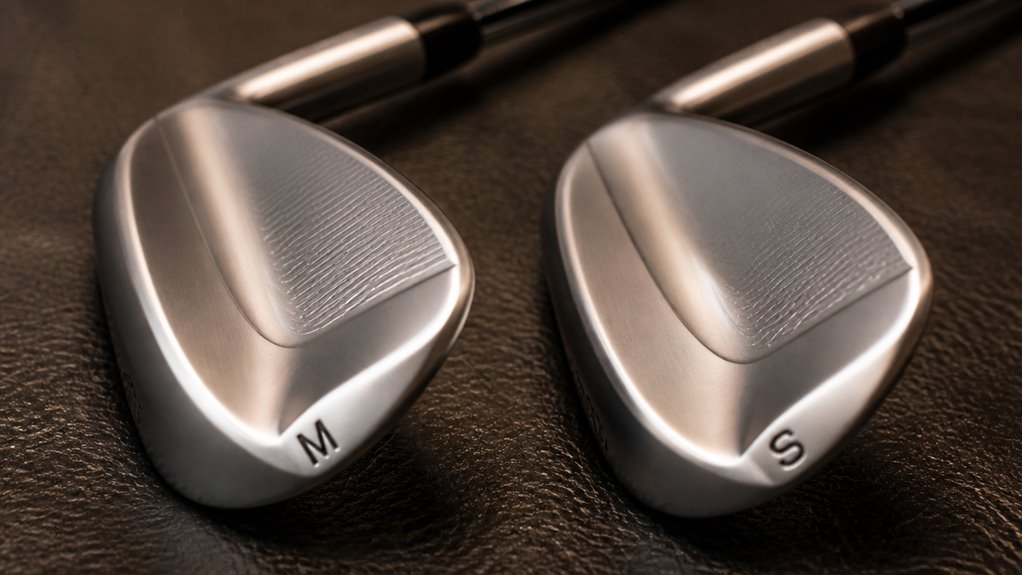
If you prefer creative shot-making with open-face play, the Vokey M Grind is your best bet. It offers more heel and toe relief for easier face manipulation and works great on firmer turf.
Meanwhile, the S Grind delivers a narrower sole with higher bounce. This provides stable, consistent turf interaction ideal for square-faced strikes on softer ground.
Choosing between them depends on your swing type, turf conditions, and shot versatility. There’s plenty more to explore on how each excels.

- Titleist Vokey SM10 (Tour Chrome)
- Your swing is unique and requires the right tools. Finding your ideal mix of grinds will provide you…
- Every SM10 groove is cut to the edge to maximize spin. Each Vokey wedge is 100% inspected for utmost…

- Titleist Vokey SM10 (Tour Chrome)
- Your swing is unique and requires the right tools. Finding your ideal mix of grinds will provide you…
- Every SM10 groove is cut to the edge to maximize spin. Each Vokey wedge is 100% inspected for utmost…
- Key Takeaways
- Vokey M Grind vs S Grind: Key Differences in Bounce, Sole Design, and Short-Game Performance
- Main Differences Between Vokey M and S Grinds
- Which Grind Suits Your Swing Type and Angle of Attack?
- How Sole Design Affects Turf Interaction and Shot Versatility?
- How Bounce Angles Affect Your Short Game?
- How Course and Turf Conditions Influence Your Grind Choice?
- Shot Types and Playing Styles Best Suited to M vs S Grinds
- Why M Grind Suits Creative, Open-Face Shots?
- Why S Grind Offers Stability for Square-Faced Shots?
- Frequently Asked Questions
- Vokey M Grind vs S Grind: Final Verdict
Key Takeaways
- M Grind offers more heel and toe relief, enabling easier face opening for flop and specialty shots.
- S Grind features a narrower sole with higher bounce, promoting square-faced stability and consistent turf contact.
- M Grind suits firmer turf and versatile shot-making with varied trajectories and open-face play.
- S Grind excels in softer turf and medium to soft sand, resisting digging for reliable, repeatable shots.
- M Grind supports creative play and forgiveness, while S Grind prioritizes stability and straightforward shot consistency.
Vokey M Grind vs S Grind: Key Differences in Bounce, Sole Design, and Short-Game Performance
| Comparison Factors | Vokey M Grind | Vokey S Grind |
|---|---|---|
| Primary Design Focus | Versatile shot-making and clubface manipulation | Consistent square-faced contact and stability |
| Sole Design | Relieved sole with enhanced heel and toe clearance | Narrower, more traditional sole profile |
| Bounce Angle | Approximately 8° in the models discussed | Approximately 10° in the models discussed |
| Heel and Toe Relief | More pronounced relief | Less aggressive relief |
| Clubface Manipulation | Designed for frequent face opening and closing | Better suited to predominantly square-faced shots |
| Open-Face Performance | Greater flexibility for open-face techniques | Less specialized for open-face techniques |
| Square-Face Performance | Capable of standard shots with versatile setup options | Designed for predictable square-face interaction |
| Swing Type | Shallow to moderate angle of attack | Moderate to slightly steep angle of attack |
| Turf Conditions | Firm to medium turf conditions | Medium to softer turf conditions |
| Sand Conditions | Firm to medium sand, depending on technique | Medium to softer sand, depending on technique |
| Flop Shots | Well suited to high, open-face shots | Less specialized for aggressive face opening |
| Chip Shots | Supports varied trajectories and creative techniques | Emphasizes straightforward, repeatable chips |
| Pitch Shots | Versatile pitch trajectories | Consistent square-faced pitch shots |
| Turf Interaction | Sole relief supports varied clubface positions | Traditional sole supports predictable ground contact |
| Shot Versatility | Higher emphasis on specialty shots | Higher emphasis on conventional shots |
| Best Playing Style | Creative golfers who manipulate loft and face angle | Golfers who favor consistent, neutral clubface delivery |
| Overall Recommendation | Choose for open-face flexibility and varied short-game shots | Choose for square-faced stability and straightforward technique |
Main Differences Between Vokey M and S Grinds
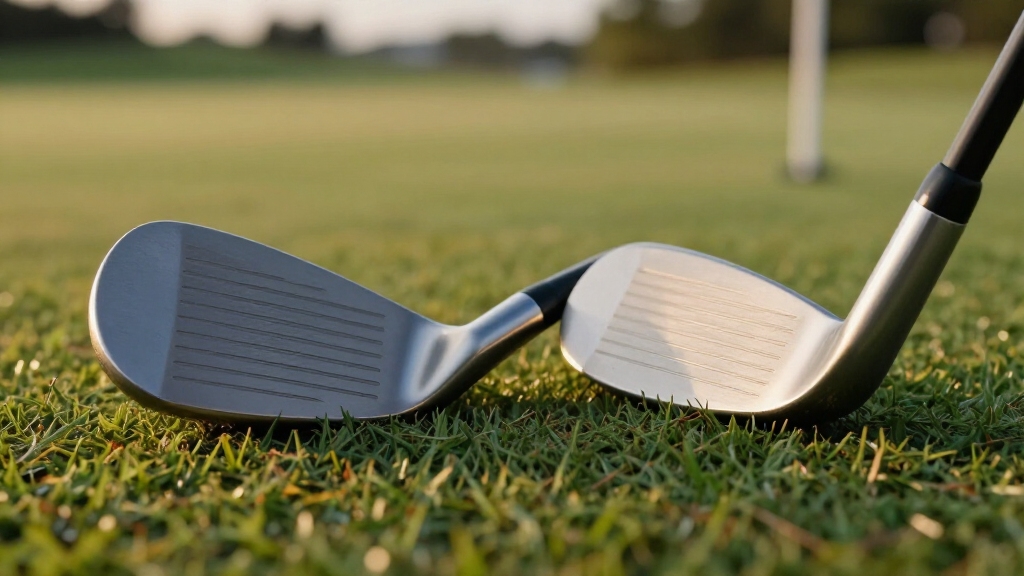
While both the Vokey M Grind and S Grind belong to the same family of wedges, they serve distinct purposes based on how you play around the green.
The M Grind offers more heel and toe relief, making it easier to open or close the face and execute a variety of shots. It’s versatile and favored by players who like to manipulate trajectory and shot shape.
The S Grind, on the other hand, features a narrower sole with less relief, designed for square-faced shots and stability through impact. It suits golfers who prefer straightforward mechanics and predictable turf interaction.
Bounce differences also matter: the M Grind usually has lower bounce (around 8°), ideal for firmer conditions.
The S Grind’s higher bounce (around 10°) enhances stability in softer turf.
Choosing the right grind can improve consistency by matching your natural stroke and shot-making style, much like how matching putter design to stroke path maximizes performance with stroke fit.
Which Grind Suits Your Swing Type and Angle of Attack?
Understanding your swing type and angle of attack helps determine which grind will best complement your short game.
If you have a shallow to moderate angle and like to manipulate the clubface, the M Grind offers versatility with heel and toe relief to open or close the face.
Conversely, if your angle is moderate to slightly steep and you prefer a consistent, square-faced strike, the S Grind’s narrower sole provides stability and dependable contact.
| Swing Type | Grind Recommendation | Why It Fits |
|---|---|---|
| Shallow to Moderate | M Grind | Allows face manipulation for creativity |
| Moderate to Slightly Steep | S Grind | Provides stability for square strikes |
| Versatile Shot-Maker | M Grind | Supports varied trajectories and shots |
Choosing the right grind can also improve your comfort and performance by reducing strain, similar to how selecting a properly sized golf bag based on player height enhances ease of use on the course.
How Sole Design Affects Turf Interaction and Shot Versatility?
Because the sole design directly influences how your wedge interacts with turf and sand, choosing between the M Grind and S Grind can markedly affect your shot versatility.
The M Grind offers more heel and toe relief, letting you open the face easily without the sole sitting flat. This enhances creativity on varied shots like flops and cuts.
This design suits firmer turf and tighter lies, giving you precise control when manipulating loft.
In contrast, the S Grind features a narrower, traditional sole with less relief. This promotes stable, square-faced contact ideal for straightforward chips and pitches.
It works well in softer turf, offering consistent turf interaction and dependable performance.
Understanding these differences helps you align your wedge choice with your typical shot style and course conditions for best short-game results.
Additionally, the choice between wider soles with higher bounce versus thinner soles with lower bounce plays a crucial role in turf interaction, which directly influences shot consistency and precision in different ground conditions, making sole design a key factor in wedge performance bounce and turf interaction.
How Bounce Angles Affect Your Short Game?
When you adjust the bounce angle on your wedge, you directly influence how the club interacts with the turf and sand during your short game.
Bounce affects how easily your wedge glides through the ground or bunker, impacting shot control and consistency.
For example, lower bounce angles allow cleaner contact when the clubface is opened. Higher bounce angles provide more resistance against digging in, stabilizing the sole on square-faced shots.
Understanding these nuances helps you select the right grind and bounce combination for your style.
Lower bounce (around 8°) enhances versatility for open-faced shots and softer turf engagement.
Higher bounce (around 10°) offers stability for square-faced, full shots.
Bounce influences bunker play by controlling sole interaction with sand.
Adjusting bounce impacts your ability to manipulate trajectory and shot shape.
Matching bounce to your angle of attack optimizes turf contact and shot reliability.
A wedge with higher bounce helps glide through sand and turf, reducing the risk of fat or thin shots for average golfers.
How Course and Turf Conditions Influence Your Grind Choice?
In evaluating your wedge grind, consider how the turf and course conditions will affect your turf interaction and shot execution.
The M Grind excels on firm or medium turf and sand, offering the versatility needed when tighter lies require face rotation and precise loft control. Its heel and toe relief allow you to open the face without the sole digging in excessively.
Conversely, the S Grind thrives in medium to softer turf, providing a more stable, predictable sole for square-faced contact. This grind helps you maintain consistent turf interaction when conditions demand less aggressive entry.
Ultimately, the firmness of the turf and sand influences whether you prioritize the M Grind’s adaptability or the S Grind’s stability. This makes course conditions a critical factor in your wedge grind choice.
Additionally, understanding how bounce angle impacts turf interaction can further refine your grind selection for optimal playability.
Shot Types and Playing Styles Best Suited to M vs S Grinds
Although both the M and S grinds come from Vokey’s trusted design, they cater to distinct shot types and playing styles. If you prefer to open, close, and square the clubface frequently, the M Grind suits your creative approach.
Conversely, if you rely on a neutral, square-faced style, the S Grind offers stability and simplicity. Your choice depends on how you like to interact with the turf and manipulate shots around the green.
M Grind excels for flop shots, cut shots, and open-face bunker play. S Grind fits stock chips, pitches, and square-faced strikes.
M Grind supports varied trajectories and face manipulation. S Grind delivers dependable contact and consistency. Your angle of attack and shot creativity influence the best grind for you.
Adjusting the swing weight of your wedges can further enhance control and shot consistency around the green.
Why M Grind Suits Creative, Open-Face Shots?
The M Grind is a game-changer when it comes to creative, open-face shots. Its enhanced face rotation and versatile sole relief really shine here.
What that means for you is that you can easily open the clubface, making it perfect for those flop and cut shots.
If you’re someone who loves to shape the ball and play with different trajectories around the green, you’ll definitely appreciate how the M Grind supports that style. It gives you the control and precision you need to execute those tricky shots.
Additionally, the M Grind’s wide sole design helps prevent digging, allowing for smoother turf interaction during open-face shots.
Enhanced Face Rotation
Opening greater shot creativity around the green hinges on the ability to manipulate the clubface effectively. The M Grind excels in this area due to its enhanced sole relief.
This relief provides more heel and toe clearance, making it easier to open the face without the sole digging into the turf. That means you can execute delicate flop shots, high lobs, and creative spins more confidently.
The M Grind’s design supports varied trajectories and shot shapes, giving you more control and versatility.
Increased heel and toe relief allows smoother face opening.
Reduced sole contact minimizes turf resistance when opening the face.
Enhanced rotation capability suits open-face bunker shots.
Supports manipulation for flop, cut, and specialty shots.
Maintains effective turf interaction despite aggressive face positioning.
Additionally, understanding weight distribution can further improve control and forgiveness when manipulating the clubface.
Versatile Sole Relief
When you need a wedge that adapts seamlessly to a variety of open-face shots, the M Grind’s versatile sole relief delivers exactly that.
Its design features significant heel and toe relief, allowing you to open the face without the sole sitting flat against the turf.
This means you can manipulate the clubface confidently for creative shots around the green.
Unlike the S Grind’s narrower sole, which offers more stability for square-faced strikes, the M Grind provides flexibility without compromising turf interaction in medium to firm conditions.
This makes it ideal if you like to vary trajectory and shot shape.
Ultimately, the M Grind’s sole relief supports a more inventive short game, matching players who prefer to open the blade and experiment with different shot styles.
Its design philosophy aligns with the balance between game-improvement and consistent distance performance, offering both forgiveness and playability.
Flop And Cut Shots
The M Grind’s design not only enhances versatility but also excels in supporting creative shot-making like flop and cut shots.
When you open the clubface, the M Grind’s heel and toe relief prevent the sole from digging excessively.
This allows precise control over trajectory and spin, making it ideal for manipulating the ball’s flight path around the green.
Consider these features:
- Enhanced heel and toe relief aids open-face shots
- Lower bounce promotes cleaner contact on delicate shots
- Versatile sole shape supports multiple shot trajectories
- Suitable for firm or medium turf conditions
- Enables confident face manipulation for high, soft landings
If you frequently play flop or cut shots, the M Grind offers the adaptability and control essential for creative short-game execution.
Its design principles share key similarities with cavity back irons that use perimeter weighting to enhance forgiveness and control.
Why S Grind Offers Stability for Square-Faced Shots?
Because the S Grind features a narrower sole with less heel and toe relief, it provides consistent contact when you keep the clubface square through impact.
This design promotes stability by minimizing sole rotation, which helps you achieve cleaner, more predictable turf interaction.
With about 10 degrees of bounce, the S Grind offers enough cushioning to prevent digging, especially on medium to softer turf, while maintaining a dependable full sole.
You’ll find it ideal if your swing emphasizes a moderate to slightly steeper angle of attack, focusing on straightforward chips and pitches rather than creative face manipulation.
Unlike the M Grind, which encourages versatility through face opening, the S Grind’s traditional sole supports repeatable, stable shots.
This makes it a solid choice for those prioritizing consistency over shot shaping.
Frequently Asked Questions
Can I Use M and S Grinds Interchangeably During a Round?
You can use M and S grinds interchangeably during a round, but it depends on your comfort and shot preferences.
The M Grind offers versatility for creative shots, while the S Grind provides stability for square-faced swings.
Switching between them helps adapt to varying turf and shot conditions, but frequent changes might affect consistency.
Stick with what feels reliable for your typical lies and shot types to maintain confidence throughout your round.
How Do M and S Grinds Affect Wedge Durability Over Time?
You won’t notice a big difference in wedge durability between M and S grinds since both use similar materials and finishes.
However, the M Grind’s more aggressive sole relief might cause slightly faster wear in heel and toe areas if you frequently open the face.
The S Grind’s narrower sole offers more uniform contact, possibly preserving the club’s edges longer.
Ultimately, your swing style and turf conditions play a bigger role in wear over time.
Are M and S Grinds Suitable for Left-Handed Golfers?
Yes, both M and S grinds are suitable for left-handed golfers. The grind options are symmetrical and designed to perform equally well regardless of handedness.
You’ll get the same versatility with the M Grind and the same stability with the S Grind on left-handed wedges. Your choice should focus on your playing style and turf conditions rather than hand orientation.
The grind’s performance isn’t affected by whether you play left or right-handed.
What Shaft Options Pair Best With M and S Grind Wedges?
You’ll want shaft options that complement your play style and wedge grind. For M Grind wedges, lighter, more flexible shafts like KBS Tour or Project X LZ help you manipulate shots easily.
For S Grind wedges, stiffer, stable shafts such as True Temper Dynamic Gold or Project X provide consistent feedback and control on square-faced shots.
Ultimately, choose shafts that match your swing tempo and desired feel for the best performance.
Do M and S Grinds Require Different Practice Routines?
You might find your practice routine naturally shifts depending on the grind you use.
If you favor versatility and open the face often, you’ll want to spend more time on flop shots and manipulating trajectories.
Conversely, with a simpler, square-faced setup, focusing on consistent, repeatable chips and pitches makes sense.
Vokey M Grind vs S Grind: Final Verdict
Choosing between the Vokey M and S grinds ultimately depends on your unique swing and course conditions.
If you enjoy a bit of artistic flair with open-faced creativity, the M grind gently encourages that freedom.
On the other hand, the S grind quietly supports a more grounded, square-faced approach, offering reliable stability.
Neither is better; just different tools tailored to subtly enhance your short game’s rhythm and adaptability.
Your perfect fit awaits your personal touch.
- Titleist Vokey SM10 (Tour Chrome)
- Your swing is unique and requires the right tools. Finding your ideal mix of grinds will provide you…
- Every SM10 groove is cut to the edge to maximize spin. Each Vokey wedge is 100% inspected for utmost…
- Titleist Vokey SM10 (Tour Chrome)
- Your swing is unique and requires the right tools. Finding your ideal mix of grinds will provide you…
- Every SM10 groove is cut to the edge to maximize spin. Each Vokey wedge is 100% inspected for utmost…
Last update on 2026-11-05 / Affiliate links / Images from Amazon Product Advertising API