
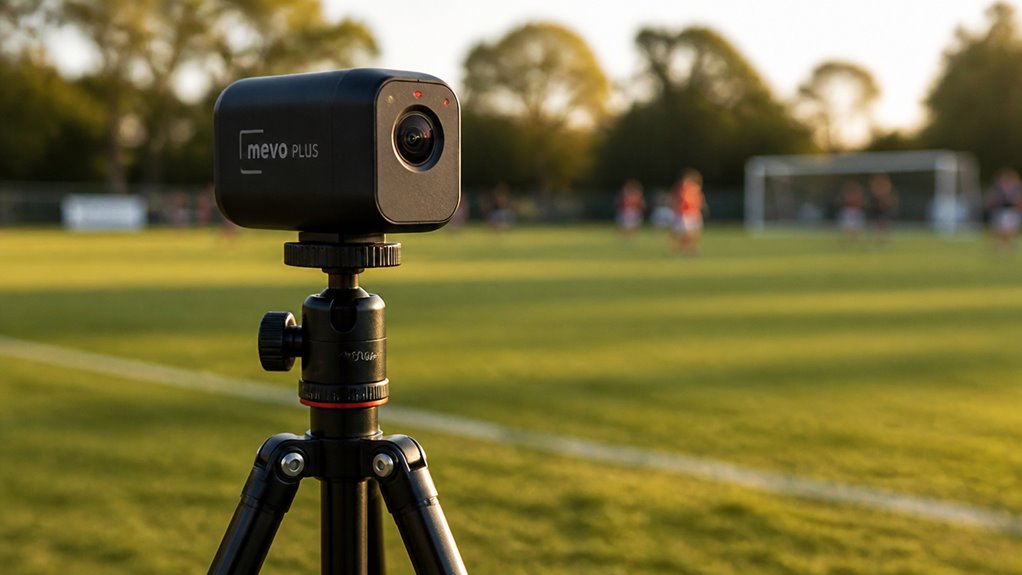
You should position the Mevo Plus sensor exactly 8 feet directly behind the ball for peak radar tracking.
Guarantee at least 13 feet of unobstructed ball flight ahead to capture accurate speed, spin, and launch angle data.
For indoor use, maintain a minimum room length of 18 feet, with 21–22 feet preferred to enhance precision.
Adjust distance settings in the device menu to match your setup, especially for chipping and putting.
Following these guidelines maximizes consistent and reliable measurement results.
Further details explain setup nuances and environment considerations you’ll want to know.
- Key Takeaways
- Why 8 Feet Behind the Ball Is Ideal for Mevo?
- Minimum and Optimal Indoor Ball Flight Space
- Minimum Room Size for Accurate Mevo+ Setup
- Mevo+ Alignment Behind the Ball
- Adjusting Mevo+ Distance Settings
- How to Set Up Mevo+ for Chipping and Putting?
- Why More Ball Flight Improves Mevo+ Accuracy?
- Indoor Room and Screen Clearance Tips for Mevo+ Accuracy
- Comparing Mevo+ Outdoor and Indoor Setup Distances
- Frequently Asked Questions
- Mevo Plus Distance Requirements: Final Setup Tips
Key Takeaways
- Position the Mevo Plus sensor 8 feet directly behind the ball for optimal radar tracking and consistent shot data.
- Ensure a minimum indoor room length of 18 feet, ideally 21–22 feet, to accommodate sensor placement and full ball flight.
- Allocate about 13 feet of ball flight space in front of the tee for accurate speed, spin, and trajectory measurements.
- Maintain at least 1 foot of rear-wall clearance behind the sensor to prevent radar interference and signal reflection.
- For short shots, adjust the “Distance to Ball” setting in the radar menu to match the specific environment and shot type.
Why 8 Feet Behind the Ball Is Ideal for Mevo?
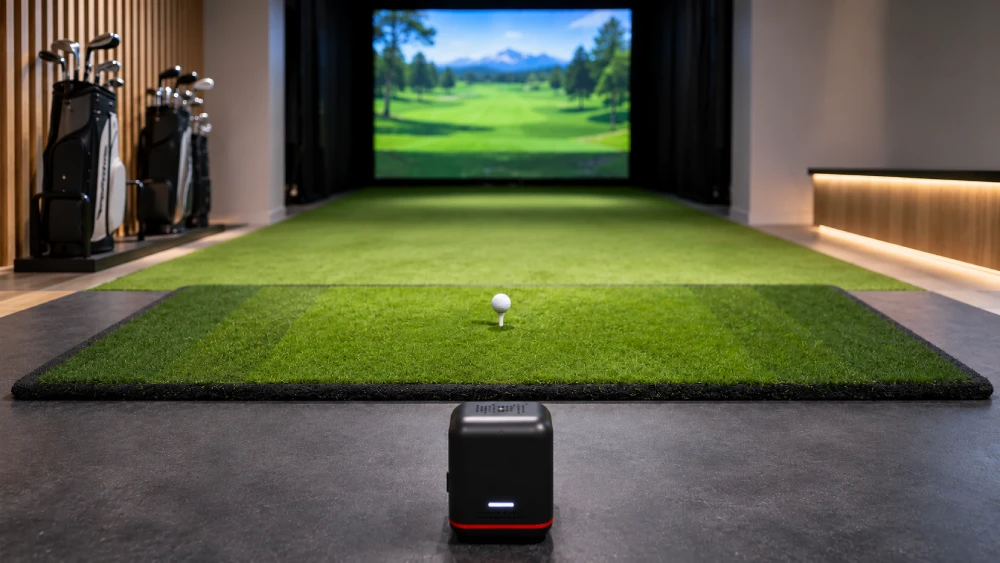
Placing the Mevo+ sensor 8 feet behind the ball guarantees peak radar tracking by balancing proximity and unobstructed ball flight. This distance optimizes radar signal reception, ensuring accurate measurement of ball speed, spin, and launch angle.
You’ll find that 8 feet offers sufficient space to capture essential ball data without interference from the club or ground. While some setups range from 7 to 9 feet, 8 feet serves as the most consistent and recommended benchmark for outdoor full swing and limited-flight shots.
Positioning the sensor directly behind the ball prevents skewed readings caused by lateral offsets. Additionally, maintaining this precise distance facilitates repeatable results across various shot types, enhancing data reliability for both coaching and performance analysis.
Because Mevo Plus uses a combination of Doppler radar and camera technology, keeping the sensor at this optimal distance is crucial for minimizing indoor interference and maximizing tracking performance.
Minimum and Optimal Indoor Ball Flight Space
To get the most out of your Mevo+, you’ll want to make sure you have a minimum indoor room length of about 18 feet. This gives you enough space for the ball to fly properly.
Now, here’s the important part: for peak tracking accuracy, you need roughly 13 feet of ball flight distance beyond the tee. Just remember, when the device is positioned 8 feet behind the ball, that extra space really makes a difference.
If your room doesn’t have enough length, you might run into some issues with radar measurements. So, ensuring those proper room dimensions is really key for getting reliable data. It’ll help you enjoy a more accurate and satisfying experience!
The Mevo+ uses advanced radar tracking technology that requires this space to accurately analyze your full shot trajectory and swing parameters.
Recommended Ball Flight Distance
Achieving accurate ball flight tracking indoors with the Mevo+ requires maintaining a recommended minimum of 13 feet of ball flight distance.
This distance guarantees the radar sensor captures sufficient flight data for reliable full-swing analysis.
While some setups operate with as little as 8 feet of ball flight, this minimal distance compromises tracking fidelity and data accuracy.
For peak performance, you should position the sensor approximately 8 feet behind the tee, which aligns with Mevo+ guidelines to maximize signal clarity.
Maintaining at least 13 feet forward from the ball allows the radar to track trajectory and spin effectively.
Adhering to these parameters within your indoor space will enhance measurement precision and consistent shot evaluation, critical for effective practice and performance improvement.
Due to the Mevo Plus’s combination of Doppler radar and camera technology, proper spacing is essential to capture full ball flight data accurately indoors.
Minimum Indoor Room Length
Although indoor space constraints vary, you need at least 18 feet of total room length to accommodate the Mevo+ sensor placement and ball flight requirements.
This length guarantees the sensor, positioned about 8 feet behind the tee, captures adequate ball flight data.
Typically, this requires 8 to 13 feet of forward flight space.
While 18 feet is the minimum, extending to 21–22 feet enhances performance and reduces interference. To optimize your setup, consider the following:
- Maintain 8 feet behind the ball for sensor placement consistency.
- Allocate a minimum of 8 to 13 feet of ball flight distance in front.
- Assure at least 1 foot of rear-wall clearance to prevent radar interference.
For best results, ensure your room setup minimizes sensor interference and allows for accurate data capture.
Impact On Tracking Accuracy
Maintaining the recommended minimum room length directly influences the accuracy of Mevo+ tracking indoors. When you guarantee at least 18 feet of total space, typically 8 feet behind the ball and 13 feet of ball flight forward, you maximize the radar’s ability to capture accurate ball speed, spin, and trajectory data.
Insufficient ball flight space compromises tracking fidelity, causing inconsistent results. For best performance, aim for around 21–22 feet total length.
| Parameter | Recommended Distance |
|---|---|
| Distance Behind Ball | 8 feet (2.4 meters) |
| Ball Flight Distance | 13 feet (3.96 meters) |
| Minimum Room Length | 18 feet (5.5 meters) |
| Optimal Room Length | 21–22 feet (6.4–6.7 meters) |
| Rear Wall Clearance | ≥ 1 foot (0.3 meters) |
Adhering to these distances guarantees precise radar tracking and minimizes measurement errors indoors. Proper calibration and consistent room conditions also play a critical role in ensuring sensor fidelity and long-term accuracy.
Minimum Room Size for Accurate Mevo+ Setup
When setting up your Mevo+ indoors, you need at least 18 feet of total room length to guarantee accurate ball tracking and data capture. This minimum guarantees sufficient distance behind the ball for the sensor placement, plus adequate ball flight space.
While some setups manage with 16 feet, 18 feet provides a safer margin for reliable readings. Ideally, 21 to 22 feet offers enhanced accuracy due to extended ball flight.
Consider the following for ideal room size:
Allocate roughly 8 feet behind the ball for sensor positioning. Guarantee at least 13 feet of ball flight space in front of the ball. Maintain clearances near walls and screens to prevent radar interference.
Adhering to these dimensions supports precise Mevo+ indoor performance. Additionally, selecting an enclosure with impact screen quality can further ensure accurate data capture and reduce ball ricochets.
Mevo+ Alignment Behind the Ball
Meeting the minimum room size requirements sets the stage for proper Mevo+ alignment behind the ball, which markedly influences data accuracy.
You must position the Mevo+ sensor directly behind the ball, avoiding any lateral offset to ensure precise radar tracking.
The optimal distance is approximately 8 feet (2.4 meters) behind the tee for outdoor full swing and chipping setups. This placement balances radar signal clarity with ball flight visibility.
For indoor setups, maintaining this distance while allowing sufficient ball flight space ahead is vital to avoid measurement errors. Additionally, ensure at least one foot of rear clearance behind the Mevo+ to prevent interference.
Proper alignment reduces data anomalies and improves shot consistency in your performance analysis.
Using a simulator-ready impact screen behind the hitting area can further enhance data quality by providing a consistent target backdrop for the sensor.
Adjusting Mevo+ Distance Settings
Although the Mevo+ sensor is typically positioned about 8 feet behind the ball, you should fine-tune the distance settings within the device’s radar setup menu to match your specific environment and shot type.
Position the Mevo+ sensor roughly 8 feet behind the ball, then fine-tune distance settings for optimal accuracy.
This adjustment guarantees peak radar accuracy, especially when room dimensions or ball-flight distances vary from standard setups. Precise calibration compensates for deviations in placement, indoor space constraints, and shot variety.
When adjusting distance settings, consider these factors:
- Exact sensor-to-ball distance measured in feet or meters
- The available ball flight space affecting radar tracking reliability
- Specific shot modes (full swing, chipping) requiring tailored distance input
For best results, ensure proper positioning behind the ball to maintain the Doppler radar’s ±3% accuracy margin.
How to Set Up Mevo+ for Chipping and Putting?
Since chipping and putting involve shorter ball flights and more delicate shot dynamics, you must adjust your Mevo+ sensor placement and settings accordingly to guarantee accurate data capture.
Position the Mevo+ approximately 8 feet behind the ball for chipping, aligning it directly behind the tee to optimize radar tracking. For putting, reduce this distance to about 5 feet, ensuring the sensor remains centered to accurately measure the minimal ball flight and spin variations.
In both cases, fine-tune the “Distance to Ball” setting within the radar menu to match your specific setup distance. Maintain at least one foot of rear clearance to minimize interference.
This precise positioning and calibration enable the Mevo+ to reliably capture the nuanced data required for effective chipping and putting analysis.
For best results when filming these shots, consider using a magnetic aluminum tripod for stable and flexible phone mounting, allowing hands-free video capture alongside your Mevo+ data.
Why More Ball Flight Improves Mevo+ Accuracy?
Why does increased ball flight distance enhance Mevo+ accuracy? When the ball travels farther, the radar sensor obtains more data points, enabling precise calculation of speed, spin, and trajectory.
Increased ball flight distance gives Mevo+ more data for precise speed, spin, and trajectory calculations.
This extended flight path reduces measurement noise and improves detection stability. You’ll notice improved consistency in shot readings with adequate ball flight.
Consider these key factors:
Extended radar tracking: Longer ball flight provides more time for Doppler radar to analyze velocity and spin changes.
Reduced signal interference: Sufficient flight distance minimizes false echoes and environmental noise.
Enhanced data resolution: More data points along the trajectory enable refined algorithms to compute launch parameters accurately.
Additionally, dual Doppler radars and high-speed cameras work together to capture over 27 performance metrics, ensuring comprehensive shot analysis.
Indoor Room and Screen Clearance Tips for Mevo+ Accuracy
To get the most accurate readings from your Mevo+, you’ll want to carve out at least 18 feet of indoor space. If you can stretch that to 21 or 22 feet, you’ll set yourself up for even more reliable results.
Now, when you’re positioning the screen, make sure to keep at least one foot of clearance from the rear wall. This little tip helps prevent any radar interference that could mess with your data.
Optimal Indoor Space
Although setting up your Mevo+ indoors requires careful planning, ensuring ideal space and screen clearance greatly enhances measurement accuracy.
You should aim for approximately 8 feet behind the ball with at least 13 feet of ball flight space forward. This configuration provides optimal radar tracking and data precision.
A minimum total room depth of 18 feet is often cited, but 21 to 22 feet is preferred for consistent performance.
Key considerations include:
Positioning Mevo+ directly behind the ball at about 8 feet.
Allowing 13 feet or more of unobstructed ball flight distance.
Ensuring the total indoor length accommodates sensor placement plus ball travel.
Screen And Wall Clearance
Guaranteeing proper screen and wall clearance in your indoor setup helps maintain the accuracy of Mevo+ readings by minimizing radar signal interference.
You should position the Mevo+ at least one foot away from the rear wall to prevent signal reflection that could distort data.
Similarly, guarantee the impact screen has sufficient clearance on all sides to avoid radar disruption from nearby surfaces.
Maintain a minimum clearance of 18 feet total room depth, with 8 feet behind the ball and 13 feet of ball flight forward, to optimize radar tracking.
Avoid placing the device too close to metallic or reflective objects near the screen or walls, as these can introduce noise.
Adhering to these clearance guidelines guarantees consistent, precise measurements in your indoor environment.
Comparing Mevo+ Outdoor and Indoor Setup Distances
How do Mevo+ setup distances differ between outdoor and indoor environments? Outdoors, you typically position the Mevo+ about 8 feet behind the tee, allowing unrestricted ball flight and optimal radar tracking.
Indoor setups require more space due to ball flight limitations imposed by nets and walls. You’ll need approximately 13 feet of ball flight distance forward, resulting in a recommended total room depth of at least 18 to 22 feet for accurate full-swing data.
Key distinctions include:
Outdoor setups favor 7–9 feet behind the tee with open flight paths.
Indoor setups require 8 feet behind the ball plus 13 feet forward, totaling around 21 feet depth.
Limited indoor space can reduce accuracy; more room improves radar tracking reliability.
Adjust your setup accordingly to ensure precise and consistent Mevo+ performance.
Frequently Asked Questions
Can Mevo+ Track Ball Spin Without Metallic Dots Indoors?
No, you can’t reliably track ball spin indoors with the Mevo+ without metallic dots or Titleist RCT balls.
These specialized balls provide the radar with necessary reflective markers to accurately measure spin metrics in netted environments.
Without them, the radar struggles to detect spin data due to limited radar reflections.
For precise spin readings indoors, make sure you use the recommended balls or markers as specified in Mevo+ setup guidelines.
How Does Lighting Affect Mevo+ Distance Measurements?
Imagine sunlight flooding your setup or harsh shadows creeping across the sensor.
Lighting directly impacts Mevo+ distance measurements by influencing the radar’s ability to detect the ball accurately.
Bright, even lighting reduces interference and enhances radar signal clarity.
Low light or glare can cause tracking errors or inconsistent distance data.
To guarantee precise measurements, maintain consistent, diffuse lighting that minimizes reflections and shadows around the sensor and ball.
What Is the Impact of Uneven Floors on Mevo+ Accuracy?
Uneven floors can negatively impact your Mevo+ accuracy by altering the device’s alignment and sensor-to-ball distance. These factors are critical for precise radar measurements.
If the unit isn’t level or stable, the radar may misinterpret ball trajectory and speed data.
To maintain accuracy, ensure your setup surface is flat and stable.
Use leveling tools to correct any floor irregularities before measuring distance or ball flight.
Can Mevo+ Be Used Effectively in Windy Outdoor Conditions?
You can use Mevo+ outdoors in windy conditions, but expect reduced accuracy compared to calm environments.
Wind introduces unpredictable ball flight deviations, complicating radar tracking.
While Mevo+ excels at measuring ball speed and spin, gusts can distort trajectory data, leading to less reliable distance and flight path readings.
For precise analysis, calm or indoor settings remain ideal.
Still, with awareness of wind impact, you can extract useful performance insights outdoors.
How Often Should Mevo+ Distance Calibration Be Performed?
You should perform Mevo+ distance calibration regularly to maintain accuracy, ideally before each session or any time you change your setup location.
Frequent calibration guarantees consistent readings, especially if environmental factors or sensor placement vary.
If you notice discrepancies in distance measurements or data, recalibrate immediately.
Keeping calibration up-to-date preserves the integrity of your data, supporting precise shot analysis and improving your training outcomes.
Mevo Plus Distance Requirements: Final Setup Tips
To achieve flawless Mevo+ performance, positioning yourself exactly 8 feet behind the ball isn’t just recommended—it’s critical.
Deviate even slightly, and you risk catastrophic data inaccuracies that could cripple your entire practice session.
Ensuring prime indoor space and precise alignment transforms your setup into a high-precision instrument, delivering unparalleled shot metrics.
Master these distance requirements meticulously, and your Mevo+ will operate with surgical precision, elevating your game beyond all conventional limits.