
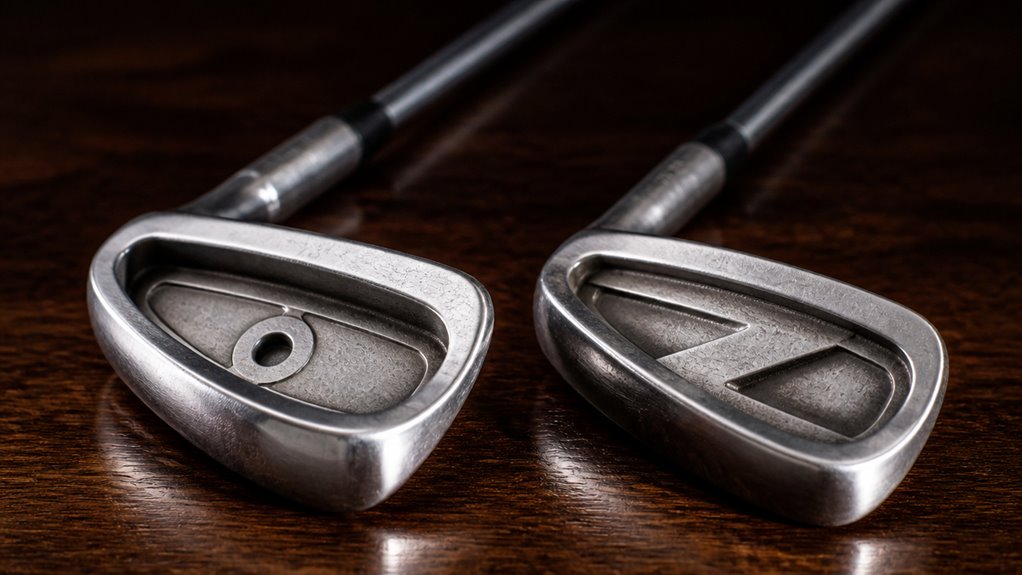
If you want precise shot-shaping and control, the Ping Eye 2’s compact, cavity-back design with minimal offset delivers tighter dispersion and a lower, controlled ball flight.
But if you prefer easier launch and forgiveness, the Ping Zing’s midsize head, higher toe, and noticeable offset help reduce slices and improve consistency on off-center hits.
Both use stainless steel and perimeter weighting, balancing durability and playability.
Keep exploring to understand which fits your game style best.

- i240
- Stiff
- 5-PW, UW
- Key Takeaways
- Ping Eye 2 vs Ping Zing: Key Differences at a Glance
- Main Differences Between Ping Eye 2 and Ping Zing Irons
- How Ping’s Eras Shaped Eye 2 and Zing Iron Designs?
- Head Design and Forgiveness Comparison of Ping Eye 2 and Zing Irons
- Launch and Shot Control: Ping Eye 2 vs Ping Zing Irons
- Key Specs: Head Size, Shaft, and Offset in Eye 2 and Zing Irons
- Which Golfers Benefit Most From Ping Eye 2 vs Ping Zing Irons?
- Why Ping Zing Irons Are Easier to Hit for Average Players?
- Which Ping Iron Fits Your Game Better: Eye 2 or Zing?
- Frequently Asked Questions
- Are Ping Eye 2 or Zing Irons Better for Beginners?
- How Do Ping Eye 2 and Zing Irons Perform on Different Turf Conditions?
- What Is the Resale Value Difference Between Ping Eye 2 and Zing Irons?
- Can Ping Eye 2 and Zing Irons Be Easily Re-Shafted or Upgraded?
- Do Ping Eye 2 and Zing Irons Come in Left-Handed Versions?
- Make Your Final Ping Eye 2 vs Ping Zing Decision
Key Takeaways
- Ping Eye 2 irons feature a compact, traditional profile prioritizing shot control and precise turf interaction with minimal offset.
- Ping Zing irons have a midsize head with offset and a higher toe for increased forgiveness and easier launch.
- Eye 2 offers stronger shot-shaping ability and a lower, more penetrating ball flight for skilled players.
- Zing is designed for average golfers seeking forgiveness, higher launch, and consistent ball flight on off-center hits.
- Both sets use stainless-steel cavity-back construction, but Eye 2 suits control-focused players, while Zing favors forgiveness and ease of use.
Ping Eye 2 vs Ping Zing: Key Differences at a Glance
| Comparison Factor | Ping Eye 2 | Ping Zing |
|---|---|---|
| Head Design | Compact, traditional cavity-back profile | Midsize head with a higher toe |
| Forgiveness | Moderate forgiveness with a stronger control focus | Greater forgiveness on off-center strikes |
| Offset | Minimal or no offset for precise shot shaping | Noticeable offset that helps square the clubface |
| Launch | Produces a lower, more controlled ball flight | Promotes an easier, higher launch |
| Shot Shaping | Better suited to golfers wanting workability and trajectory control | Prioritizes consistency and ease of use |
| Turf Interaction | Compact profile favors precise interaction on tighter lies | Wider, forgiving profile can suit softer or thicker turf |
| Player Type | Better matched to skilled, control-focused golfers | Better matched to average golfers seeking forgiveness |
| Construction | Stainless-steel cavity-back with perimeter weighting | Stainless-steel cavity-back with perimeter weighting and higher-toe design |
| Overall Character | Classic feel, feedback, and control | User-friendly launch and forgiveness |
Main Differences Between Ping Eye 2 and Ping Zing Irons
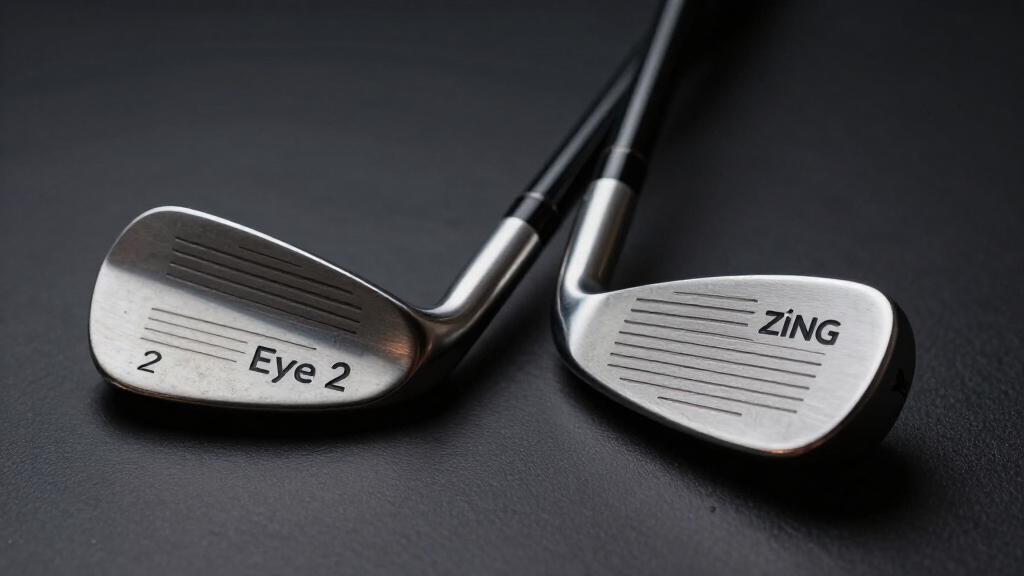
While both the Ping Eye 2 and Ping Zing irons share a focus on forgiveness through cavity-back designs and steel shafts, they differ markedly in head size, shape, and playability.
Ping Eye 2 and Zing irons both emphasize forgiveness but differ significantly in design and playability.
You’ll notice the Eye 2 features a compact, traditional profile with classic perimeter weighting, offering a more control-oriented feel and stronger shot-shaping ability.
In contrast, the Zing irons present a midsize head with a higher toe, increasing forgiveness, especially on off-center strikes.
The Zing’s offset design aids players seeking easier launch and consistent ball flight, whereas the Eye 2 typically lacks offset, catering to those preferring precise turf interaction.
Both sets maintain similar shaft options and lie angles, but Zing leans toward user-friendliness, while Eye 2 prioritizes feedback and workability for skilled players.
Additionally, the cavity back design in both irons helps redistribute weight to the perimeter, enhancing forgiveness on off-center hits and promoting more consistent ball flight.
How Ping’s Eras Shaped Eye 2 and Zing Iron Designs?
You’ll notice that Ping’s design philosophy took a significant turn over the years. Back in the 1980s, the Eye 2 was all about perimeter weighting, which really focused on control. Fast forward to the 1990s, and you see the Zing shifting gears towards increased forgiveness and a midsize profile.
As time went on, the trends in golf clubs started leaning toward larger clubheads. This change was all about enhancing playability, especially on those mis-hits. You can see how this trend directly influenced the Zing’s shape and performance.
This evolution reflects a broader industry emphasis on head design and forgiveness, which plays a crucial role in improving shot consistency and confidence.
Evolution of Design Philosophy
As Ping’s design philosophy evolved through the 1980s and early 1990s, the progression from the Eye 2 to the Zing irons reflected a shift toward balancing traditional control with increased forgiveness.
You’ll notice the Eye 2’s compact, perimeter-weighted stainless-steel head emphasized shot-shaping and turf interaction. In contrast, the Zing introduced a midsize profile with a higher toe to enhance forgiveness without sacrificing feel.
Key design evolutions include:
Progression from a classic, control-focused cavity back (Eye 2) to a more user-friendly, forgiving shape (Zing).
Incorporation of offset in Zing to aid consistency, absent in Eye 2.
Refinement of head geometry to support easier launch and off-center hits in Zing.
This evolution mirrors Ping’s response to changing player demands and technological advances.
Similar to Ping’s shift, modern irons like the Cobra 3100 I/H use optimized center of gravity placement to enhance forgiveness and consistent ball flight.
Forgiveness Trends Over Time
Because forgiveness became a central focus in club design during the 1980s and 1990s, Ping’s Eye 2 and Zing irons embody distinct eras of this trend. The Eye 2, launched in 1982, emphasizes perimeter weighting and cavity-back construction. This provides a larger effective hitting area with a classic, compact profile.
By contrast, the 1991 Zing irons feature a midsize head and a higher toe, enhancing forgiveness on mis-hits. You’ll find the Zing irons generally easier to use for consistency. The Eye 2 offers more control-oriented feedback.
Properly matching the swing weight of these irons can further optimize their feel and performance to suit individual swing styles.
| Feature | Ping Eye 2 (1980s) | Ping Zing (1990s) |
|---|---|---|
| Head Size | Compact | Midsize |
| Forgiveness Focus | Perimeter weighting | High toe, larger sweet spot |
| Player Preference | Control and feel | Ease of use, forgiveness |
| Design Era | Early stainless-steel design | Later, modern shape |
Profile Changes and Impact
While Ping’s Eye 2 irons reflect the company’s early 1980s focus on compact, perimeter-weighted designs prioritizing control and traditional turf interaction, the later Zing models demonstrate a clear shift toward midsize profiles with a higher toe to enhance forgiveness and ease of use.
This evolution mirrors Ping’s response to changing player needs and technological advancements. When you compare the two, consider:
Eye 2’s compact head and minimal offset promote precise shot shaping and feedback.
Zing’s midsize head with a raised toe area increases the moment of inertia, reducing twisting on off-center strikes.
The higher toe in Zing irons supports a larger sweet spot, helping you maintain consistency even on mis-hits.
These profile changes markedly impact playability, tailoring each model to distinct golfer preferences.
Additionally, modern shaft technologies like graphite construction improve swing speed and comfort, influencing club performance across different Ping eras.
Head Design and Forgiveness Comparison of Ping Eye 2 and Zing Irons
Though both Ping Eye 2 and Zing irons emphasize forgiveness through their cavity-back construction, their head designs differ markedly in shape and size to achieve this goal.
The Eye 2 features a classic, compact head with perimeter weighting, enhancing control while still enlarging the sweet spot.
The Zing adopts a midsize head with a higher toe, increasing forgiveness on mishits.
If you prioritize feedback and shot shaping, Eye 2 suits you best. For easier playability and off-center forgiveness, Zing excels.
These design differences align with the general distinction between blades and cavity backs, where perimeter weighting increases the Moment of Inertia (MOI) to enhance forgiveness.
| Feature | Ping Eye 2 | Ping Zing |
|---|---|---|
| Head Size | Compact | Midsize |
| Toe Height | Standard | Higher |
| Forgiveness | Moderate (control focus) | High (user-friendly) |
| Weighting | Perimeter weighting | Perimeter + higher toe |
| Playability | Control-oriented | Forgiveness-oriented |
Launch and Shot Control: Ping Eye 2 vs Ping Zing Irons
Understanding the differences in head design and forgiveness between the Ping Eye 2 and Zing irons sets the stage for examining how these factors influence launch characteristics and shot control.
The Eye 2’s compact, perimeter-weighted head offers a more penetrating ball flight and tighter dispersion. This appeals to players seeking precise trajectory control. In contrast, the Zing’s midsize profile with a higher toe promotes a higher launch and greater forgiveness on off-center hits, aiding consistency.
Key distinctions include:
Eye 2 delivers stronger shot-shaping ability with a lower, more controlled ball flight.
Zing produces easier launch conditions, helping you get the ball airborne quicker.
Zing offers more tolerance on mishits, reducing shot dispersion.
Your choice depends on whether you prioritize shot control or launch assistance. Modern design tweaks such as perimeter weighting and optimized center of gravity help enhance forgiveness and playability in irons like these.
Key Specs: Head Size, Shaft, and Offset in Eye 2 and Zing Irons
Both the Ping Eye 2 and Ping Zing irons feature stainless-steel heads and steel shafts. They’re commonly offered with regular and stiff shaft flex options to suit different player preferences.
When you examine head size, the Eye 2 opts for a compact, traditional profile with perimeter weighting. In contrast, the Zing employs a midsize head with a higher toe, enhancing forgiveness.
Shaft lengths and lie angles remain within standard ranges for both sets, ensuring a familiar feel and setup. Offset is a key differentiator: the Zing incorporates noticeable offset to promote squaring the clubface and reduce slices.
On the other hand, the Eye 2 typically presents minimal or no offset, favoring shot-shaping precision. This contrast in design reflects their distinct approaches—Eye 2’s classic control versus Zing’s modern forgiveness.
Both sets are designed with shaft flex options to match varying swing speeds and player control preferences.
Which Golfers Benefit Most From Ping Eye 2 vs Ping Zing Irons?
When choosing between Ping Eye 2 and Ping Zing irons, your playing style and desired performance characteristics will largely determine which model suits you best.
If you prioritize shot-shaping and precision, the Eye 2’s compact profile and perimeter weighting offer greater control and traditional turf interaction.
Conversely, if you want enhanced forgiveness and easier launch, the Zing’s midsize head and higher toe area provide more consistent performance on off-center hits.
You’ll benefit most from:
Ping Eye 2 if you seek classic feedback and stronger control for skilled, consistent ball-strikers.
Ping Zing if you prefer a more forgiving, user-friendly iron suited for average players.
Both irons if you want durable stainless steel construction with steel shafts and similar playability specs.
Choose based on your balance of control versus forgiveness needs.
Additionally, just as the Jones Classic Stand Bag balances durability and style, selecting irons that align with your preferences ensures a harmonious golf experience.
Why Ping Zing Irons Are Easier to Hit for Average Players?
Ping Zing irons consistently deliver easier playability for average players thanks to their midsize head design and higher toe area. This increases the club’s forgiveness on off-center strikes.
You’ll find the larger effective hitting area reduces mishits’ impact, promoting straighter, more consistent shots. The higher toe raises the moment of inertia (MOI), enhancing stability through impact, especially on toe strikes.
This contrasts with the Eye 2’s more compact head and traditional profile, which prioritize control over forgiveness. Additionally, the Zing’s offset helps square the clubface at impact, aiding players who struggle with slicing.
With stainless steel construction and cavity-back design, the Zing balances durability and playability. This makes it more user-friendly for average players seeking consistency without sacrificing distance or feel.
For added comfort and stability, features like coil-over shocks in golf carts demonstrate how thoughtful engineering can improve performance and user experience.
Which Ping Iron Fits Your Game Better: Eye 2 or Zing?
If you prioritize shot control and a traditional feel, the Eye 2 irons will likely suit your game better. Their compact head design and perimeter weighting provide precise feedback and strong shaping ability.
Conversely, if you need more forgiveness and easier launch, the Zing irons with their midsize heads and high toe profile offer a user-friendly option.
Consider these factors when choosing:
Eye 2 excels for golfers seeking strong turf interaction and shot-shaping control.
Zing fits those wanting enhanced forgiveness and consistency on mis-hits.
Shaft options and lie angles remain similar, so head design and playability should guide your choice.
Ultimately, your preference between classic control and modern forgiveness determines which Ping iron matches your playing style.
Frequently Asked Questions
Are Ping Eye 2 or Zing Irons Better for Beginners?
For beginners, Ping Zing irons are generally better because they offer a midsize head with a higher toe area, increasing forgiveness on off-center hits.
You’ll find the Zing’s design helps you launch the ball more easily and maintain consistency.
The Eye 2 irons provide more precise control but demand better shot-making skills, which can challenge beginners.
How Do Ping Eye 2 and Zing Irons Perform on Different Turf Conditions?
When it comes to turf, you know “you reap what you sow.”
Ping Eye 2 irons’ compact, traditional soles cut cleanly through tighter lies, giving you precise turf interaction.
Meanwhile, Ping Zing’s slightly wider, more forgiving soles handle softer or thicker turf better, reducing chunked shots.
So, if you often play on firm, tight fairways, Eye 2 excels.
For varied or lush conditions, Zing offers easier turf forgiveness and consistency.
What Is the Resale Value Difference Between Ping Eye 2 and Zing Irons?
You’ll generally find Ping Eye 2 irons hold higher resale value than Ping Zing irons.
The Eye 2’s iconic status and vintage appeal make them sought-after by collectors and enthusiasts, driving up prices.
In contrast, Zing irons, while user-friendly, lack the same legacy prestige, resulting in lower market demand and resale prices.
If you want better yield on investment, Eye 2 sets tend to outperform Zing sets in the used market.
Can Ping Eye 2 and Zing Irons Be Easily Re-Shafted or Upgraded?
Think of re-shafting as breathing new life into a classic engine.
You can easily upgrade both irons since their stainless-steel heads and standard hosels accommodate steel or graphite shafts without major modification.
The Eye 2’s traditional design offers straightforward shaft replacement, while the Zing’s slightly modernized hosel still supports standard re-shafting.
Just make certain proper fitting for lie angle and flex to maintain performance and feel after your upgrade.
Do Ping Eye 2 and Zing Irons Come in Left-Handed Versions?
Yes, you can find left-handed versions of both Ping Eye 2 and Ping Zing irons, though availability varies.
Since Eye 2 is older and highly sought after, left-handed sets are rarer and often come from used or vintage markets.
Ping Zing, being newer, has better left-handed availability but still may require searching specialized retailers or collectors.
Custom orders or re-shafting right-handed heads is usually not practical for lefties.
Make Your Final Ping Eye 2 vs Ping Zing Decision
When choosing between Ping Eye 2 and Ping Zing irons, remember that “the right tool makes the job easier.”
Eye 2 irons offer precision and control for skilled players seeking workability.
Zing irons provide more forgiveness and higher launch, ideal for average golfers.
Consider head design, shaft options, and offset to match your swing.
By understanding these technical distinctions, you can select the iron that truly fits your game and elevates your performance on the course.
- i240
- Stiff
- 5-PW, UW
Last update on 2026-09-30 / Affiliate links / Images from Amazon Product Advertising API